What Is a Chatbot? Business Uses and Examples
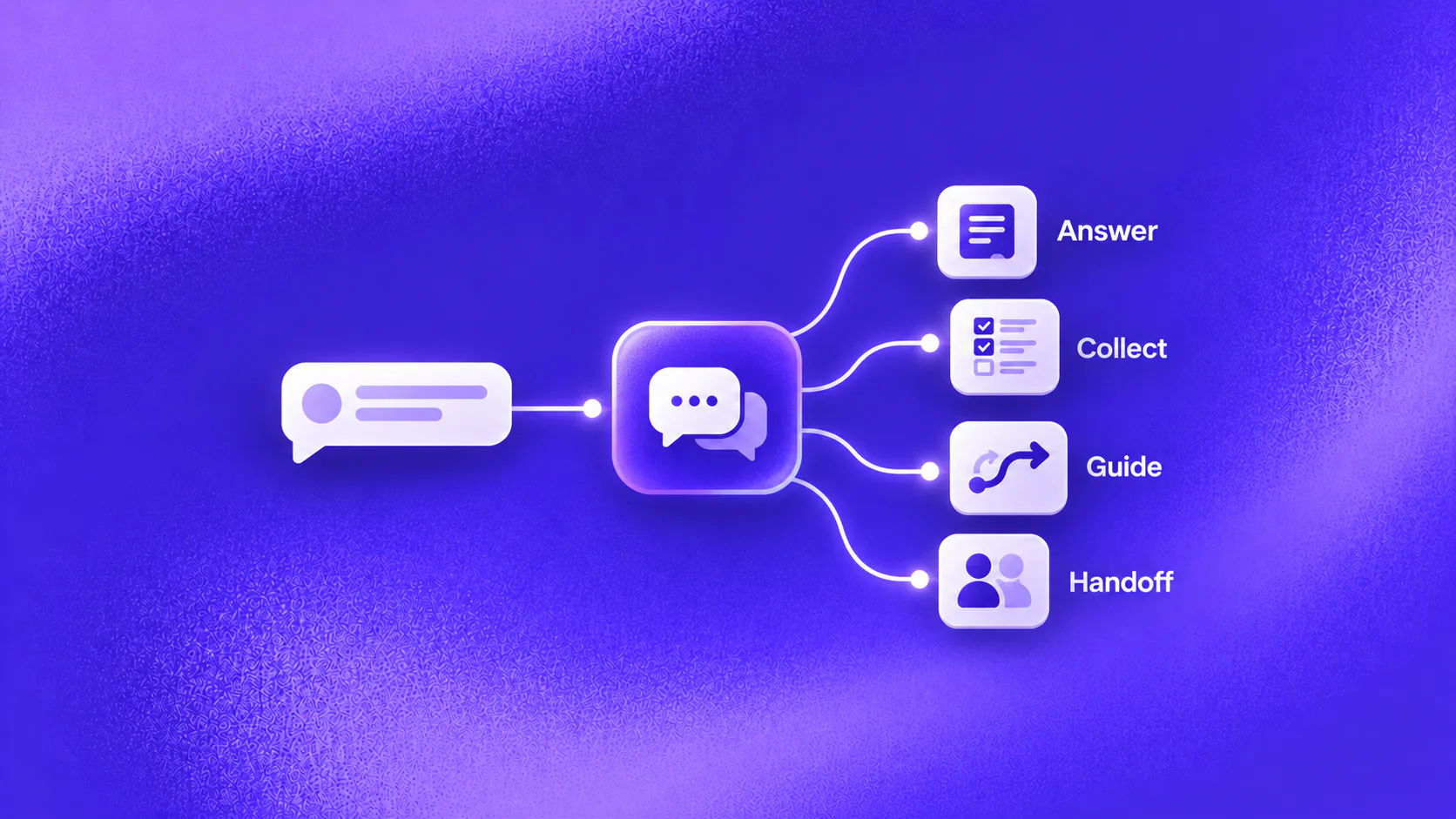
A chatbot is software that holds a text or voice conversation with a person. Businesses use one to answer common questions, collect information, guide a customer through a defined task and bring in a person when the request needs judgment.
Key takeaways
- A chatbot is useful when it helps a customer reach a clear next step rather than merely returning a reply.
- Rule-based, knowledge-based and generative systems suit different levels of language variation and task complexity.
- The safest first use case has frequent demand, reliable information, a measurable outcome and an obvious route to a person.
- Businesses should measure completed customer tasks, unresolved requests and handoff quality instead of conversation volume alone.
What is a chatbot?
A chatbot is software that communicates with a person through text or voice. It can answer a question, ask for information, present a choice or guide someone towards a defined next step. The conversation may happen on a website, messaging app or another digital channel.
The definition is simple. The business decision is not. A chatbot that displays opening hours has a very different job from one that collects an enquiry, checks what the person needs and prepares a useful handoff. Before comparing technology, decide what the customer should be able to accomplish.
Imagine an enquiry arriving after the sales team has finished for the day. The prospect wants to know whether a service fits their situation and how to arrange a consultation. A useful chatbot answers from current information, asks only the questions that affect the next step and records the request. An unhelpful one repeats a menu until the prospect leaves.
Related must-read articles
- Chatbot examples across sales and service
- Customer service chatbot guide
- Lead generation chatbot guide
- Appointment booking chatbot guide
- What is an AI chatbot?
How does a chatbot work?
Every chatbot needs a way to receive a message, decide what it means and return an appropriate response. What happens between those steps varies.
A simple system may match a button or phrase to a fixed reply. A knowledge-based system searches an approved source before answering. A more capable system may interpret everyday language, collect details and start a permitted process through a connected tool. If it cannot complete the request safely, it should preserve the context and route the conversation to the right person.
That mechanism matters only when it changes the customer experience. The customer cares whether the answer is accurate, whether the requested action happened and whether someone owns the exception. The team cares whether the conversation reduces repeated work without creating a second queue of unresolved requests.
Businesses evaluating the underlying information should review how approved knowledge is managed, how actions are controlled through customer workflows and how human handoff works in practice.
What types of chatbot are available?
The categories overlap, but four practical types help buyers understand the trade-offs.
Rule-based systems
A rule-based chatbot follows predefined paths. Buttons and decision trees make the journey predictable, which suits narrow tasks such as choosing a department or collecting standard details. The weakness appears when a customer uses language the flow did not anticipate.
Retrieval and knowledge-based systems
This type finds information in an approved help centre, policy library or product source. It works well when customers ask the same question in different ways. The quality of the response still depends on the accuracy, scope and maintenance of that information.
Generative systems
A generative chatbot can compose a response rather than selecting one fixed sentence. This makes conversation more flexible, but fluency does not prove accuracy. Businesses still need approved sources, response limits, testing and accountable review.
Task-oriented systems
A task-oriented chatbot helps move a defined process forward. It might collect requirements, request a booking slot or retrieve a status through an authorised connection. Completion must come from the relevant system, not from a conversational promise.
Many businesses combine these approaches. Fixed choices can control a sensitive step, while natural-language handling deals with varied questions around it.
Where can businesses use a chatbot?
The best use cases begin with a real customer delay or repeated team task.
First enquiries and lead qualification
A chatbot can respond when an enquiry reaches the business, establish the person’s need and collect the details required for the next decision. The purpose is not to interrogate every visitor. It is to prevent promising enquiries from waiting without an answer and to give the team usable context. See how the broader lead qualification journey can be designed around declared customer information.
Product or service discovery
Customers often know the outcome they want but not which option fits. The conversation can ask about preferences, explain relevant differences and point towards the next step. A person should take over when the choice needs professional advice, negotiation or judgment.
Appointment and request progression
A chatbot can collect the service, preferred time and contact information needed for a request. If it connects to a reliable scheduling source, it may offer available slots and confirm the result. Otherwise, it should describe the request as pending. The appointment booking use case shows why confirmation and exception ownership matter.
Customer service
Common service questions include delivery status, cancellation rules, account access and what happens next. A chatbot can answer approved questions and gather context before a person becomes involved. A clear customer service workflow prevents customers from repeating the same explanation.
Follow-up and re-engagement
Where consent and channel rules permit, businesses can continue a conversation after an incomplete journey or send relevant information to an approved audience. The chatbot can handle replies and route interested customers. It should also respect opt-outs and stop when the customer has completed the task.
What makes a chatbot useful rather than frustrating?
Start with the end of the conversation. If the customer asks to change a booking, what counts as complete? If the answer is a confirmed change, a message saying “your request is being processed” is not enough.
Use these checks:
- A narrow first job. Choose one frequent task with a clear beginning and end.
- Reliable information. Decide which source controls prices, policies, availability and status.
- Honest confirmation. Do not claim that an action succeeded until the connected system confirms it.
- Useful recovery. If the process fails, preserve what the customer already supplied and give the request an owner.
- Easy human access. Customers should not have to fight the chatbot to reach a person.
Channel choice also affects the experience. Compare where customers already contact you across web chat, WhatsApp, Instagram, Telegram and email before deciding where to launch.
How should you measure a chatbot?
Conversation count is easy to report and hard to interpret. A high number may mean adoption, repeated failure or both.
Measure the outcome attached to the task:
- Questions answered without correction
- Qualified enquiries passed to the right owner
- Booking requests that received a confirmed next step
- Requests abandoned before completion
- Conversations transferred to a person
- Customers who contacted the business again about the same issue
- Failures caused by missing information or unavailable systems
The review should connect customer outcomes with team workload. The analytics platform can support that work only when the implementation records meaningful stages and results.
How should a business choose its first chatbot use case?
List the customer conversations your team handles every week. Look for a task with steady demand, reliable answers and a visible result. Avoid starting with the most sensitive or complicated journey simply because it attracts executive attention.
Then read a sample of real enquiries. Note how customers describe the issue, which details staff request and where the conversation usually stalls. Build the first scope around that evidence. Test ordinary cases, vague requests, incorrect information, direct requests for a person and system failures.
A chatbot earns a wider role after it completes the first job reliably. Until then, expansion only gives the same weaknesses more places to appear.
What are the limits of a chatbot?
A chatbot works inside the information, instructions and connections available to it. It cannot repair an inaccurate policy, make an unavailable appointment appear or take responsibility for a decision the business has not assigned.
Language also creates ambiguity. A customer may combine several requests, omit a key detail or use a phrase that has different meanings across services. The chatbot should ask a clarifying question when the answer changes the route. If uncertainty remains, it should involve a person rather than filling the gap with a confident guess.
Sensitive decisions need stronger boundaries. Medical advice, financial recommendations, legal interpretation, complaint recovery and policy exceptions may require qualified or authorised judgment. A chatbot can collect administrative information and explain the approved process, but the business must decide where automation stops.
System access creates another limit. If the chatbot can read a schedule but cannot write to it, it can discuss availability without confirming a booking. If an order system is unavailable, it cannot provide a verified status. The customer should see the actual state, including failure or delay.
Finally, customer preference matters. Some people want a person from the start. Others are happy to use a chatbot for a quick, routine task. Good design supports both without hiding the human route or forcing staff into every simple exchange.
Treat these limits as design inputs. They help the business choose a realistic first use case, write honest completion rules and decide which failures need immediate ownership.
Additional resources
- Explore customer-operation use cases
- Compare supported customer channels
- See how AI agents handle customer journeys
- Plan contextual human handoff
- Book a ZINQ demonstration
Frequently asked questions
What is a chatbot?
A chatbot is software that communicates with people through text or voice. It may follow predefined choices, search approved information, interpret everyday language or connect a customer to a business process.
What is a chatbot used for in business?
Businesses use a chatbot for common questions, lead capture, qualification, appointment requests, product discovery, status updates, customer support and structured handoff to staff.
Is every chatbot powered by artificial intelligence?
No. Some systems follow fixed rules and buttons. Others interpret natural language or generate responses from approved information. The right approach depends on the task, risk and amount of variation in customer questions.
When should a chatbot transfer the conversation to a person?
A person should step in when the request involves judgment, negotiation, sensitive information, identity uncertainty, an exception, an unavailable system or a direct request for human help.
Conclusion
A chatbot should remove one clear point of friction for the customer and the team. Choose the task first, define completion and exceptions, then test whether the conversation produces a reliable next step.
READY TO SEE ZINQ IN ACTION?
From first enquiry to conversion, follow-up and support, ZINQ helps automate the next step while keeping your team in control.
Book a DemoAdditional resources
-
Chatbot Examples for Sales and Customer Service
Useful chatbot examples solve a defined customer task, such as qualifying an enquiry, finding a suitable product, requesting an appointment, checking an order or preparing a support handoff. The strongest examples end with a visible outcome rather than an automated reply alone.
The ZINQ team · October 30, 2026 · Comparisons & Guides -
Customer Service Chatbot: Use Cases, Benefits and Handoffs
A customer service chatbot can improve support by answering routine questions, collecting issue details, retrieving authorised status information and routing exceptions with context. It becomes a dead end when it blocks human help, uses outdated information or claims an action succeeded without confirmation.
The ZINQ team · October 30, 2026 · Customer Support & CX -
Lead Generation Chatbot: Qualification and Follow-Up
A lead generation chatbot engages an inbound enquiry, answers the prospect's first question, collects the details that affect fit or routing and gives the conversation a clear next step. It should qualify declared intent without making hidden assumptions or forcing every prospect through a long form.
The ZINQ team · October 30, 2026 · Sales & Conversion