Banking Chatbot for Applications, Service and Handoffs
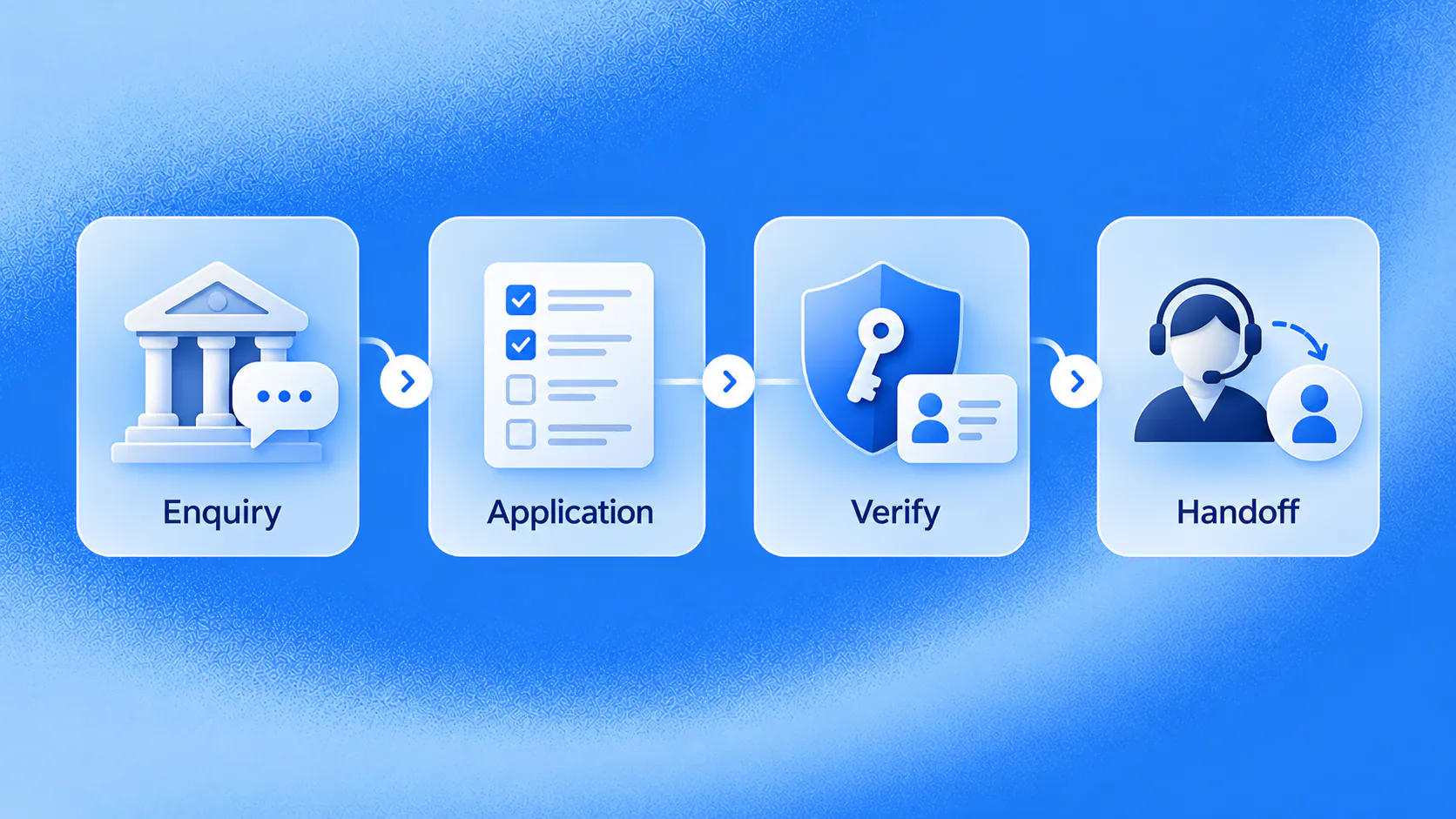
A banking chatbot can answer approved public product questions, collect initial application or appointment information, explain documented service processes and route urgent or account-specific requests after the required identity controls. It must not provide financial advice, approve credit, complete KYC, determine fraud or authorize transactions.
Key takeaways
- Separate public product information from account-specific requests before collecting or revealing sensitive information.
- Use the conversation to clarify requirements, application steps and appointments without making advice, credit or approval decisions.
- Route urgent service events through an approved path rather than treating them like ordinary support questions.
- Keep identity, authorization, financial judgment and consequential decisions with verified systems and authorized people.
What role can a banking chatbot play?
A banking chatbot can help a prospect or customer find the correct administrative path. It may answer approved public product questions, collect initial enquiry information, support appointment requests, explain documented application steps and route service issues to the responsible team.
It must distinguish public information from account-specific information. It must also preserve the boundary around financial advice, credit decisions, KYC approval, fraud determination, dispute decisions and transaction authorization.
Consider an illustrative prospect asking about the documents normally required for a business-account application. The conversation can explain the approved public process and offer an appointment. It should not decide eligibility or suggest that approval is likely.
Related must-read articles
- What is a chatbot?
- Customer service chatbot guide
- Lead generation chatbot guide
- Appointment booking chatbot guide
Why do banking conversations become difficult?
Banking customers may use the same channel for product research, an incomplete application, account access or an urgent card concern. Those requests carry different risk, information and ownership.
Common friction includes:
- Product enquiries waiting in service queues
- Applicants not understanding the next step
- Missing documents discovered too late
- Appointment requests requiring repeated calls
- Incomplete applications receiving generic follow-up
- Public and account-specific questions being mixed
- Urgent service issues routed too slowly
- Customers repeating information after transfer
- Conversations continuing after opt-out or staff ownership
A banking chatbot should classify the journey early enough to protect the customer and direct the request appropriately.
What can it answer publicly?
Public answers may cover approved product features, published fees, general eligibility criteria, standard document lists, branch information, service hours and application steps. The institution must own and review those sources.
The banking chatbot should state when an answer is general information. If a customer asks whether a specific fee applies to their account, whether a transaction cleared or whether they qualify for a product, the conversation has moved beyond public knowledge.
Useful public paths include:
- Product category explanation
- Document and process guidance
- Appointment or callback requests
- Branch or service information
- Published service timelines
- Links to secure application or support routes
The knowledge layer provides context for governed public answers, but it does not remove the need for financial-services review.
How can it support a product enquiry or application?
A prospect may know the goal but not the correct product or process. The conversation can clarify whether the enquiry concerns an account, card, loan, payment service or another supported category. It can collect the preferred next step and provide approved information.
For an application journey, the banking chatbot may remind an eligible contact about missing administrative steps, explain where to submit information securely and offer an appointment. It should not collect sensitive information in an inappropriate channel or interpret the application outcome.
If application status is available through a verified connection, use exact states such as received, information required, under review or completed. Do not describe a pending application as approved.
Can it qualify and book appointments?
Yes, for supported journeys. It can identify the topic, preferred branch or service route, suitable time and accessible contact method. This helps the receiving team prepare without asking for unnecessary sensitive details.
An illustrative prospect asking about a home-loan process may need a general information appointment. The banking chatbot can collect the stated purpose and schedule against current availability. A qualified adviser handles product suitability, affordability, terms and recommendations.
See the appointment booking use case for connected calendar and confirmation requirements.
How should it handle existing-customer service?
Start by deciding whether the request can remain public or requires identity and authorization. General instructions for replacing a card may be public. The status of a specific card or transaction is not.
Account-specific service may require:
- Verified customer identity
- Appropriate authorization
- A secure connected system
- Clear action limits
- Audit history
- A recovery path if the connection fails
The banking chatbot should never reveal sensitive information because a person supplied a name, phone number or account reference in an open conversation. Verification must follow the institution’s approved control.
How should urgent requests be routed?
Lost cards, suspicious transactions, payment failures and account-access problems should not wait behind ordinary information questions. The conversation can recognize the request and direct the customer to the approved urgent route.
It should not decide whether fraud occurred, whether a dispute is valid or whether a transaction should be reversed. It may collect permitted initial context and preserve what the customer has already explained for the authorized team.
If immediate action must occur through a secure service or telephone route, say so clearly. A banking chatbot is not useful when it creates the appearance of action while the urgent task remains unowned.
Can it support follow-up and re-engagement?
Permitted follow-up may help an applicant complete a stated next step, remind a customer about an appointment or provide relevant service information. Communication must use consented first-party contacts, appropriate segments, suppression, frequency and opt-out rules.
Do not treat re-engagement as permission to send every product message to every contact. Product relevance, regulatory requirements and the customer’s stated preference matter. Stop automated messages when a person owns the case or the customer opts out.
The campaigns and segments capability supports governed outreach to eligible contacts; it does not create or optimize paid advertising.
When should a person step in?
Transfer when the customer asks, identity cannot be verified, financial judgment is required, a complaint or vulnerability appears, the answer is uncertain, an urgent event needs authorized action or a connected service fails.
Provide the receiving person with:
- The customer’s stated purpose
- Product or service category
- Information already provided
- Verification state, without exposing credentials
- Process guidance already shared
- Attempted actions and failures
- Requested next step
The human handoff capability should prevent unnecessary repetition while preserving access control.
What must remain with authorized people and systems?
Keep these outside routine chatbot authority:
- Financial or investment advice
- Product suitability recommendations
- Credit scoring and approval
- KYC approval
- Fraud determination
- Transaction authorization
- Dispute decisions
- Pricing or rate commitments
- Account access exceptions
The banking chatbot can help collect and route administrative information. It cannot make a consequential banking decision safe merely by presenting it conversationally.
How do you measure useful outcomes?
Measure progress and control together:
- Public questions answered from approved sources
- Enquiries routed to the correct product team
- Appointment requests completed
- Applications reaching a documented next step
- Urgent requests entering the approved route
- Account-specific requests requiring secure service
- Transfers received with usable context
- Unanswered questions and outdated knowledge
- Failed identity or connected actions
- Follow-up replies, failures and opt-outs
The analytics layer can support review of configured stages. Do not claim credit, fraud, conversion or advertising attribution that the implementation cannot verify.
How should teams govern the conversation?
Product teams may own public information, operations may own application states, service teams may own customer requests, and compliance or risk teams may approve boundaries. Assign an accountable source owner and review date for each answer set.
Test ambiguous requests, urgent events, failed verification, missing application information and attempts to obtain account data without authorization. Review logs for questions that cross from public information into protected service.
Start with a narrow journey that has clear information and ownership, such as public product questions plus appointment booking. Expand only after the banking chatbot consistently recognizes the boundary and responsible teams can own exceptions.
What should a controlled first rollout look like?
Select a journey that relies on approved public information and has a visible, low-risk next step. Product questions with appointment booking may be easier to govern than account servicing because the customer has not yet entered a protected account workflow.
Define the exact boundary for the banking chatbot before writing responses. List which questions remain public, which require secure verification and which must move immediately to an authorized person or service. Give every exception an owner.
Test the banking chatbot with:
- A public fee question followed by an account-specific question
- A prospect asking whether approval is likely
- A customer attempting to share credentials in chat
- A lost-card or suspicious-transaction message
- An incomplete application with missing documents
- A failed appointment or secure-service connection
- A request for financial advice
Review whether the banking chatbot used the correct public source, protected sensitive information and described each state honestly. A submitted request is not approval, and routing an urgent issue is not the same as resolving it.
Record the owner and review date for every knowledge set. Retest the banking chatbot when fees, product criteria, branch processes, application steps, identity controls or urgent-service routes change. Expansion should follow proven control and ownership, not pressure to automate every banking conversation.
Require documented approval before the banking chatbot enters another regulated journey.
Additional resources
- ZINQ for banking and financial services
- Customer service
- Lead qualification
- Human handoff
- Workflow automation
- Book a ZINQ demo
Frequently asked questions
What can a banking chatbot answer without authentication?
It may answer approved public questions about products, fees, eligibility criteria, documents, branch information and application processes, subject to the institution's current policies.
Can a banking chatbot show an account balance?
Only when the implementation has appropriate identity, authorization and connected-system controls. A public conversation must not expose account-specific information.
Can it approve a loan or recommend a financial product?
No. Credit, suitability, financial advice, KYC approval, fraud decisions and transaction authorization remain with qualified people and governed systems.
Conclusion
A banking chatbot should make safe administrative progress easier while drawing a clear boundary around identity, advice, credit, fraud and transaction decisions.
READY TO SEE ZINQ IN ACTION?
From first enquiry to conversion, follow-up and support, ZINQ helps automate the next step while keeping your team in control.
Book a DemoAdditional resources
-
What Is a Chatbot? Business Uses and Examples
A chatbot is software that holds a text or voice conversation with a person. Businesses use one to answer common questions, collect information, guide a customer through a defined task and bring in a person when the request needs judgment.
The ZINQ team · October 30, 2026 · Comparisons & Guides -
Customer Service Chatbot: Use Cases, Benefits and Handoffs
A customer service chatbot can improve support by answering routine questions, collecting issue details, retrieving authorised status information and routing exceptions with context. It becomes a dead end when it blocks human help, uses outdated information or claims an action succeeded without confirmation.
The ZINQ team · October 30, 2026 · Customer Support & CX -
Lead Generation Chatbot: Qualification and Follow-Up
A lead generation chatbot engages an inbound enquiry, answers the prospect's first question, collects the details that affect fit or routing and gives the conversation a clear next step. It should qualify declared intent without making hidden assumptions or forcing every prospect through a long form.
The ZINQ team · October 30, 2026 · Sales & Conversion