Customer Service Chatbot: Use Cases, Benefits and Handoffs
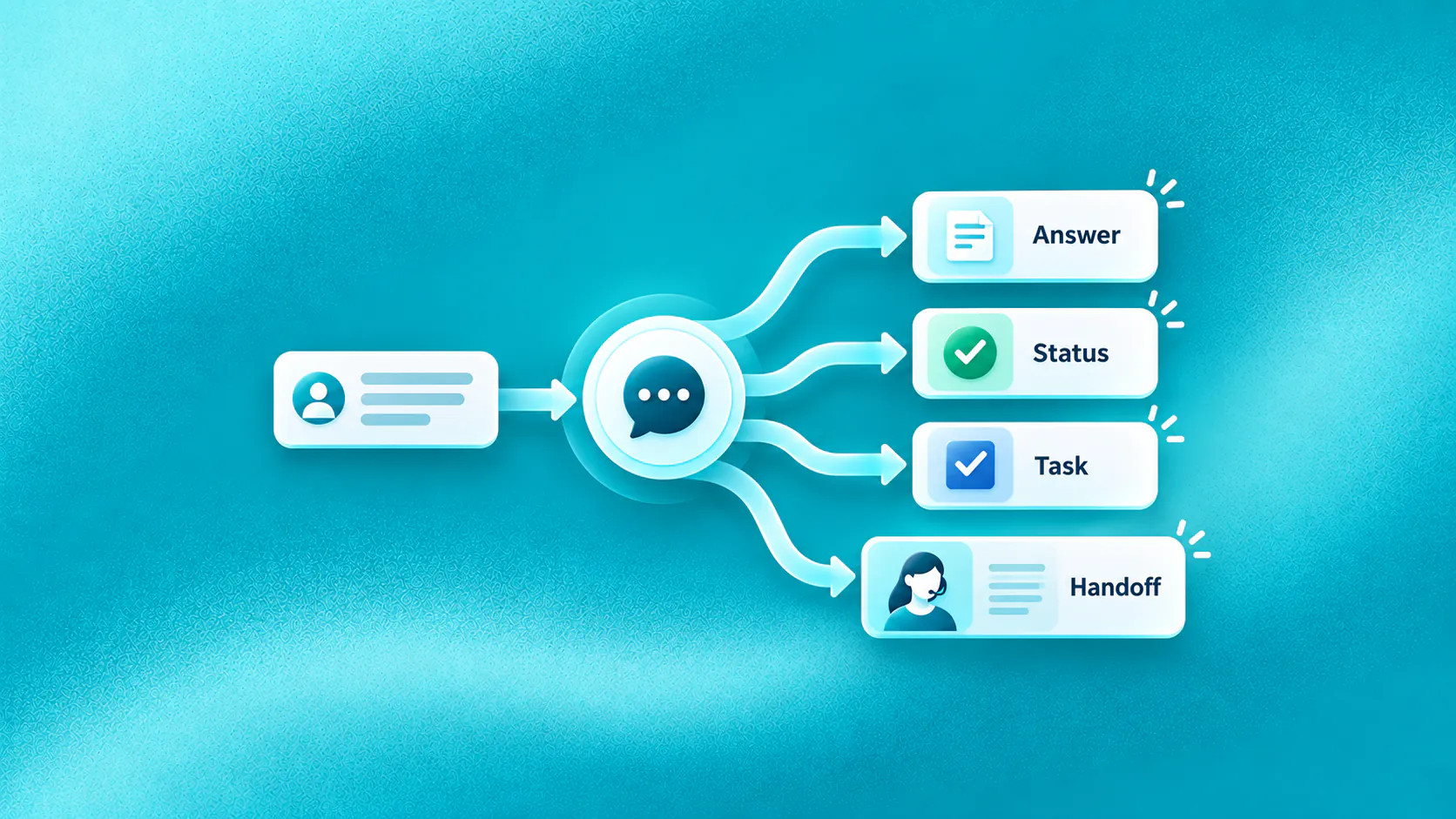
A customer service chatbot can improve support by answering routine questions, collecting issue details, retrieving authorised status information and routing exceptions with context. It becomes a dead end when it blocks human help, uses outdated information or claims an action succeeded without confirmation.
Key takeaways
- A customer service chatbot should solve a bounded request or move it to an accountable person with the context intact.
- Approved knowledge, connected status and honest confirmation matter more than a conversational tone.
- Customers need a clear way to reach a person for exceptions, complaints, sensitive issues and failed actions.
- Measure resolution quality, repeat contact, corrections and handoff delay instead of relying on deflection alone.
What should a customer service chatbot improve?
A customer service chatbot should help a customer reach an accurate answer, complete a routine request or get to the right person without starting again. Faster replies matter, but speed alone does not improve service. An instant dead end is still a dead end.
Consider an illustrative support request. A customer says an order has not arrived. The conversation asks for the authorised identifier, retrieves the current status and explains the next step. If the delivery has an exception, the customer service chatbot creates an owned request with the relevant details. It does not repeat the standard delivery policy or claim that the issue is resolved.
That difference shapes the whole implementation. Begin with the customer’s task and the team’s responsibility, not with a target for automated conversation volume.
Related must-read articles
- What is a chatbot?
- Chatbot examples across sales and service
- How to implement chatbot-to-human handoff
- Why human handover matters
- AI chatbot customer service guide
Which customer service problems suit a chatbot?
The strongest starting points are frequent, bounded and supported by reliable information.
Repeated questions with stable answers
Customers ask about opening hours, delivery areas, cancellation rules, required documents and basic account steps. A customer service chatbot can answer from an approved source and link to the relevant action. The content owner must update that source when the policy changes.
This is more useful than copying a long FAQ into a conversation. The answer should match the customer’s question, explain any condition that affects them and state what to do next. Teams can organise this information through approved knowledge controls.
Status questions that use authorised data
Order, booking, application and service status questions create repetitive lookup work. If the implementation has the right connection and permission, the service assistant may retrieve the current state. It should request only the information needed to find the record and protect account-specific details.
When the source is unavailable, the conversation should say so. A generic reassurance is not a substitute for a status. Ecommerce teams can review this distinction in the order tracking and support journey.
Structured intake before a person takes over
Some requests need staff, but staff do not need to begin with an empty screen. The conversation can ask what happened, which product or service is involved and what the customer has already tried. It can then create a task or assign the conversation with the summary attached.
The intake should remain short. Asking every possible question increases abandonment and frustrates customers who already explained the problem. The broader customer service use case should define which details change the route or resolution.
Routine returns, changes and cancellations
A conversation can explain the published rule, collect the request and initiate a permitted step. The automated path must distinguish between receiving a request and completing it. If approval, identity verification or a connected confirmation is missing, the status remains pending.
For ecommerce returns, the returns and exchanges journey provides a useful model for separating standard requests from exceptions.
Where does customer service automation become a dead end?
Dead ends usually come from operating choices rather than wording.
The answer is current, but not relevant
A customer asks about a delayed item and receives the normal shipping timetable. The source may be accurate, yet the response ignores the exception. The system needs a way to recognise that the standard answer no longer fits.
The conversation promises an action it did not confirm
“Your cancellation is complete” is a consequential statement. The assistant should make it only after the authorised system confirms the result. Otherwise, it should say that the request was submitted and explain who owns the next step.
Human help exists but is hard to reach
A hidden handoff option protects automation metrics at the customer’s expense. People should be able to request help directly. The conversation should also detect complaints, sensitive situations, repeated failure and out-of-scope requests that need staff.
The transfer loses the conversation
A transfer is not useful if the customer must type the same explanation again. Context should include the customer’s stated goal, relevant details, answers already provided and why the request moved. The human handoff platform should preserve that working context.
What should the customer service chatbot complete?
Write a completion rule for every supported journey.
| Customer request | Useful completion | When a person steps in |
|---|---|---|
| Common policy question | Correct answer and relevant next step | Policy exception or unclear applicability |
| Order or booking status | Authorised current status | Missing record, dispute or operational exception |
| Return request | Confirmed initiation or honest pending state | Approval, refund exception or identity issue |
| Basic troubleshooting | Approved fix works or task is created | Repeated failure, safety issue or unsupported case |
| Complaint | Acknowledged request with an owner | Judgment, recovery decision or sensitive context |
This table is not a universal automation plan. Each business needs its own policy, systems and ownership. The point is to define what the automated path can finish and what it must not pretend to finish.
How should people and automation work together?
Design the automated and human paths together. If you build the customer service chatbot first and add handoff later, the transfer often becomes a generic escape route rather than part of the service process.
Decide:
- Which requests always go to staff
- Which signals indicate an exception
- What context accompanies the transfer
- Which queue or role receives it
- What the customer sees while waiting
- When automation stops replying
- How staff return a resolved conversation to the correct state
Supported conversations can appear in an omnichannel team inbox, but businesses should not assume that separate channel identities are automatically merged into one customer record. Identity and context rules must be explicit.
How should you measure a customer service chatbot?
Deflection alone can hide poor experiences. A customer who leaves after an irrelevant answer may look automated even though nothing was resolved.
Use measures tied to service quality:
- Requests completed without correction
- Repeat contact about the same issue
- Transfers that arrived with usable context
- Time between transfer and staff ownership
- Requests abandoned during intake
- Wrong or outdated answers identified in review
- Failed connected actions
- Customer feedback after a completed interaction
The customer service chatbot should also create a learning loop. Repeated unanswered questions may reveal missing knowledge. Frequent transfers at one step may reveal a broken process. Review those patterns through conversation analytics, then fix the source or workflow rather than adding more conversational polish.
How should you launch the first support journey?
Choose one request that staff handle frequently and understand well. Read recent conversations. Record the words customers use, the information staff need, the exceptions they encounter and what counts as resolved.
Then test the customer service chatbot with ordinary questions, incomplete information, spelling differences, contradictory details, direct requests for a person and unavailable systems. Staff who own the process should review the answers and handoffs before launch.
Expand only after the first journey produces dependable outcomes. A narrow service that works is more valuable than a broad interface that answers confidently and leaves the real request untouched.
Who should own the service after launch?
A customer service chatbot needs an operating owner, not only a launch team. Customer questions, policies and internal processes change. Someone must notice when the automated experience no longer matches the work.
Content owners should review the answers customers receive and update the approved source when a policy, product or process changes. Service operations should review unresolved requests, transfers and repeat contact. The team responsible for connected systems should monitor failed lookups and actions. Frontline staff should have a simple way to flag an answer that created confusion.
Set a regular review around real conversations. Sample successful resolutions, abandoned journeys, corrected answers and transfers. Ask whether the customer reached the intended outcome and whether staff received enough context to continue.
The customer service chatbot also needs change control. A new answer may solve one question while creating risk elsewhere. Test updates against ordinary requests, exceptions and direct requests for human help before releasing them broadly.
Ownership should remain clear during outages. If the knowledge source, order system or routing connection fails, decide whether the conversation pauses, offers a limited alternative or moves directly to staff. Customers should not discover the outage by receiving repeated irrelevant replies.
This ongoing work is part of customer service. A conversation cannot remain reliable if the business treats it as a one-time website project.
Additional resources
- Plan a customer service journey
- Design contextual human handoff
- Manage tickets and tasks
- Compare customer channels
- Book a ZINQ demonstration
Frequently asked questions
What can a customer service chatbot handle?
It can answer approved questions, collect support details, provide authorised status information, guide routine requests and prepare a contextual handoff when staff must decide or act.
Can a customer service chatbot replace support staff?
It should not replace judgment, empathy, negotiation or responsibility for exceptions. Its role is to complete suitable routine work and give staff better context for the conversations they own.
How do you prevent chatbot dead ends?
Define completion, keep knowledge current, confirm connected actions, detect exceptions, provide an accessible human route and assign every failed or transferred request to an accountable owner.
Conclusion
A customer service chatbot improves support when it removes repetitive friction without hiding unresolved work. Design the human route at the same time as the automated path and measure whether customers actually reach an answer or owned next step.
READY TO SEE ZINQ IN ACTION?
From first enquiry to conversion, follow-up and support, ZINQ helps automate the next step while keeping your team in control.
Book a DemoAdditional resources
-
What Is a Chatbot? Business Uses and Examples
A chatbot is software that holds a text or voice conversation with a person. Businesses use one to answer common questions, collect information, guide a customer through a defined task and bring in a person when the request needs judgment.
The ZINQ team · October 30, 2026 · Comparisons & Guides -
Chatbot Examples for Sales and Customer Service
Useful chatbot examples solve a defined customer task, such as qualifying an enquiry, finding a suitable product, requesting an appointment, checking an order or preparing a support handoff. The strongest examples end with a visible outcome rather than an automated reply alone.
The ZINQ team · October 30, 2026 · Comparisons & Guides -
How to implement a chatbot-to-human handoff
Implement a chatbot to human handoff by defining transfer triggers, conversation ownership, queue routing and the context a person needs to continue. Test explicit human requests, authority limits, missing information and system failures, then verify that the receiving team accepted the case.
The ZINQ team · September 21, 2026 · AI Chatbots