Chatbot Examples for Sales and Customer Service
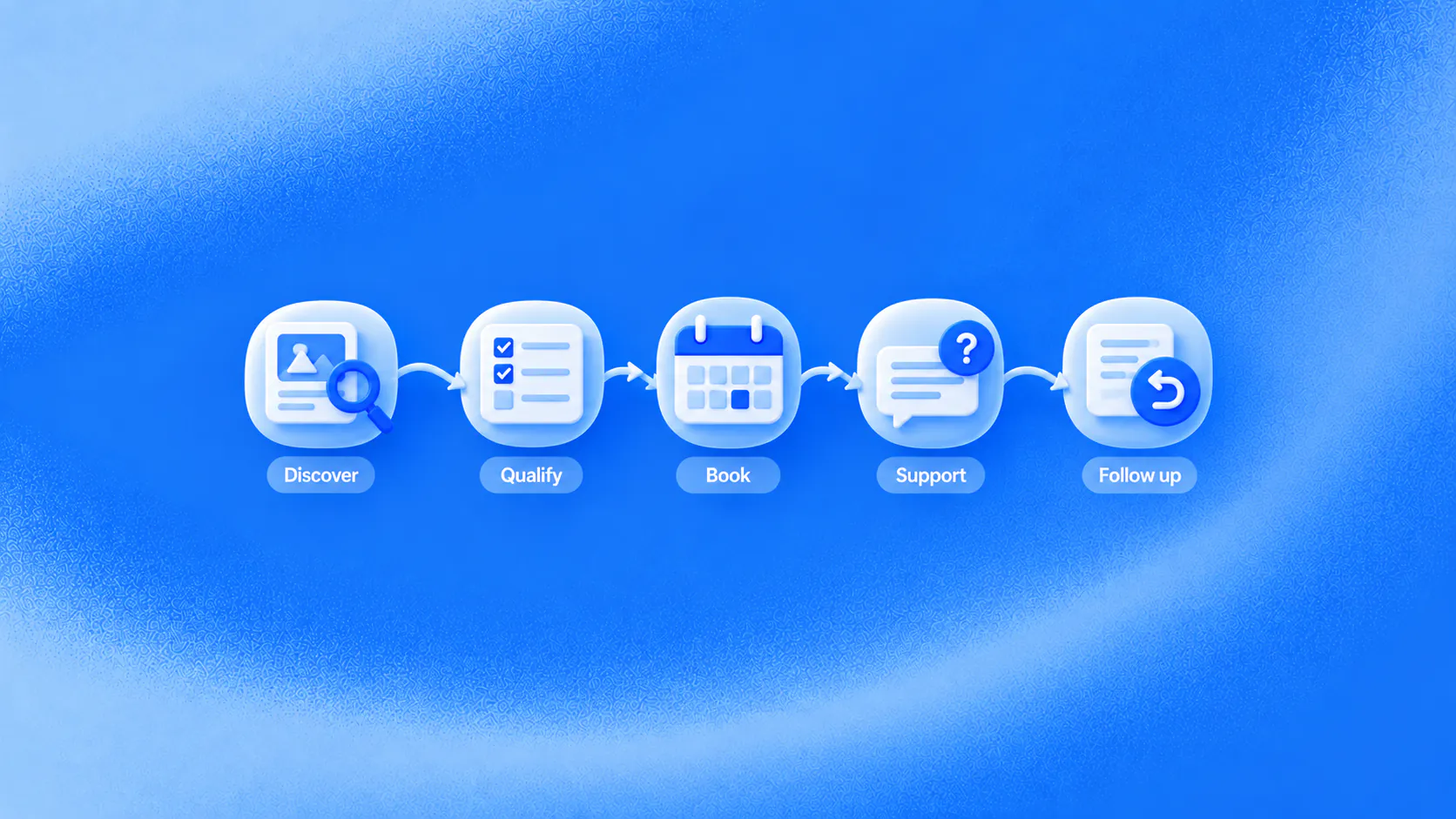
Useful chatbot examples solve a defined customer task, such as qualifying an enquiry, finding a suitable product, requesting an appointment, checking an order or preparing a support handoff. The strongest examples end with a visible outcome rather than an automated reply alone.
Key takeaways
- The best chatbot examples begin with a customer goal and finish with a clear next step.
- Sales conversations benefit from fast qualification, useful discovery and accountable follow-up.
- Service conversations need accurate answers, connected status and a handoff that preserves context.
- Businesses should choose examples that match their customer journey rather than copying a competitor's feature list.
What makes a chatbot example worth copying?
The best chatbot examples do more than show a polished exchange. They reveal what the customer wanted, what information the conversation used, what action followed and when a person became responsible.
That standard removes many impressive-looking demonstrations from consideration. A friendly answer is useful only if it is correct. A booking conversation is useful only if the slot is confirmed. A qualified lead is useful only if the right person receives the context and knows what to do next.
The following chatbot examples cover sales, service and customer growth. Each is an illustrative situation, not a customer case study or performance claim.
Related must-read articles
- What is a chatbot?
- Customer service chatbot guide
- Lead generation chatbot guide
- Appointment booking chatbot guide
- AI chatbot examples and use cases
Which chatbot examples help sales teams?
1. Qualify an incoming enquiry without a form wall
A prospect messages after seeing a service page. The conversation answers the first question, then asks about the need, timing and relevant requirements. The prospect does not face ten questions before receiving help.
These chatbot examples work when the questions change the next step. The result may be a consultation request, a suitable information path or a handoff to the correct sales owner. Qualification should use information the prospect provides, not hidden assumptions about personal traits.
The business can map the process through its lead qualification journey and keep supported-channel conversations organised in an omnichannel inbox.
2. Help a customer choose a suitable product or service
An online shopper knows the problem but not the right option. The conversation asks about intended use, preferences and constraints, then explains a short list of relevant choices using current product information.
Product-discovery conversations should not pretend to make professional or consequential decisions. They narrow the choice and make the trade-offs easier to understand. In ecommerce, the same pattern can support product discovery and recommendations.
3. Turn interest into an appointment request
A prospective customer asks whether the business has availability next week. The conversation collects the service, preferred day and contact details. If live availability is connected, it offers a valid slot and confirms the booking. If not, it records a request and sets the right expectation.
The useful lesson from these chatbot examples is the difference between a request and a confirmed outcome. The appointment booking workflow should make that state visible.
4. Recover an incomplete buying journey
A customer starts a purchase or quote request but stops after raising a question. Where consent and channel rules permit, the business follows up with relevant help. The conversation answers the objection, restates the next step and stops if the customer opts out or completes the journey.
Recovery conversations need restraint. Sending the same promotion repeatedly is not recovery. A better approach uses the known stage, current information and a clear suppression rule. Ecommerce teams can compare this with a structured cart recovery journey.
Which chatbot examples improve customer service?
5. Answer a common policy question from an approved source
A customer asks whether an item can be returned after opening. The conversation finds the relevant policy, explains the applicable condition and links to the next step. If the case falls outside the published rule, it creates a clear route to staff.
Knowledge-backed chatbot examples depend on maintained sources. If the policy changes but the source does not, fast delivery only spreads the wrong answer faster. Teams should assign ownership for approved customer knowledge.
6. Provide an order or request status
A customer asks where an order is. A generic reply explains normal delivery times. A connected conversation retrieves the authorised status and states what happens next. If the parcel is delayed or the identifier is invalid, the request moves to the appropriate queue.
These chatbot examples reduce repeated lookup work only when the status is current. Ecommerce businesses can review the boundaries on the order tracking and support page.
7. Collect the details needed to resolve an issue
A support customer reports that a service is not working. The conversation asks which step failed, what the customer already tried and whether an error appeared. It may provide an approved fix for a known issue. Otherwise, it creates a task with the details attached.
Good intake chatbot examples save the customer from repeating the story. They do not use automation to delay access to help. A customer service process should define both resolution and escalation.
8. Handle a cancellation or return request
A customer wants to cancel. The conversation explains the applicable rule, collects the request and confirms whether the cancellation completed or awaits review. It does not present retention offers as obstacles to leaving.
The strongest chatbot examples distinguish a completed action from an intake step. They also protect any refund, account or identity checks that require authorised handling.
9. Ask for feedback at the right moment
After a completed interaction, the business asks one or two questions about the experience. A poor score can create a recovery task rather than disappear into a dashboard.
Feedback conversations work best when the customer has something specific to evaluate. The feedback and CSAT journey should connect a response with accountable follow-up.
Which examples support retention and re-engagement?
10. Continue onboarding after purchase
A new customer asks how to complete the first setup step. The conversation explains the relevant instruction, checks whether it worked and offers the next resource. Complex account questions move to the appropriate owner.
These onboarding examples reduce uncertainty during the period when a customer is most likely to need basic guidance. They should draw from current onboarding information rather than improvise advice.
11. Re-engage an approved first-party contact
A previous customer has not returned for a relevant service. Where permission and channel rules allow, the business sends a timely reminder or update. The conversation handles replies, records interest and stops messages after an opt-out.
Re-engagement chatbot examples should never be confused with paid advertising. The business is communicating with an appropriate contact it already holds. The win-back and re-engagement use case covers the operational boundaries.
12. Move an exception to a person with context
A customer asks for something outside the defined process. The conversation recognises the exception, summarizes the request and assigns it to someone who can decide. The customer sees what will happen next.
Human handoff is not a failure. In many chatbot examples, it is the correct outcome. The failure occurs when the context disappears, nobody owns the conversation or automation continues after a person has taken over. Review the human handoff model before launch.
How should you choose among these chatbot examples?
Do not copy the longest list. Score each candidate against the work your team actually handles:
| Question | What to look for |
|---|---|
| How often does it happen? | Enough demand to justify design and maintenance |
| Is the information reliable? | A clear owner and current source |
| What counts as complete? | A visible answer, action or accepted handoff |
| What can go wrong? | Known exceptions, unavailable systems and ambiguous requests |
| Who owns the exception? | A named queue, team or role |
| Can you measure the result? | Completion, abandonment, correction and repeat contact |
Start with one journey. Read real conversations before designing it. Test ordinary wording, vague wording, wrong information, system failure and direct requests for a person. The chatbot examples that survive those tests are better candidates than the ones that merely look good in a demonstration.
What do weak chatbot examples have in common?
Weak implementations often begin with the interface rather than the customer task. The conversation looks polished, but the customer still needs to call, complete another form or repeat the request elsewhere.
Watch for these warning signs:
- No defined finish. The conversation can answer, but nobody has decided what counts as completion.
- Information without ownership. The reply comes from a document that no team maintains.
- A form disguised as chat. The customer must answer a long sequence before receiving any help.
- Generic reassurance. The system says it is handling the request without a confirmed action or accountable owner.
- Handoff as an afterthought. The transfer loses the earlier answers or sends every exception into one unmonitored queue.
- Success measured by containment. The dashboard rewards conversations that did not reach staff even when the customer abandoned them.
Useful chatbot examples expose the less attractive moments as well as the ideal path. They show what happens when the customer gives incomplete information, changes direction, asks for a person or reaches an unavailable system.
Before copying an example, ask the team that owns the work to describe its ordinary exceptions. A booking team knows why apparently open slots cannot always be used. A service team knows which policy questions become complaints. Those details turn a generic conversational pattern into a workable business process.
The goal is not to reproduce another company’s flow. Use examples to recognise a problem, then design around your customers, policies, systems and staff responsibilities.
Additional resources
- Explore customer-operation use cases
- Compare supported channels
- Review workflow controls
- See conversation analytics
- Book a ZINQ demonstration
Frequently asked questions
What are some useful chatbot examples?
Useful examples include lead qualification, product discovery, appointment requests, cart recovery, order status, common support questions, feedback collection and contextual human handoff.
Which chatbot example should a business start with?
Start with a frequent task that has reliable information, a clear completion point, manageable risk and an obvious owner for exceptions.
Can one chatbot handle sales and customer service?
It may support both, but each journey needs its own knowledge, actions, limits, measures and handoff rules. A broad scope should follow proven performance on narrower tasks.
Conclusion
Strong chatbot examples make the customer's next step easier and give the business a result it can verify. Choose the journey first, then decide what conversation and connections it requires.
READY TO SEE ZINQ IN ACTION?
From first enquiry to conversion, follow-up and support, ZINQ helps automate the next step while keeping your team in control.
Book a DemoAdditional resources
-
What Is a Chatbot? Business Uses and Examples
A chatbot is software that holds a text or voice conversation with a person. Businesses use one to answer common questions, collect information, guide a customer through a defined task and bring in a person when the request needs judgment.
The ZINQ team · October 30, 2026 · Comparisons & Guides -
Customer Service Chatbot: Use Cases, Benefits and Handoffs
A customer service chatbot can improve support by answering routine questions, collecting issue details, retrieving authorised status information and routing exceptions with context. It becomes a dead end when it blocks human help, uses outdated information or claims an action succeeded without confirmation.
The ZINQ team · October 30, 2026 · Customer Support & CX -
Lead Generation Chatbot: Qualification and Follow-Up
A lead generation chatbot engages an inbound enquiry, answers the prospect's first question, collects the details that affect fit or routing and gives the conversation a clear next step. It should qualify declared intent without making hidden assumptions or forcing every prospect through a long form.
The ZINQ team · October 30, 2026 · Sales & Conversion