Lead Generation Chatbot: Qualification and Follow-Up
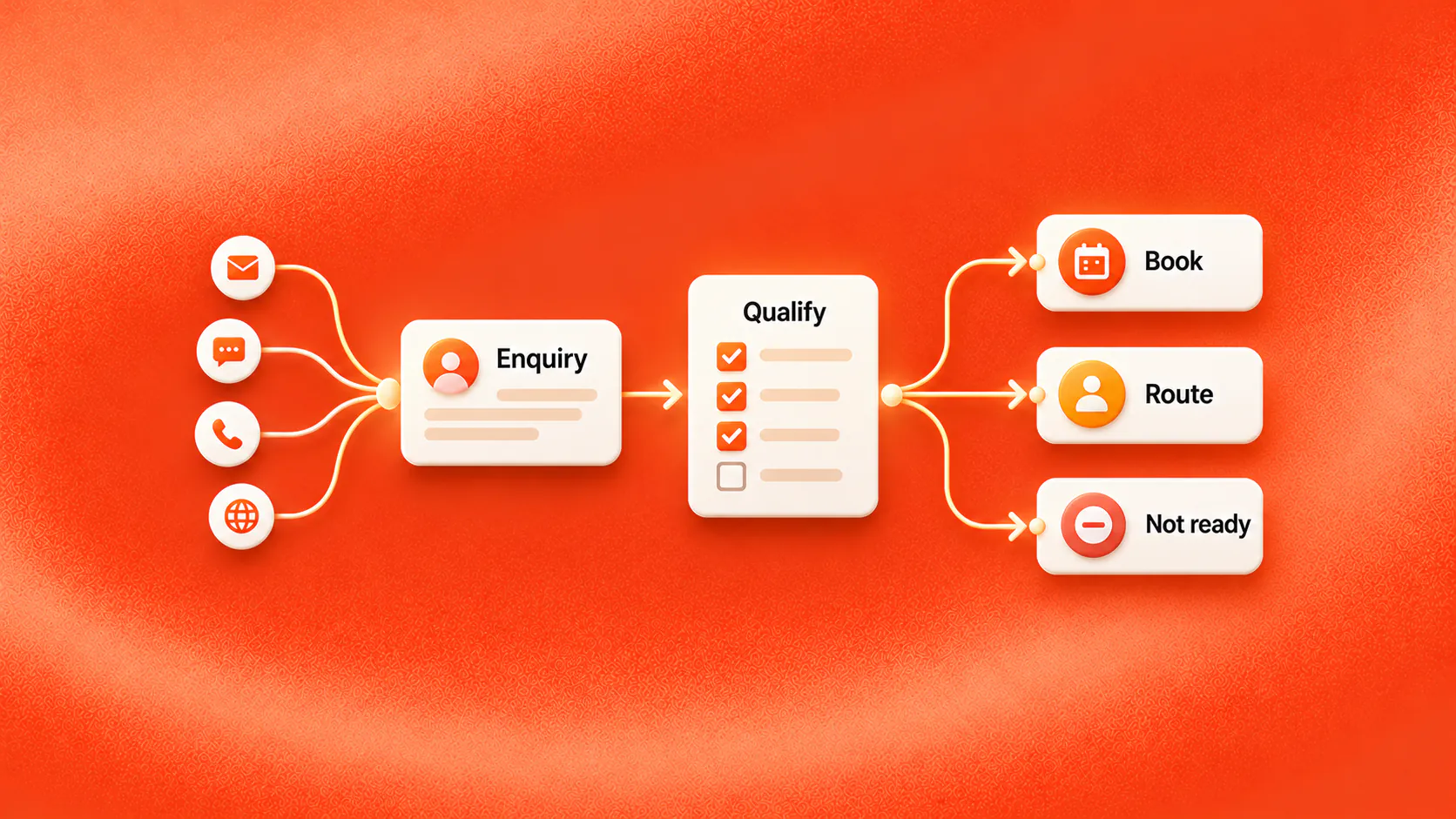
A lead generation chatbot engages an inbound enquiry, answers the prospect's first question, collects the details that affect fit or routing and gives the conversation a clear next step. It should qualify declared intent without making hidden assumptions or forcing every prospect through a long form.
Key takeaways
- A lead generation chatbot begins after a prospect reaches the business through a supported channel or entry point.
- Qualification questions should change the next step, not collect information simply because it may be useful later.
- The conversation should answer before asking for extensive details and preserve context when sales staff take over.
- Measure qualified progression, booking or requested next steps, abandonment and lost reasons rather than raw lead count alone.
What does a lead generation chatbot do?
A lead generation chatbot engages a prospect after the enquiry reaches the business. It answers the first question, gathers the details that affect fit or routing and offers a useful next step. That may be a consultation, product path, appointment request or conversation with sales.
It does not create or manage paid advertising. A prospect may arrive from a website, QR code, social profile, Click-to-WhatsApp ad or another entry point. The lead generation chatbot begins when that person starts the conversation. Its job is to prevent interest from becoming an unread message.
Imagine an illustrative enquiry arriving late in the evening. The prospect asks whether a service supports a particular requirement. A useful conversation answers that question first, then asks about intended use and timing. By morning, the team sees a clear request and agreed next step instead of a name with no context.
Related must-read articles
- What is a chatbot?
- Chatbot examples across sales and service
- Appointment booking chatbot guide
- AI lead generation chatbot guide
- Conversational AI for lead qualification
Where do inbound leads get lost?
Most losses happen between moments of intent.
The first reply comes too late
A prospect asks a specific question while comparing options. If nobody replies until the next working day, the buying decision may have moved on. A lead generation chatbot can provide an immediate approved answer and establish the next step. It should not pretend that a salesperson is present when nobody is.
The business asks for too much before helping
A long form can feel like a price for receiving basic information. Recreating that form in chat does not remove friction. The conversation should answer what it can, then ask only for details that change qualification or routing.
Every enquiry receives the same path
A prospect seeking an urgent appointment needs a different next step from someone researching a future purchase. Qualification should reflect declared need and timing. It should not infer sensitive traits or use opaque scoring that the prospect cannot correct.
The handoff loses context
If sales asks the same questions again, the prospect sees no benefit from the earlier conversation. The handoff should pass the stated need, answers collected, relevant source context and requested next action. The lead qualification use case can define that information consistently.
How should a lead generation chatbot qualify an enquiry?
Start with the prospect’s question. Qualification works better after the conversation has provided value.
Use a short sequence:
- Understand the immediate need. Let the prospect explain what they want in their own words.
- Answer the first useful question. Use approved information about the offer, availability or process.
- Ask what changes the next step. This may include intended use, timing, location or a stated budget range.
- Offer a relevant action. Provide a booking path, suitable resource or human conversation.
- Record the outcome. Mark the enquiry as booked, routed, awaiting follow-up, not ready or outside scope.
The qualification flow should stop asking once it has enough information for the next decision. Sales can continue discovery when nuance, negotiation or judgment matters.
What qualification questions are useful?
The right questions depend on what the business sells. Use this decision test: would a different answer change who responds, what information appears or which action becomes available?
| Business question | Customer-friendly version | Why it matters |
|---|---|---|
| What do they need? | What are you hoping to accomplish? | Identifies the relevant service or product path |
| When do they need it? | When would you like to get started? | Separates immediate from future demand |
| Where is service required? | Which area or location is this for? | Checks service coverage or routing |
| What constraint matters? | Is there a budget range or requirement we should work within? | Prevents unsuitable recommendations |
| What next step do they prefer? | Would you like information, an appointment or a conversation with the team? | Respects the prospect’s stage and intent |
A lead generation chatbot should explain why sensitive or unusual information is needed. If the answer is not required for the next step, do not ask for it yet.
How can the conversation move towards conversion?
Qualification is not the finish line. The prospect needs a useful next action.
Product or service discovery
The conversation can narrow suitable options using stated needs and approved information. It should explain the relevant difference rather than presenting an unexplained recommendation. Complex advice stays with a qualified person.
Appointment or demo request
When the prospect is ready, the conversation can collect scheduling preferences or use connected availability where supported. A request remains pending until the relevant system or staff member confirms it. See the appointment booking journey.
Sales handoff
High-intent, unusual or negotiation-heavy enquiries may need a person. The transfer should include a concise summary and an owner. The human handoff model helps prevent the prospect from returning to the start.
Follow-up after silence
Where consent and channel rules permit, the business may send a relevant follow-up. The message should relate to the unfinished journey and stop after a reply, booking, completion or opt-out. ZINQ’s public follow-up use case describes the broader operational pattern without implying paid-ad management.
Which channels can carry lead conversations?
Choose the channel where prospects already initiate contact. A website conversation can help an anonymous visitor ask a question before leaving. WhatsApp can continue after a click, QR scan or direct message. Instagram can handle supported DMs arising from social engagement. Web chat can connect questions with the page being viewed.
The experience should suit the channel. A website visitor may need a short answer before sharing contact information. A messaging prospect may expect the conversation to continue asynchronously. Channel rules also affect permitted follow-up and message timing.
How should marketing and sales divide responsibility?
Marketing owns the promise and entry experience. Sales owns qualification standards and the next commercial action. Operations owns routing, data quality and failure recovery. The lead generation chatbot exposes gaps between those teams quickly.
Agree on:
- Which enquiries are in scope
- Which questions determine route or priority
- Which information the conversation may use
- Which outcomes sales accepts
- Who owns unqualified but promising enquiries
- What happens when integrations fail
- When follow-up stops
- How opt-outs and consent are recorded
A shared team inbox can support ownership across supported channels. It should not be described as automatically combining every identity from every channel into one person.
How should you measure a lead generation chatbot?
Raw lead count can rise while lead quality falls. Measure movement through the journey:
- Enquiries that received a relevant first answer
- Prospects who completed useful qualification
- Qualified enquiries routed to the correct owner
- Requested appointments or demos confirmed
- Enquiries abandoned during questioning
- Follow-ups that received a reply or opt-out
- Lost reasons recorded consistently
- Handoffs delayed after qualification
Use customer conversation analytics to review stages the implementation can actually record. Do not present those measures as paid-media attribution unless a verified advertising system supplies and governs that data.
What should you test before launch?
Test real wording from recent enquiries. Include vague requests, low-intent questions, contradictory answers, unsupported locations, urgent needs and direct requests for a person. Confirm what happens when scheduling, CRM or routing connections are unavailable.
The lead generation chatbot also needs a clear stopping rule. It should not keep qualifying after the prospect books, opts out or reaches a salesperson. Review the first journey weekly at launch. Fix questions that cause abandonment and routes that create delay before adding more entry points.
What should happen to a lead that is not ready?
Not every useful enquiry should reach sales immediately. A prospect may fit the offer but still be researching, waiting for an internal decision or planning for a later date. Labelling that person unqualified can throw away useful context.
The lead generation chatbot should give an appropriate next step based on what the prospect states. An early researcher may receive a relevant guide or product explanation. A prospect with a future timeline may request permitted follow-up. Someone outside the current service area should receive an honest answer rather than a calendar link that the team cannot honour.
Record the reason the conversation did not progress. Useful categories might include timing, location, requirement mismatch, missing information, no response or preference for later contact. Avoid vague labels such as “bad lead” that tell the team nothing and may encourage poor assumptions.
Where permission exists, a follow-up should reflect the unfinished conversation. It should not restart qualification from the beginning or send the same generic promotion to every contact. The business also needs frequency limits, suppression after completion and a clear opt-out.
Sales should review whether its qualification rules exclude prospects who later become suitable customers. That feedback can improve the questions and routes. The purpose is not to make the lead generation chatbot reject more people. It is to help each genuine enquiry reach the most useful next step for its current stage.
Additional resources
- Explore lead qualification
- Review appointment booking
- Compare customer channels
- See customer workflow controls
- Book a ZINQ demonstration
Frequently asked questions
What is a lead generation chatbot?
A lead generation chatbot engages inbound prospects through a conversation, captures relevant contact and need information, asks qualification questions and routes the enquiry towards an appropriate next step.
What questions should a lead generation chatbot ask?
Ask only questions that affect fit, priority, route or next action. Depending on the offer, these may cover the prospect's need, intended use, timing, location, budget range or preferred appointment.
Does a lead generation chatbot run advertising campaigns?
No. A conversation system engages the enquiry after it reaches the business. Advertising creation, media buying, audience targeting and campaign optimisation belong to advertising platforms and teams.
Conclusion
A lead generation chatbot is valuable when it helps an interested person get an answer and a suitable next step while giving the sales team enough context to continue. Qualification should reduce friction, not replace one long form with another.
READY TO SEE ZINQ IN ACTION?
From first enquiry to conversion, follow-up and support, ZINQ helps automate the next step while keeping your team in control.
Book a DemoAdditional resources
-
What Is a Chatbot? Business Uses and Examples
A chatbot is software that holds a text or voice conversation with a person. Businesses use one to answer common questions, collect information, guide a customer through a defined task and bring in a person when the request needs judgment.
The ZINQ team · October 30, 2026 · Comparisons & Guides -
Chatbot Examples for Sales and Customer Service
Useful chatbot examples solve a defined customer task, such as qualifying an enquiry, finding a suitable product, requesting an appointment, checking an order or preparing a support handoff. The strongest examples end with a visible outcome rather than an automated reply alone.
The ZINQ team · October 30, 2026 · Comparisons & Guides -
Appointment Booking Chatbot: Scheduling and Confirmation
An appointment booking chatbot turns an enquiry into a confirmed slot by identifying the requested service, collecting the minimum required details, checking authorised availability and recording the booking in the connected system. If confirmation is unavailable, it should create a pending request and set an honest expectation.
The ZINQ team · October 30, 2026 · Sales & Conversion