Automotive Chatbot for Vehicle Sales and Service
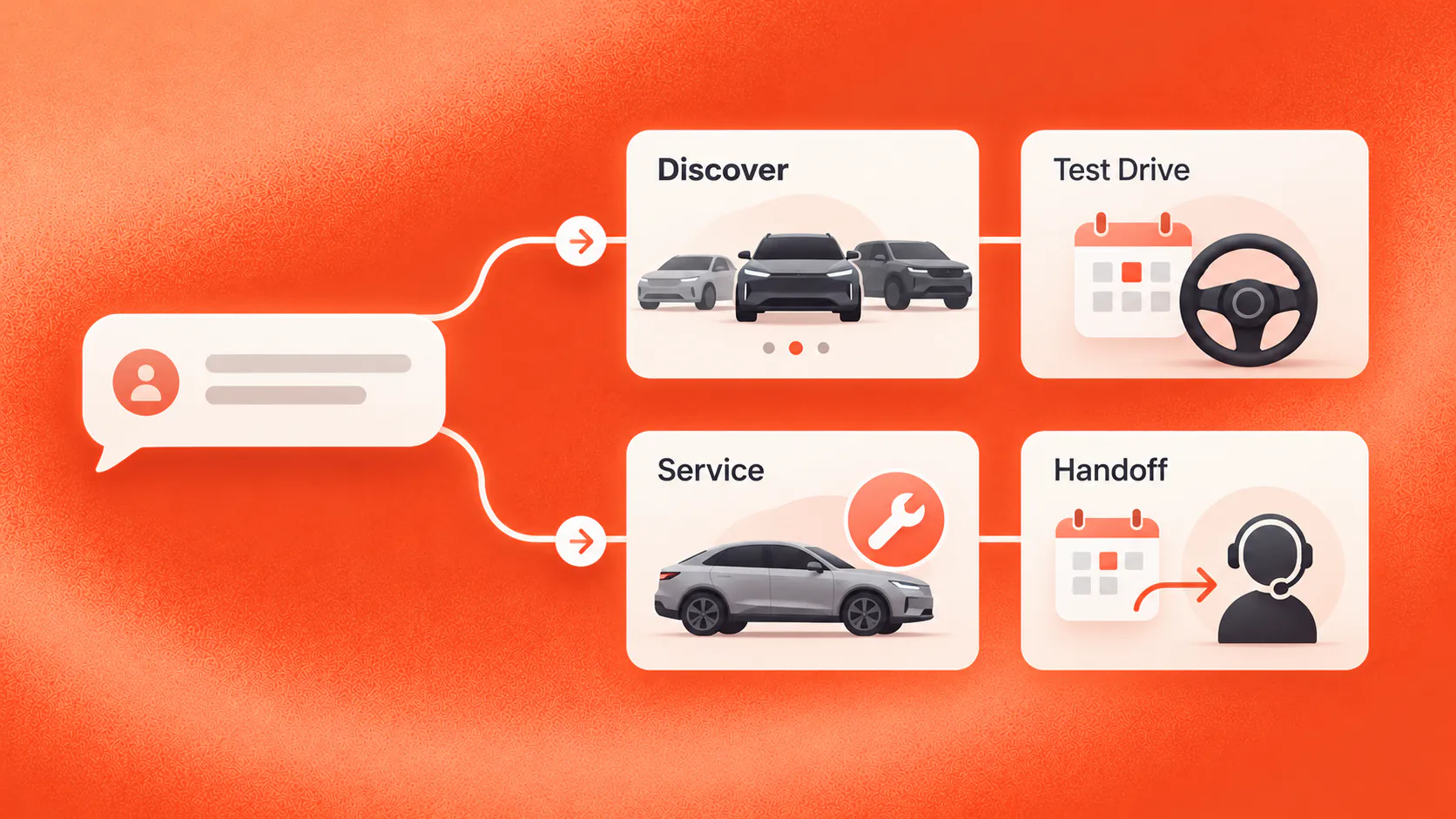
An automotive chatbot can respond to vehicle and service enquiries, collect buyer or booking requirements, support connected test-drive and service appointments, follow up with eligible contacts and route exceptions to sales or service teams. It should not value vehicles, approve finance, diagnose repairs, decide warranty coverage or negotiate terms.
Key takeaways
- Separate vehicle sales, finance interest, trade-in, service, parts and ownership questions before routing the enquiry.
- Use verified inventory, pricing and appointment data whenever the conversation presents changing information.
- Capture useful requirements once so sales or service teams can continue without restarting the conversation.
- Keep valuation, credit, diagnosis, warranty and negotiation decisions with qualified people and governed systems.
What role can an automotive chatbot play?
An automotive chatbot can help a buyer or vehicle owner reach the correct next step without waiting for a general inbox. It may answer approved questions, collect sales or service requirements, support appointment booking and preserve context for the responsible team.
The conversation must separate sales, test drives, finance interest, trade-ins, service, parts and ownership questions. Each journey uses different information and ends with a different responsible person.
Consider an illustrative buyer asking after hours whether a specific model is available for a test drive. A useful conversation checks verified inventory and calendar data, collects the preferred location and offers an available slot. It does not promise that a static listing is still available.
Related must-read articles
- What is a chatbot?
- Lead generation chatbot guide
- Appointment booking chatbot guide
- WhatsApp chatbot guide
Why do automotive enquiries lose value?
Vehicle and service enquiries arrive through websites, messaging, social channels, calls and email. A fast generic acknowledgement does not help if the dealership still does not know the model, location, timing or service need.
Common friction includes:
- Vehicle enquiries going unanswered after hours
- Buyers contacting another dealership first
- Lead records missing model or timeline
- Test-drive booking requiring repeated calls
- Unavailable vehicles remaining visible
- Sales and service requests sharing one queue
- Cancelled appointments receiving no rebooking path
- Service requests reaching advisers without context
- Customers repeating details after handoff
An automotive chatbot should turn an incoming message into a clear sales or service state rather than another unowned notification.
How can it support vehicle discovery?
The conversation can ask about vehicle type, intended use, preferred model, location, budget range, timeline and essential features. It may then narrow options using verified inventory and approved product information.
Useful discovery questions include:
- Which vehicle or category interests the buyer?
- Is the need new, used, personal or commercial?
- Which features matter most?
- What purchase timeline applies?
- Is a test drive the preferred next step?
- Is there finance or trade-in interest for staff follow-up?
The automotive chatbot should not decide affordability, approve finance or value a trade-in. It can identify interest and route the buyer to the qualified team.
If current inventory is not connected, present general model information and request staff confirmation. Never imply that a specific vehicle is available based only on an old listing.
How can it qualify a sales enquiry?
Qualification should help the buyer and the salesperson. Collect enough information to identify the next useful action without forcing a long form before answering a basic question.
An illustrative buyer may ask whether a vehicle suits a seven-person household. The conversation can explain approved seating and feature information, ask about important requirements and share current options. A salesperson handles suitability judgment, price, finance and negotiation.
The automotive chatbot may capture:
- Vehicle or model interest
- New or used preference
- Location
- Purchase timeline
- Essential features
- Test-drive preference
- Finance or trade-in interest
- Preferred contact method
See the lead qualification use case for routing and ownership design.
How can it support test-drive booking?
A connected journey can collect the selected vehicle, dealership location, preferred day and contact details, then offer current appointment availability. Confirmation should come from the scheduling system.
The automotive chatbot can also send permitted reminders and provide a rescheduling path. If the selected vehicle becomes unavailable, it should offer staff review or verified alternatives rather than silently changing the booking.
Do not describe a request as confirmed until the system returns confirmation. The appointment booking use case provides the workflow context.
How should sales follow-up work?
Follow-up should reflect the buyer’s stated interest and stage. A person who requested a test drive needs a different message from someone who only asked about general features.
Appropriate journeys may include:
- Test-drive confirmation and reminder
- Rebooking after a cancellation
- Staff follow-up on finance interest
- A verified alternative after a vehicle becomes unavailable
- Re-engagement when a relevant vehicle arrives
- Permitted replacement-cycle communication
Use first-party consent, segmentation, suppression, frequency and opt-out rules. Stop automated messages after a salesperson owns the conversation or the buyer requests no further contact.
How can it support service booking?
Service journeys need different questions. The conversation may collect vehicle information, requested service type, preferred location and appointment time. It can explain approved service preparation and support connected booking.
For an illustrative vehicle owner reporting a warning light, the automotive chatbot may record the description and route it to service. It must not diagnose the cause, declare the vehicle safe to drive or prescribe a repair. Safety-sensitive concerns require qualified guidance.
Service paths may include:
- Routine service booking
- Appointment rescheduling or cancellation
- Initial symptom collection
- Parts or accessory enquiry routing
- Repair-status requests after verification
- Recall or warranty information from approved sources
Diagnosis, repair recommendations and warranty decisions remain with qualified teams.
When should a person step in?
Transfer when the buyer or owner asks, inventory or pricing is uncertain, negotiation begins, finance or trade-in judgment is required, a safety-sensitive service issue appears, warranty interpretation is needed or a connected action fails.
Provide the receiving person with:
- Sales or service journey type
- Vehicle or model context
- Requirements already collected
- Appointment state
- Answers and options already shown
- Actions attempted
- Requested next step
The human handoff capability should prevent the customer from repeating the same vehicle or service details.
What must remain outside chatbot authority?
Keep these decisions with responsible people and systems:
- Vehicle valuation
- Trade-in appraisal
- Finance approval or credit assessment
- Price negotiation
- Repair diagnosis
- Safety advice
- Warranty decisions
- Unverified inventory or status confirmation
The automotive chatbot may collect context and make the handoff productive. It should not convert a request for expert judgment into an automated answer.
How do you measure business value?
Measure progress across the relevant journey:
- Vehicle enquiries receiving a useful first response
- Buyer requirements captured for routing
- Verified options viewed or shared
- Test-drive requests and confirmations
- Cancelled appointments rebooked or closed
- Service requests with sufficient initial context
- Transfers accepted without repeated information
- Unavailable inventory and failed actions
- Follow-up outcomes and opt-outs
- Questions that approved knowledge could not answer
The analytics layer can help teams review configured stages. Do not attribute a vehicle sale or service revenue to the conversation without verified evidence.
Who should own sales and service accuracy?
Marketing may own approved model information, inventory operations may own availability, sales may own qualification and follow-up, and service teams may own appointment and repair processes. Assign a source and owner for every changing field.
Review enquiries that stopped before a test drive, vehicles requested after becoming unavailable and service transfers missing useful context. Correct the responsible inventory, content, routing or staffing problem rather than treating every failure as a copy issue.
Start with one high-friction journey, such as vehicle-enquiry qualification or routine service booking. Test duplicate leads, unavailable vehicles, appointment conflicts, changed interest, safety-sensitive concerns and direct requests for staff before expanding.
What should the first dealership workflow include?
Choose a journey with frequent demand, reliable data and a clear team owner. Vehicle-enquiry qualification may fit when digital leads arrive incomplete. Routine service booking may fit when advisers spend much of the day confirming the same basic details.
Define what the automotive chatbot can answer, which fields it may collect and what counts as a completed next step. If inventory or calendar data is unavailable, the fallback should create an owned request rather than provide an estimated answer.
Test the automotive chatbot with:
- A vehicle that sold after the listing was published
- A buyer interested in several models
- A request for an unapproved discount
- A trade-in valuation question
- A test-drive slot that becomes unavailable
- A service request with a possible safety concern
- A warranty or recall interpretation request
- A duplicate enquiry from another channel
Review whether the automotive chatbot separated sales, finance interest, trade-in, service and parts correctly. Check that the automotive chatbot did not turn a model description into a suitability recommendation or a symptom description into a diagnosis.
Give inventory, appointment, product and service information separate owners. Retest the automotive chatbot when available vehicles, prices, opening hours, service capacity or routing assignments change.
The first automotive chatbot workflow should also define closure. A booked test drive, staff-owned sales conversation, confirmed service appointment, explicit no-interest response and opt-out are different outcomes. Recording them prevents unnecessary follow-up and gives managers a clearer view of where enquiries stop.
Assign one owner to review unresolved automotive chatbot conversations every week and correct the responsible data, routing or staffing gap.
Additional resources
- ZINQ for automotive
- Lead qualification
- Appointment booking
- Follow-up
- Omnichannel inbox
- Book a ZINQ demo
Frequently asked questions
What can an automotive chatbot do for a dealership?
It can answer approved vehicle or service questions, collect requirements, support test-drive and service booking, continue permitted follow-up and route the conversation to the appropriate team.
Can it recommend a vehicle?
It may narrow current options using stated preferences and verified inventory, but suitability, price negotiation, finance and trade-in decisions require responsible people and systems.
Can it diagnose a vehicle problem?
No. It may collect symptoms and service context for routing, but diagnosis, repair recommendations, warranty decisions and safety advice remain with qualified service professionals.
Conclusion
An automotive chatbot should help each enquiry reach the right sales or service next step while preserving live data, professional judgment and clear staff ownership.
READY TO SEE ZINQ IN ACTION?
From first enquiry to conversion, follow-up and support, ZINQ helps automate the next step while keeping your team in control.
Book a DemoAdditional resources
-
What Is a Chatbot? Business Uses and Examples
A chatbot is software that holds a text or voice conversation with a person. Businesses use one to answer common questions, collect information, guide a customer through a defined task and bring in a person when the request needs judgment.
The ZINQ team · October 30, 2026 · Comparisons & Guides -
Lead Generation Chatbot: Qualification and Follow-Up
A lead generation chatbot engages an inbound enquiry, answers the prospect's first question, collects the details that affect fit or routing and gives the conversation a clear next step. It should qualify declared intent without making hidden assumptions or forcing every prospect through a long form.
The ZINQ team · October 30, 2026 · Sales & Conversion -
Appointment Booking Chatbot: Scheduling and Confirmation
An appointment booking chatbot turns an enquiry into a confirmed slot by identifying the requested service, collecting the minimum required details, checking authorised availability and recording the booking in the connected system. If confirmation is unavailable, it should create a pending request and set an honest expectation.
The ZINQ team · October 30, 2026 · Sales & Conversion