What Is an AI Chatbot?
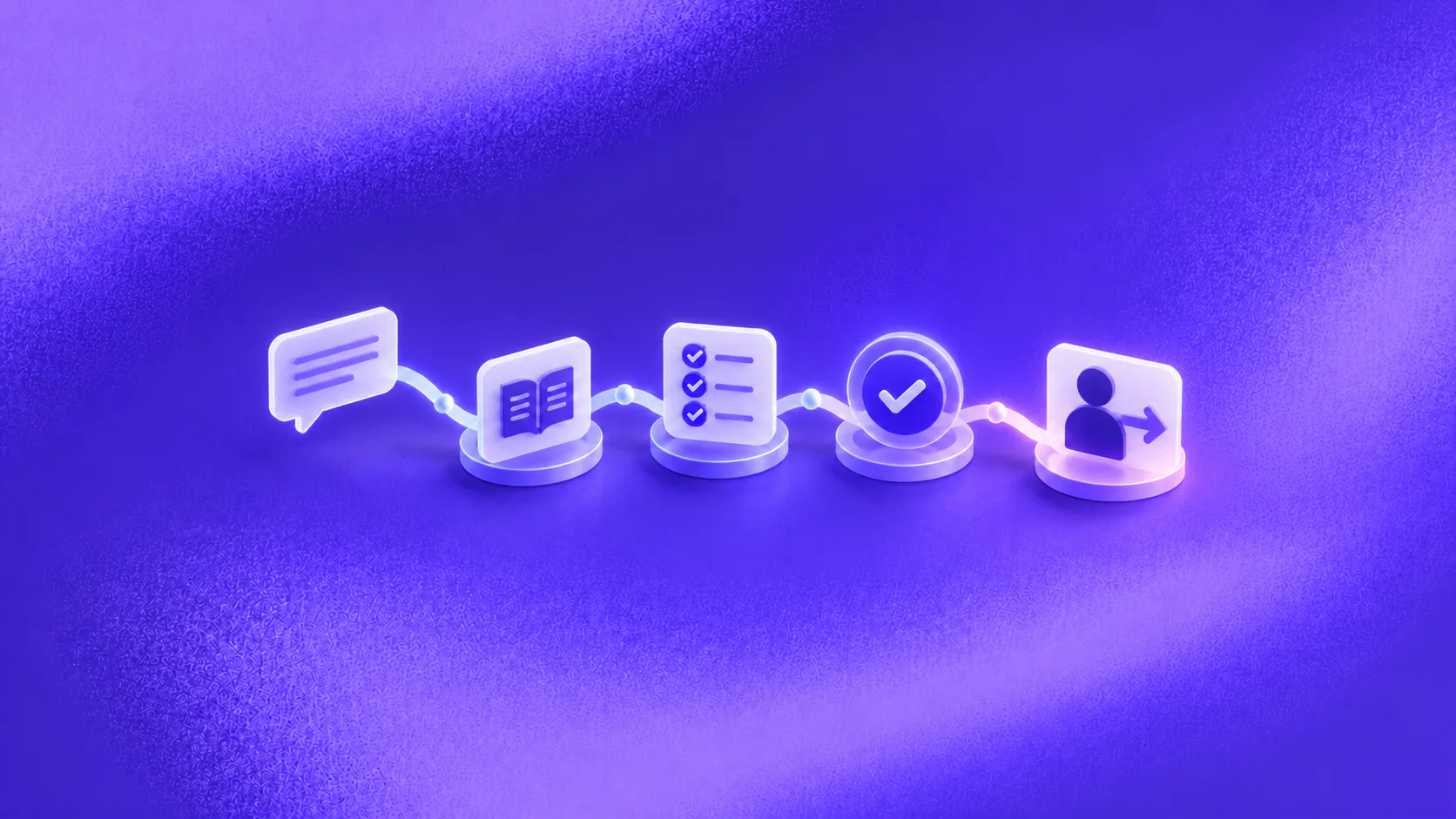
An AI chatbot is software that understands everyday language and responds through a customer conversation. For a business, it can answer approved questions, collect details, qualify an enquiry, complete a connected action and pass an exception to the right person.
Key takeaways
- An AI chatbot should move a customer towards a verified next step, not merely produce a fluent reply.
- Start with a frequent customer task such as qualification, booking, order help or support, then define what completion means.
- Approved knowledge, connected systems, clear action limits and human ownership determine whether the chatbot is useful.
- Measure completed outcomes, corrections, failed actions and repeat contacts rather than counting conversations alone.
What is an AI chatbot?
An AI chatbot is software that understands everyday language and responds through text or speech. In business, it can answer from approved information, collect details, qualify an enquiry, trigger a permitted action and involve a person when the request needs judgment.
The useful question is not whether it sounds human. It is whether the customer gets somewhere. A visitor asking about availability should receive an accurate answer and a clear next step. A customer moving a booking should receive a confirmed change or learn exactly why staff must help.
Consider an illustrative enquiry arriving at 9 p.m. The prospect asks whether a service is available for three locations and what it costs. A basic bot may display office hours. An AI chatbot can answer the approved availability question, collect the necessary details and offer the right booking or follow-up path. The team starts the next day with a usable enquiry instead of an unread message.
Related must-read articles
Where does an AI chatbot fit in the customer journey?
A customer conversation can begin before a sale and continue after it. The business should decide which stages the assistant can finish and where responsibility changes.
First enquiry and qualification
The assistant can respond when an enquiry arrives, establish what the person needs and ask only the questions that affect the next step. A software enquiry may need the intended use, team context and required integration. The purpose is to avoid delayed callbacks and repeated discovery, not to interrogate the prospect.
The lead qualification use case shows how declared information can guide routing without opaque profiling.
Product or service discovery
Customers often know their problem but not the right option. The chatbot can explain approved choices, compare relevant differences and ask a clarifying question. It should not invent availability or conceal uncertainty.
For example, an online shopper asking about suitability needs product facts, stock information and return conditions. If the approved catalogue cannot answer, the assistant should offer the next useful route.
Booking, application or checkout
When the customer is ready, the conversation should reduce effort. The chatbot may collect required details, show available slots or return the person to the correct checkout step. The calendar, commerce platform or responsible system must confirm the result.
A message saying “your appointment is booked” is not proof if no appointment exists. See the appointment-booking workflow for the wider process.
Follow-up and recovery
A consented contact may leave because a question went unanswered or the timing was wrong. The assistant can continue an approved follow-up and respond when the person replies. The business still needs consent, channel rules, sensible frequency, suppression controls and an easy opt-out. ZINQ does not create or manage paid advertising campaigns.
Customer service
After purchase, the assistant can answer approved questions, collect a request, retrieve status information and create a ticket when the connected workflow supports it. A return, cancellation or complaint may still require identity checks, policy review or human discretion. The customer-service use case explains the operating context.
What are common AI chatbot examples?
The best examples are ordinary moments where delay or missing context creates work:
- A sales enquiry receives approved answers, qualification questions and a booking path.
- A shopper gets delivery and return information before returning to checkout.
- An appointment request reaches available times outside staffed hours.
- An order-status question retrieves a current result after the required verification.
- An exception reaches the correct person with the conversation and collected details.
The dedicated AI chatbot examples guide develops these journeys and their boundaries.
How does an AI chatbot work?
In plain language, the system combines a customer channel, operating instructions, approved knowledge, current conversation context, connected tools and an owner for exceptions.
Some chatbots follow fixed paths. Others use language models to interpret varied questions and compose grounded responses. Many deployments combine both. A booking needs predictable fields and confirmation. A product question may need flexible language supported by current information.
The model is only one part of the result. The knowledge platform, workflow layer and connected business systems determine what the assistant can reliably accomplish.
AI chatbot, scripted chatbot, live chat or AI agent?
| Option | Best suited to | Main limitation |
|---|---|---|
| Scripted chatbot | Predictable menus and fixed questions | Breaks when the customer departs from the path |
| AI chatbot | Natural questions, approved answers and bounded tasks | Needs reliable knowledge, controls and review |
| Live chat | Requests needing judgment, empathy or negotiation | Depends on staff availability |
| AI agent | Multi-step work using knowledge and tools | Requires stronger testing and permissions |
Labels vary. Judge actual behaviour. The AI agent and chatbot comparison explains the distinction.
What business benefits should you expect?
It can help more enquiries receive a useful first response, reduce repeated questions, collect details consistently and make ownership clearer. These are operating improvements, not guaranteed revenue claims.
A fast response has little value if the answer is wrong. A completed chat has little value if the booking, order or case was never created. Business value comes from a verified next step.
When should a person step in?
Human involvement is the last use case, not a step inserted into every routine exchange. A person should take over when the request needs judgment, negotiation, empathy, authority or information the system cannot verify.
Common triggers include uncertain identity, a failed connected system, a complaint, an exception, missing knowledge or a direct request for staff. The receiving team needs the customer’s goal, relevant details, answers already shown, actions attempted and the reason for transfer.
ZINQ’s human handoff and omnichannel inbox pages describe that operating model.
How should you choose an AI chatbot platform?
Begin with one customer job and define completion. Then test every option against the same difficult cases.
Check whether the platform can use approved sources, complete the required action, respect permissions, work on the intended channels, transfer useful context and let staff review failures. Include channel charges, usage, implementation and maintenance when comparing cost.
Do not judge a polished demo alone. Test missing details, a failed connection, an unsupported request and a direct request for staff. The implementation guide provides the rollout sequence.
What should you measure?
Measure the customer task. Useful measures include confirmed bookings, qualified next steps, completed requests, corrected answers, failed actions, repeat contacts and handoffs that reached the right owner.
Review conversations beside the numbers. A falling handoff rate may mean the AI chatbot handles more work, or it may mean customers cannot reach staff. Start with one bounded journey and expand only after the ordinary and difficult cases work.
Additional resources
- Customer conversation channels
- ZINQ AI agents
- Workflow automation guide
- What is conversational AI?
- Human-in-the-loop AI agents
Frequently asked questions
What is an AI chatbot?
An AI chatbot uses artificial intelligence to understand and respond to natural-language messages. A business chatbot may also collect information, retrieve approved records, start workflows or transfer the conversation to a person.
What can an AI chatbot do for a business?
It can answer approved questions, capture and qualify enquiries, help customers choose, progress bookings or checkouts, provide status information and prepare a useful handoff.
Is an AI chatbot the same as generative AI?
No. Generative AI is one technology a chatbot may use. A business chatbot also needs approved knowledge, instructions, integrations, permissions and accountable ownership.
When should a person take over?
A person should step in for exceptions, sensitive decisions, unclear identity, negotiation, complaints, unavailable systems or a direct request for human help.
Conclusion
An AI chatbot earns a place in customer operations when it completes one useful journey reliably. Define the boundary, test difficult cases and verify the outcome before expanding.
READY TO SEE ZINQ IN ACTION?
From first enquiry to conversion, follow-up and support, ZINQ helps automate the next step while keeping your team in control.
Book a DemoAdditional resources
-
AI Chatbot Examples and Practical Use Cases
Useful chatbot examples show a customer reaching an observable next step: a qualified enquiry, suitable option, confirmed booking, completed checkout, current status answer or well-prepared handoff. The best use case is frequent, bounded and connected to a result the business can verify.
The ZINQ team · October 22, 2026 · AI Chatbots -
How to Create an AI Chatbot: Implementation Guide
To create an AI chatbot for business, choose one frequent customer task, define its completion and exception rules, prepare approved knowledge, connect only the required systems, test real messages and launch with a named operating owner.
The ZINQ team · October 22, 2026 · AI Chatbots -
AI Chatbot vs AI Agent: Which Does Your Business Need?
An AI chatbot primarily manages a conversation, while an AI agent is generally expected to pursue a goal and take bounded actions through connected tools. The labels overlap, so businesses should compare the journey completed, authority granted, confirmation method and human ownership.
The ZINQ team · June 17, 2026 · AI Chatbots