Human-in-the-loop AI agents: where people should stay in control
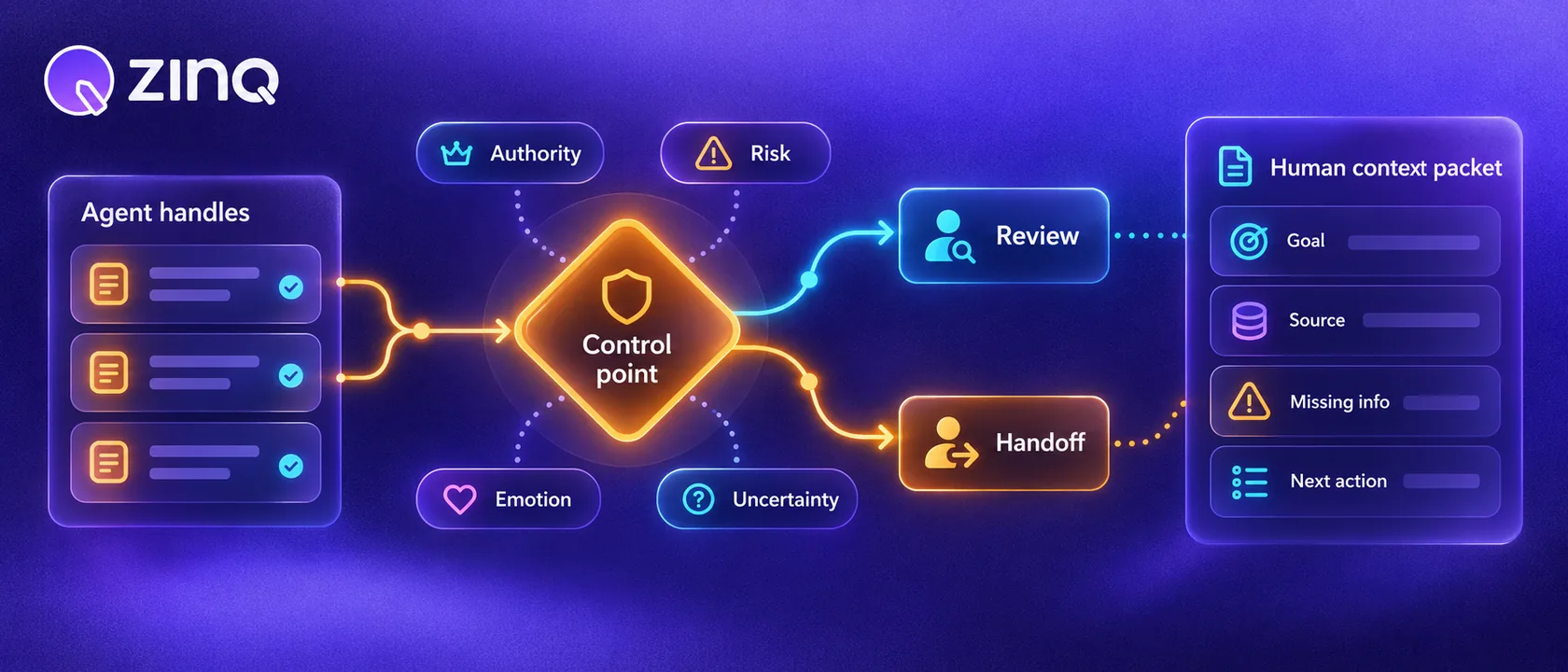
Human-in-the-loop AI agents keep people involved when a customer request needs judgment, authority, empathy, sensitive information review or a decision the agent is not allowed to make.
Key takeaways
- Human-in-the-loop design is about control, not distrust of automation.
- The agent should hand off when authority, confidence, emotion or risk changes.
- A useful handoff includes summary, source, missing information and requested next action.
- Review should focus on risky or unclear cases, not every harmless message.
Human in the loop does not mean slow
Human-in-the-loop AI agents keep people involved at the right moments. That does not mean every message waits for approval. It means the agent has clear rules for when to answer, when to ask, when to act and when to stop.
Customer conversations need this because not every request is equal. A delivery status question, a booking enquiry and a complaint about a sensitive issue should not follow the same automation rule.
The goal is practical control. Let the agent handle repeatable work. Keep people responsible for judgment, authority and trust.
Where people should stay involved
People should stay in the loop when the consequence of a wrong answer is high or when the agent lacks authority.
Common handoff triggers include:
- customer anger or distress
- policy exceptions
- high-value sales conversations
- sensitive personal or financial details
- medical, legal or compliance-related judgment
- requests the agent cannot verify
- repeated failed attempts
- custom pricing or discounts
- disputes and complaints
These triggers should be written before launch. If the team decides them later, the agent will learn through customer frustration.
The difference between review and handoff
Review and handoff are not the same.
Review means a person checks something before or after the agent responds. This can be useful for new workflows, risky answers or training quality.
Handoff means the person takes over the customer conversation. The agent should stop trying to solve the request and give the human enough context to continue.
A good human-in-the-loop design uses both. Review improves the system. Handoff protects the customer experience.
What a good handoff includes
A handoff should not be a transcript dump. People need a short operating packet.
Include:
- the customer’s goal
- the current channel and identity details available
- information already collected
- answer source or knowledge used
- what the agent could not verify
- why the handoff happened
- urgency or sentiment
- the next action the customer expects
This is why human handoff should be part of the agent workflow, not an emergency button added later. A support person should know whether they are stepping into a complaint, a booking change, a high-intent lead or a policy exception.
How to decide what needs approval
Approval should match risk. If every harmless response needs approval, the team recreates a manual inbox. If nothing needs approval, the business may lose control.
Use a simple risk model:
| Request type | Agent can answer | Human approval needed | Human takes over |
|---|---|---|---|
| Public FAQ | Yes | No | Rarely |
| Booking details | Yes, within rules | Sometimes | If exception appears |
| Pricing policy | Only approved facts | For custom terms | For negotiation |
| Complaint | Acknowledge and collect context | Usually | Often |
| Sensitive request | Limited intake | Yes | Often |
The point is not to make the agent timid. It is to make the boundary visible.
How this works across channels
Human-in-the-loop design becomes harder when customers move across channels. A customer may begin on web chat, reply on WhatsApp and later email screenshots. If each channel has a separate inbox, handoff gets messy.
The team needs a shared view of the conversation. That is where an omnichannel inbox and connected customer contacts matter. The human should see the context, not hunt for it.
Without shared context, the agent may hand off correctly and the human may still ask the customer to repeat everything.
What to measure
Measure whether the loop is helping.
Useful metrics include:
- handoff rate by intent
- accepted handoffs versus avoidable handoffs
- human rework after handoff
- escalation reasons
- answer corrections after review
- repeated customer contacts
- time from handoff to human response
Do not aim for the lowest possible handoff rate. Some handoffs are good. The better goal is fewer unnecessary handoffs and better context for the necessary ones.
Common mistakes
The first mistake is hiding human help. Customers should know when a person is available or when the request has been sent to one.
The second mistake is using handoff as a failure bucket. “Agent could not answer” is not enough. Name the reason.
The third mistake is reviewing everything forever. Early review is useful. Permanent review of every low-risk answer slows the operation without improving customer trust.
The fourth mistake is missing the owner. A handoff to nobody is just a delay with better wording.
Conclusion
Human-in-the-loop AI agents are not a compromise. They are how automation stays useful in real customer operations. Define the agent’s authority, write the handoff triggers, send useful context and keep people responsible where judgment matters.
Frequently asked questions
What does human in the loop mean for AI agents?
It means a person reviews, approves or takes over when the AI agent reaches a defined limit such as uncertainty, sensitivity, complaint, high value or decision authority.
Does every AI response need human approval?
No. Requiring approval for every low-risk answer removes the speed benefit. Use approval for cases where the consequence of a wrong answer is higher.
What should the agent send during handoff?
It should send the customer's goal, collected details, answer source, missing information, reason for handoff and the next action the customer expects.
Can human-in-the-loop agents work across channels?
Yes, but the handoff owner must see the same customer context across WhatsApp, web chat, Instagram, email or other connected channels.
Conclusion
Human-in-the-loop AI agents work best when the handoff rule is designed before launch. Let the agent handle repeatable work, and keep people in control where judgment, authority or customer trust matters.
READY TO SEE ZINQ IN ACTION?
From first enquiry to conversion, follow-up and support, ZINQ helps automate the next step while keeping your team in control.
Book a DemoRelated articles
-
How to set up human handover in an AI support workflow
A human handover is complete when the right person or queue receives the unresolved request with usable context. Define triggers, ownership, customer expectations and control of further automated replies before rollout.
Pavan · June 17, 2026 · Customer Support & CX -
How to implement customer service chatbot handoff
Implement customer service chatbot handoff by defining transfer triggers, conversation ownership, destination queues and the context a person needs to continue. Test explicit human requests, authority limits, missing information and system failures, then verify that the receiving team accepted the case.
The ZINQ team · September 21, 2026 · AI Chatbots -
Designing human handover for clinic AI communication
Clinic AI communication needs a defined route to an appropriate person when a request is clinical, urgent, unclear or outside the approved administrative scope. A handoff is useful only if the receiving team can act on it.
Pavan · August 11, 2026 · Industries → Clinical & Healthcare