Insurance Chatbot for Enquiries, Renewals and Claims
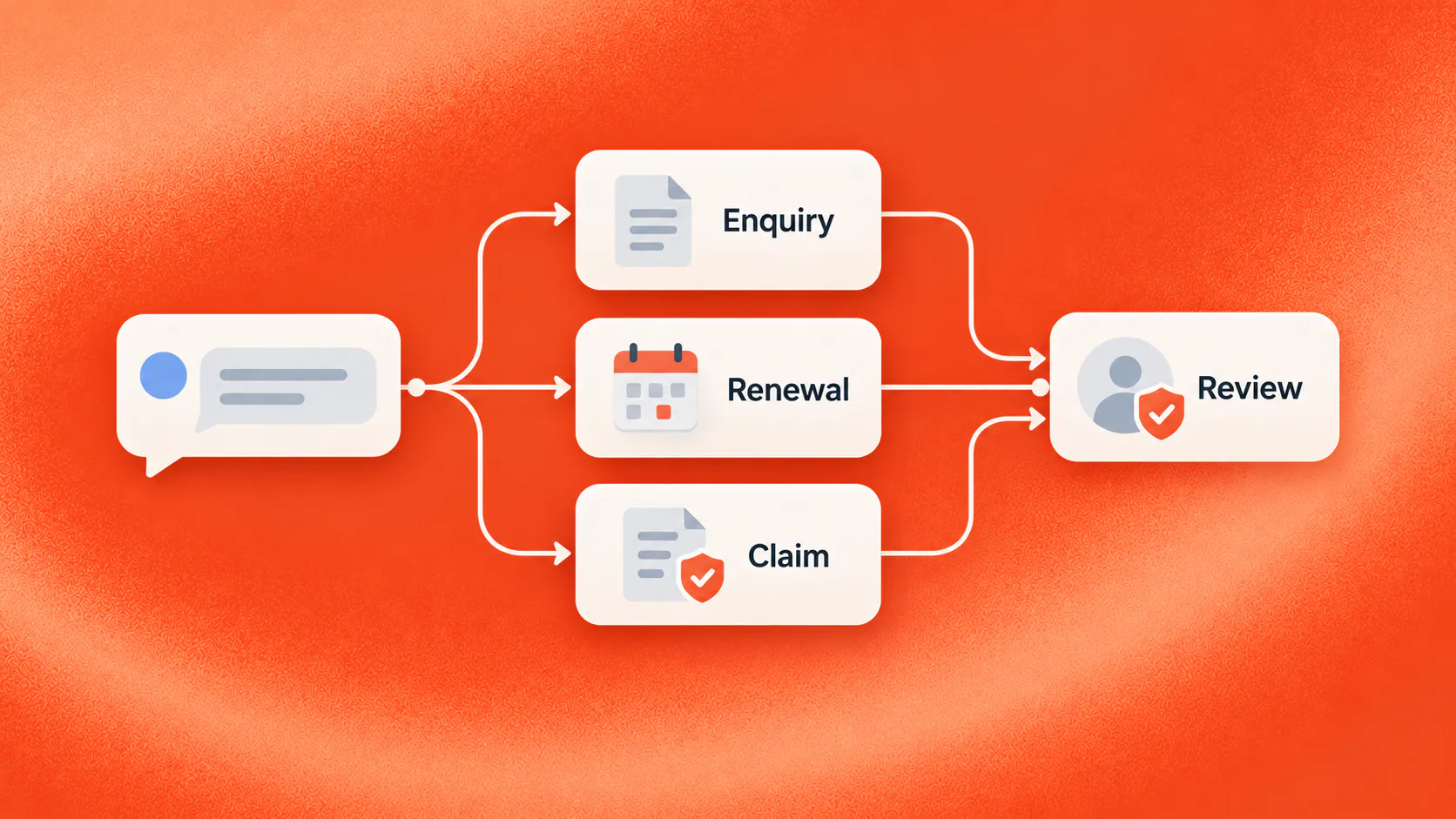
An insurance chatbot can support general product enquiries, quote or application intake, adviser booking, document reminders, renewal conversations, claims intake and status routing. Underwriting, premium calculation, policy recommendations, coverage decisions, fraud decisions, claim approval and settlement remain with authorized people and systems.
Key takeaways
- Separate sales, service, renewal and claims intent before collecting detailed information.
- Explain product categories and process steps without recommending a policy or giving financial advice.
- Use identity and authorization controls before sharing policy- or claim-specific information.
- Transfer emotional, complex and consequential decisions to authorized people with the conversation context.
What role can an insurance chatbot play?
An insurance chatbot can help a prospect or policyholder understand the next administrative step. It may answer approved general questions, collect initial enquiry information, support adviser booking, remind customers about missing documents, begin claims intake and route requests to the responsible team.
It should not recommend a policy, calculate a premium, decide coverage, underwrite risk, detect fraud, approve a claim or determine settlement. Those are consequential insurance decisions for authorized people and systems.
Consider an illustrative motor-insurance prospect asking what information is normally required to request a quote. A useful conversation explains the approved process, collects basic enquiry context and offers an adviser appointment. It does not calculate a price or state which coverage the person should buy.
Related must-read articles
- What is a chatbot?
- Lead generation chatbot guide
- Customer service chatbot guide
- Conversational AI in insurance
- Insurance AI agent guide
Why do insurance conversations lose momentum?
Insurance journeys combine unfamiliar terminology, missing documents, regulated decisions and several responsible teams. A prospect may not know whether the question belongs to sales, servicing, renewal or claims. A policyholder may not know what information is needed before a person can help.
Common friction includes:
- New enquiries waiting too long for a response
- General questions going unanswered
- Quote enquiries arriving without basic information
- Applicants abandoning when requirements are unclear
- Missing documents delaying progress
- Adviser appointments requiring repeated messages
- Renewal communication beginning too late
- Claims starting without enough information for routing
- Customers repeating policy or claim details during handoff
An insurance chatbot can organize the administrative path without taking over the regulated decision.
How do insurance types change the conversation?
Different products create different questions, evidence and boundaries.
| Insurance type | Common administrative conversation | Human or system boundary |
|---|---|---|
| Health | General product, network, document and process questions | No medical, coverage or claims decision |
| Motor | Quote intake, renewal, documents and claim initiation | No valuation, premium or liability decision |
| Life | General product information and adviser booking | No suitability recommendation or financial advice |
| Property | General coverage information and claim intake | No coverage determination or settlement |
| Travel | Product, trip-detail and claim-process questions | No visa advice or claim approval |
| Commercial | Initial requirements and specialist routing | No risk underwriting or binding decision |
The insurance chatbot needs approved knowledge, intake fields, identity controls and owners for the specific product and journey. One generic script cannot safely handle every insurance conversation.
How can it support a new quote or application enquiry?
The conversation can identify the insurance category, answer approved general questions and collect the basic information an adviser needs for the next step. It should explain why information is requested and avoid collecting sensitive details before the appropriate secure stage.
A practical sequence is:
- Identify the enquiry type. Determine whether the person seeks general information, a quote, service, renewal or claims help.
- Answer approved public questions. Explain the process without giving personalized advice.
- Collect initial administrative context. Ask only what changes routing or preparation.
- Offer adviser booking or the approved application path.
- Record completion or missing requirements.
The lead qualification use case provides context for routing without using hidden or discriminatory profiling.
How should document follow-up work?
Incomplete applications often stall because the customer does not understand what remains. An insurance chatbot can provide an approved reminder, explain where to submit permitted information and record the customer’s response.
The message should not expose sensitive policy information or request confidential identifiers in an inappropriate channel. It should stop when the requirement is completed, withdrawn or transferred. Exceptions need a responsible employee, not an endless reminder sequence.
Use the customer follow-up use case to define timing, stopping rules and ownership.
Can the chatbot support renewals and re-engagement?
Where permitted, the insurance chatbot can remind an eligible policyholder about an approaching renewal, explain approved administrative steps and offer an adviser conversation. It should reflect the relevant product and current status rather than sending the same message to every policyholder.
The conversation can record whether the person wants to continue, needs information, wants adviser help, has already acted or does not want further messages. Price negotiation, coverage changes, suitability and advice remain with authorized teams.
Consent, communication preferences, channel rules and opt-outs must be applied consistently. The campaigns and segments capability supports configured first-party outreach where appropriate; it does not run paid advertising.
How can it help someone begin a claim?
Claims often begin during a stressful event. The insurance chatbot can explain the approved first step, collect initial administrative information and route the matter to the correct claims team. It should use clear language and avoid interrogating the policyholder beyond what the intake stage requires.
Depending on the product, initial intake may include:
- Policy or account reference after appropriate verification
- Type and date of event
- General location
- Parties or property involved
- Immediate administrative needs
- Available documents or evidence
- Preferred contact route
The chatbot does not determine coverage, liability, fraud, claim value, approval or settlement.
How should policy and claim status be handled?
Policy-specific or claim-specific information requires appropriate identity and authorization checks. A phone number or social account alone may not be sufficient.
After verification, the insurance chatbot may retrieve a supported status from the responsible system or create an owned request. It should distinguish between received, under review, awaiting information, completed and unavailable states only when the system provides those definitions.
If the status cannot be retrieved, explain that clearly and assign the follow-up. Do not invent progress to reassure the customer.
When should a person step in?
Transfer when the customer requests a person, the conversation becomes emotional or complex, a dispute arises, authorization fails, professional advice is needed or a connected action does not complete.
The receiving employee should see:
- The insurance product and journey stage
- The customer’s stated question
- Information already collected
- Verification status where appropriate
- Actions already attempted
- The reason for transfer
- The requested next step
The human handoff capability should preserve context while limiting access to authorized roles.
What decisions must remain with authorized people?
Keep these activities outside routine chatbot authority:
- Policy recommendation or financial advice
- Underwriting and risk acceptance
- Premium calculation
- Coverage determination
- Fraud detection or accusation
- Claim approval, rejection or settlement
- Liability decisions
- Legal interpretation
- Binding or changing a policy without the required controls
The insurance chatbot can support administrative preparation and routing. It cannot replace accountable insurance judgment.
How do you measure insurance chatbot value?
Measure whether the conversation improved the administrative journey:
- Enquiries receiving an approved first answer
- Quote or application enquiries routed correctly
- Adviser appointments requested or confirmed
- Missing-document journeys completed
- Renewal intentions recorded
- Claims intake arriving with usable administrative context
- Policy or claim status requests completed correctly
- Transfers accepted by the right team
- Failed identity, messaging or connected actions
- Reasons journeys stop progressing
The analytics layer should support operational review without presenting message activity as policy sales, claim resolution or customer retention.
What should you test before launch?
Test general questions, incomplete applications, missing documents, changed contact preferences, identity failure, emotional claims language, unsupported product types and direct requests for an adviser or claims professional.
The first insurance chatbot journey should remain narrow and product-specific. General enquiry routing or adviser booking may be easier to govern than claims or policy servicing. Expand only after legal, compliance, product and operations owners verify the workflow for the target market.
Who should own insurance conversation quality?
An insurance chatbot can cross product, sales, service, renewal and claims teams. Assign an owner for each journey and a governance owner who can stop or change the workflow when information, regulation or operating practice changes.
Product owners should maintain approved general information. Operations should own intake requirements and connected-system states. Compliance and legal reviewers should verify regulated wording, consent and data handling. Authorized advisers or claims professionals should own decisions and exceptions.
Create a review queue for unanswered questions, incorrect routes, failed identity checks and conversations that reached a person too late. The insurance chatbot should expose uncertainty rather than create a plausible answer from incomplete policy information.
How should changes be controlled?
When a product, document requirement, renewal process or claims route changes, update the insurance chatbot and retest the affected paths. Keep a record of who approved the change and when it became effective.
The insurance chatbot should also stop or narrow a journey when the responsible system is unavailable. A temporary service problem must not lead to false status statements, duplicate applications or lost claim information. Give the customer an honest pending state and create accountable recovery work.
Additional resources
- ZINQ for insurance
- Lead qualification
- Appointment booking
- Customer follow-up
- Human handoff
- Book a ZINQ demo
Frequently asked questions
What can an insurance chatbot do?
It can answer approved general questions, collect initial quote or claim information, support adviser booking, send permitted reminders and route policy-specific requests after appropriate controls.
Can an insurance chatbot recommend a policy?
No. Policy selection, financial advice, underwriting, premium calculation and coverage decisions remain with appropriately authorized people and systems.
Can a chatbot approve an insurance claim?
No. It may collect initial claim information and provide approved process guidance, but assessment, fraud decisions, approval and settlement remain with authorized teams.
Conclusion
An insurance chatbot should make the next administrative step clearer while preserving identity, authority and professional judgment around every consequential decision. Different insurance types need different information, controls and responsible owners.
READY TO SEE ZINQ IN ACTION?
From first enquiry to conversion, follow-up and support, ZINQ helps automate the next step while keeping your team in control.
Book a DemoAdditional resources
-
What Is a Chatbot? Business Uses and Examples
A chatbot is software that holds a text or voice conversation with a person. Businesses use one to answer common questions, collect information, guide a customer through a defined task and bring in a person when the request needs judgment.
The ZINQ team · October 30, 2026 · Comparisons & Guides -
Lead Generation Chatbot: Qualification and Follow-Up
A lead generation chatbot engages an inbound enquiry, answers the prospect's first question, collects the details that affect fit or routing and gives the conversation a clear next step. It should qualify declared intent without making hidden assumptions or forcing every prospect through a long form.
The ZINQ team · October 30, 2026 · Sales & Conversion -
Customer Service Chatbot: Use Cases, Benefits and Handoffs
A customer service chatbot can improve support by answering routine questions, collecting issue details, retrieving authorised status information and routing exceptions with context. It becomes a dead end when it blocks human help, uses outdated information or claims an action succeeded without confirmation.
The ZINQ team · October 30, 2026 · Customer Support & CX