Insurance AI Agent: Intake, Service and Handoff
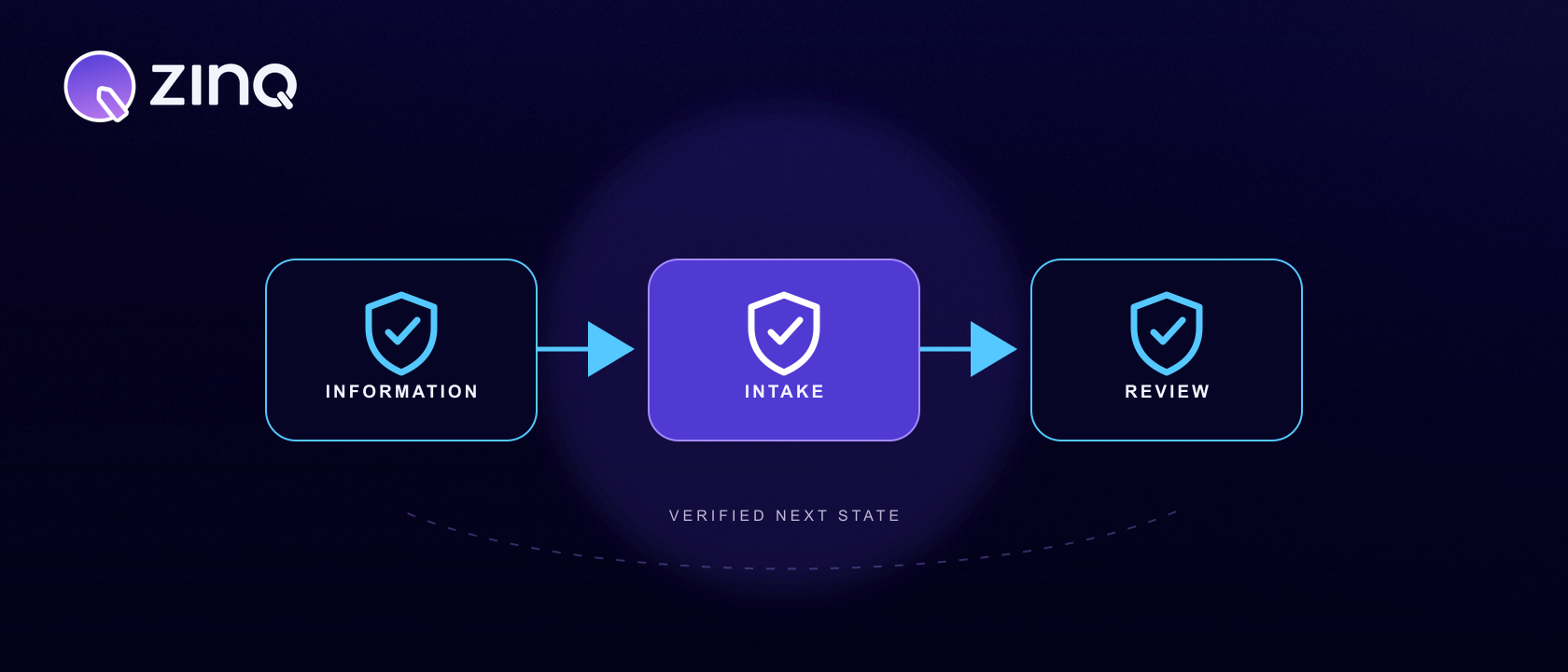
An insurance AI agent supports controlled communication workflows such as approved information, structured intake, status updates and routing, while coverage, eligibility, underwriting and claims decisions remain with authorised systems and people.
Key takeaways
- Separate information, intake and status from eligibility, coverage, underwriting and claim decisions.
- Match authentication to the sensitivity of the requested information or action.
- Tell customers whether a request is collected, submitted, under review or decided.
- Route ambiguity and exceptions to an authorised owner with the evidence already gathered.
What should an insurance AI agent do?
Start with communication work whose source, permission and end state can be defined. An insurance AI agent can explain an approved process, collect structured enquiry or claim-intake details, request specified documents, check a permitted status and route the case to the team authorised to continue.
It should not blur assistance with decision-making. Coverage, eligibility, underwriting, approval and claims outcomes depend on authorised processes, evidence and professional responsibility. A general customer-service agent can help a person navigate those processes without claiming to decide them.
This is the practical distinction behind many searches for an insurance chatbot or conversational AI for insurance. A question-and-answer interface is only one layer. The operating design must preserve identity, data, state and decision ownership.
Where does automation stop?
Use an authority table before writing the conversation.
| Task | Appropriate agent role | Required boundary |
|---|---|---|
| Public product or process information | Answer from approved, current material | Do not personalise beyond the source |
| Customer-specific status | Retrieve a permitted source-system state | Use the required identity check |
| Enquiry or claim intake | Collect defined facts and documents | Do not infer the decision |
| Submission | Send to the authorised workflow and confirm receipt | Do not call submission approval |
| Coverage, eligibility or claim outcome | Explain the recorded decision or route a question | Decision remains with authorised system or person |
| Exception or complaint | Gather context and hand off | Named owner accepts responsibility |
The safest wording follows the evidence. “We received your documents” is different from “your documents are sufficient.” “Your claim is under review” is different from “your claim will be approved.” Preserve these distinctions in templates, system mappings and staff training.
ZINQ for insurance supports controlled information, structured communication, follow-up and human routing where the relevant knowledge, workflows and integrations are configured. It should not be represented as making insurer decisions.
Which process states should customers see?
Map the actual source-system states before simplifying them for conversation. Common stages may include started, information required, submitted, received, assigned, under review, additional information requested, decided and closed. Your business may use different terms.
For each state, define what evidence creates it, what the customer may be told and who can change it. If the agent cannot retrieve a current value, it should not infer progress from the age of the conversation or the presence of uploaded documents.
Avoid vague reassurance. “Everything looks good” can sound like a decision even when the system only confirms receipt. Precise language is more useful: identify the recorded state, any next action and who owns it.
Connected systems should return the state used in the answer. Knowledge can explain the process, but a policy document alone cannot prove where a particular case sits within it.
A hypothetical claims-intake scenario
Imagine a policyholder reports a damaged item through WhatsApp. The agent first identifies the request as a claim notification and explains the approved intake process. After the required identity step, it collects the event date, a factual description and the documents specified by the workflow.
The person asks whether the loss is covered. The agent does not interpret the policy and make a coverage judgment. It explains that the authorised review determines coverage and continues with the permitted intake. The source system confirms receipt and returns a reference number, which the agent shares.
If a required document cannot be uploaded, the agent creates a service handoff with the reference, completed fields and the exact failure. If the source system times out, it tells the customer that submission has not been confirmed and routes the recovery path rather than inventing a case number.
This hypothetical example keeps three states separate: information collected, intake submitted and claim decided. Many avoidable trust problems begin when a workflow collapses them into one.
How should identity and data controls work?
Match the identity check to the request. Public process information may need none. A personal policy status, address change or claim document may require stronger assurance. Define the approved authentication path and what the agent may reveal before it succeeds.
Collect the minimum fields needed for the next authorised step. Do not ask for sensitive information simply because it might be useful later. Document where each field is stored, who can access it, how long it is retained and what happens when the customer abandons the workflow.
Keep secrets and full identifiers out of unnecessary transcripts and analytics views. Apply the organisation’s security and privacy controls across the channel, agent, integration and receiving staff tools. A conversational interface does not reduce the obligations attached to the underlying information.
This article cannot determine compliance for a deployment. Regulatory, legal, security and risk owners should review the exact jurisdiction, product, data and decision path. The International Association of Insurance Supervisors’ work on AI and machine learning supervision is a useful governance reference, not a substitute for that review.
What should human handoff contain?
Route the case when the customer requests a person, identity cannot be completed, the request falls outside approved information, the person disputes a state, an action fails, documents are ambiguous or a professional decision is required.
The handoff packet should include the verified identity state, stated intent, information collected, documents received, source-system reference, current status, action attempted and reason for escalation. Do not make staff reconstruct the case from a long transcript.
Human handoff also needs acceptance and visibility. A case placed in a shared queue is not necessarily owned. Define assignment, priority, service expectation and what the customer is told. Avoid promising a time that the receiving team has not committed to.
Pause conflicting automation once a person takes ownership. Renewal, document and support sequences should respect the latest case state and communication preference.
Which controls should be tested?
Test both ordinary and adversarial paths:
- public question followed by a request for personal data;
- customer who cannot complete authentication;
- contradictory product or policy information;
- duplicate submission;
- unsupported document type;
- source-system timeout after the final submit action;
- complaint or dispute about a recorded decision; and
- direct request for a person.
For each case, record the expected response, permitted tool call, confirmation source and owner. Confirm that retry logic cannot create duplicate claims, payments or service requests. Test after changes to knowledge, workflow rules, identity providers and core-system integrations.
Maintain an audit trail appropriate to the organisation’s controls. Review samples for unsupported interpretations, excessive data collection, state-language errors and failed escalation. A workflow can complete technically while communicating the wrong implication.
How should performance be measured?
Choose measures for the scoped workflow: intake completion among eligible starts, submissions confirmed by the source system, requests for additional information, exception rate, tool failures, duplicate creation and time until a human accepts escalated work.
Do not treat fewer handoffs as automatically better. A rise in appropriate escalation may show that the boundary works. Segment by intent, product, channel and failure reason, and keep the relevant denominator.
Conversation analytics can reveal repeated customer questions and failure points. Combine that evidence with operational and professional review. The dashboard shows where to look; accountable reviewers decide whether the workflow behaved correctly.
How should an insurer or broker start?
Choose one high-volume communication journey with stable rules, a clear system state and an authorised human owner. Status explanation or bounded intake is usually easier to govern than an ambiguous request that needs policy interpretation.
Document knowledge sources, authentication level, allowed data, tool permissions, customer-facing states, stop conditions and handoff reasons. Build a test set from real customer language and include attempts to obtain a decision the agent is not authorised to make.
Launch in a controlled scope, review early cases frequently and log changes. Expand only after the current workflow reliably distinguishes collected, submitted, reviewed and decided states.
When evaluating an insurance AI agent, ask for a demonstration of uncertainty and failure. What happens when identity fails, records conflict, submission times out or the customer asks whether a claim is covered? The answer should expose the verified state and authorised owner, not replace them with confident language.
Frequently asked questions
What is an insurance AI agent?
An insurance AI agent supports approved customer communication and service workflows by providing controlled information, collecting structured details, checking permitted states and routing requests to authorised teams.
Is it the same as an insurance chatbot?
A basic insurance chatbot may answer FAQs or collect a contact. An agent can maintain context and use connected workflows, but it should still operate within explicit permissions and decision boundaries.
Can an insurance AI agent decide whether a claim is covered?
A general service agent should not make or imply a coverage or claim decision. It can collect information, explain approved process details, show a verified status and route the case to the authorised process or professional.
Can it help with claims?
It can support first notice or intake, request defined documents, confirm receipt and communicate a source-system status. It should not present submission or review as approval.
How should sensitive information be handled?
The workflow should collect only what the approved process needs, apply suitable identity and access controls, and follow the insurer’s security, privacy, retention and review requirements.
Conclusion
A dependable insurance AI agent makes process states clearer without stepping into decisions it is not authorised to make. Scope it around approved communication, verified system status and accountable professional handoff.
READY TO SEE ZINQ IN ACTION?
From first enquiry to conversion, follow-up and support, ZINQ helps automate the next step while keeping your team in control.
Book a DemoRelated articles
-
AI in insurance onboarding and claims communication
AI can assist insurance onboarding and claims communication by explaining approved steps, collecting required information and retrieving authorized status updates. Coverage decisions, settlement judgments and advice need the insurer's appropriate review process.
Pavan · June 22, 2026 · Industries → Insurance -
Insurance renewal reminders: workflow, templates and metrics
Insurance renewal reminders work best when they help customers review their renewal, ask questions and complete the next step. Build the workflow around current policy information, a useful message sequence and a clear route to your servicing team. Stop or change the sequence as soon as the customer's situation changes.
Pavan · August 11, 2026 · Industries → Insurance -
Human-in-the-loop AI agents: where people should stay in control
Human-in-the-loop AI agents keep people involved when a customer request needs judgment, authority, empathy, sensitive information review or a decision the agent is not allowed to make.
The ZINQ team · September 30, 2026 · AI Agents & Conversational AI