Travel AI Agent: Booking States and Human Handoff
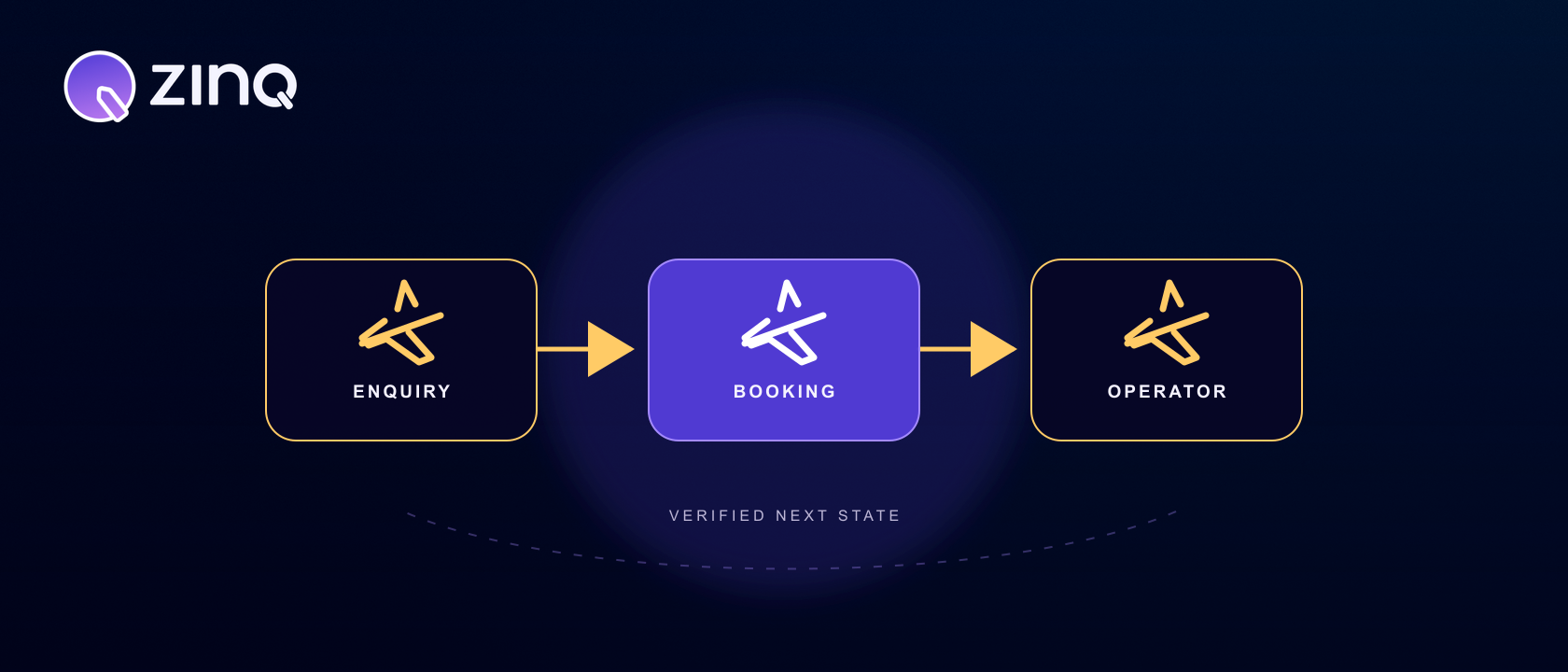
A travel AI agent supports a traveller from enquiry through booking and service by using approved information, checking live supplier or reservation data, taking permitted actions and routing disruptions or exceptions to an operator.
Key takeaways
- Separate destination guidance from live availability, reservation state and supplier action.
- Use exact language for quoted, held, requested, ticketed, confirmed, changed and cancelled states.
- Recheck price and availability before a customer commits when the source can change.
- Give disruption, urgent and policy-exception requests a visible operator owner.
What should a travel AI agent handle?
A practical travel AI agent begins with a traveller’s intent and ends with a verified next state. It may answer approved destination or product questions, collect dates and preferences, check available options, support a configured booking step, communicate an existing reservation state or route an exception to an operator.
Travel makes state unusually important. Availability and price can change between messages. A supplier may accept a request but not confirm it. A schedule change can invalidate a carefully planned connection. The agent must distinguish helpful guidance from live data and live data from permission to act.
People searching for a travel chatbot may want quick answers, but the operational need is broader. The conversation should preserve itinerary context, supplier state, customer confirmation and an accountable recovery path.
Which layers need separate rules?
Use four layers when defining authority.
| Layer | Examples | Control question |
|---|---|---|
| Approved guidance | Destination, product, baggage or process information | Which owned source supports the answer? |
| Live availability and quote | Current room, seat, package or transfer option | When was the supplier state checked? |
| Reservation action | Hold, book, change, cancel or request service | What may the workflow do, and what confirms it? |
| Operator judgment | Disruption, exception, complex itinerary or complaint | Who accepts ownership, with which context? |
Do not let one layer impersonate another. A policy page can explain how changes usually work; it cannot prove that a particular fare may be changed. A supplier search can show availability; it does not prove that a booking was ticketed or confirmed.
ZINQ for travel can support approved destination, product and booking information, traveller requirement collection, configured booking workflows, pre- and post-booking communication and exception routing.
Which journey states should be explicit?
Define the words used by the customer, agent and source system. Relevant states may include exploring, quoted, selected, held, payment pending, requested, confirmed, ticketed, changed, cancelled and disrupted. The exact vocabulary depends on the product and supplier.
Each state needs evidence. A quote comes from a priced response at a recorded time. A confirmed reservation comes from the authoritative reservation or supplier system. A cancellation request is not a cancelled booking until the system returns that result.
Expose uncertainty plainly. If a response is pending, say what is pending and who or what must confirm it. Avoid the reassuring but inaccurate “all set” when one itinerary segment remains unconfirmed.
Knowledge supports stable guidance. Connected systems supply current booking and service states. Treat freshness, timeout and partial-response behavior as part of the product design.
A hypothetical enquiry-to-booking scenario
Imagine a traveller asks in web chat for a three-night city break in a stated date range, with a hotel near public transport and an airport transfer.
The agent collects the essential preferences and uses configured sources to return current options. It labels the price as a quote and explains any expiry or availability condition supplied by the system. The traveller selects an option. Before commitment, the workflow rechecks price and availability and presents any material change.
After the traveller confirms under the approved process, the reservation system returns a confirmed hotel and a pending transfer request. The agent reports those states separately. It does not describe the whole itinerary as confirmed. The transfer request goes to the supplier or operator workflow, and the traveller receives an update when its state changes.
This hypothetical example shows why itinerary-level status is not enough. Each component can have a different authority, supplier and confirmation path. The agent should preserve the relationships without flattening them into one optimistic answer.
How should price and availability changes be handled?
Record when a quote was generated and what it includes. Recheck time-sensitive values before an action that commits the customer. If the price, inventory or terms change, explain the difference and request confirmation rather than silently substituting.
Define acceptable alternatives in advance. A hotel in a nearby area, a different room type or a flight at another time may be relevant, but the agent should not assume which constraint the traveller is willing to relax. Ask the smallest question that resolves the choice.
When a supplier returns no clear state, do not retry blindly. A timed-out booking call may have succeeded. Check the reservation system or use a stable request identifier before attempting the action again. Duplicate reservations and charges are more damaging than a short, honest wait.
Keep customer-facing totals and inclusions tied to the authoritative response. General destination copy must not fill gaps in taxes, fees, baggage, cancellation terms or supplier conditions.
How should booking changes and disruptions work?
Start by identifying the affected itinerary item, current status, traveller’s requested outcome and relevant timing. Check the applicable supplier or product rule, but avoid claiming that a change is permitted until the system or authorised operator confirms it.
Simple changes with a supported action can follow a configured workflow: retrieve the current record, present eligible options, show any material difference, obtain confirmation, execute once and return the new state. Complex or multi-supplier changes should route with the itinerary and attempted steps intact.
Disruption needs a more urgent operating model. Define triggers for immediate operator attention, such as a traveller already in transit, a near-term departure, a failed essential service or conflicting supplier states. Do not bury an urgent request behind a generic FAQ sequence.
IATA’s baseline guidance for airlines illustrates the operational complexity around booking and schedule-change handling. A specific travel business still needs its own reviewed rules, supplier agreements and escalation paths.
What should an operator handoff contain?
A travel handoff should include the verified traveller or booking identity state, itinerary components, current supplier statuses, requested outcome, options already discussed, action attempted, deadline or travel timing, and the exact reason automation stopped.
Human handoff needs a receiving owner and priority rule. “Forwarded to the team” is not enough when departure is approaching. Define how urgent work is surfaced and how the customer learns that a person has accepted it.
Pause conflicting automation after takeover. A promotional sequence or old reminder should not continue while an operator is resolving a cancellation or disruption. Resume only from an explicit, current state.
If the conversation moves from web chat to WhatsApp or email, preserve the itinerary reference and consented context. Ask the traveller to authenticate again when the new channel or requested action requires it; omnichannel continuity should not weaken access controls.
How should proactive communication work?
Tie each message to an event and a traveller need: booking confirmation, required information, payment state, schedule change, check-in reminder or post-trip follow-up. Define the audience, source event, permitted channel, template, timing and stop conditions.
Suppress or replace a message when the underlying state changes. A check-in reminder for a cancelled segment is not merely irrelevant; it can increase distress. A payment reminder should stop after confirmed payment or operator takeover.
Separate service communication from marketing. A traveller who provided contact details for a booking has not necessarily agreed to every future promotional campaign. Apply the business’s current consent and channel rules to the purpose of each sequence.
What should the team measure?
Measure workflow states: eligible enquiries that reach a usable option set, booking attempts confirmed by the source system, incomplete or partial itineraries, changes completed, disruptions handed to an operator, tool failures and time until exception ownership.
Use denominators and segment by product, supplier, channel and intent. A supplier with frequent pending responses may create a different pattern from a knowledge gap. The overall “resolved conversation” count will hide that difference.
Review samples for quote freshness, inclusion accuracy, customer confirmation, duplicate-action protection and correct escalation. Conversation analytics helps locate recurring questions and failures; travel operations reviewers interpret the itinerary and supplier context.
How should a travel business start?
Choose one journey with dependable data and a clear operator owner. A bounded product-enquiry flow or status workflow may be easier to govern than complex multi-supplier rebooking. Map the happy path and the cases involving price change, unavailable option, partial confirmation, payment uncertainty, supplier timeout, duplicate request and urgent traveller.
Build tests from real customer wording and run them after changes to knowledge, supplier connections, policies or templates. Verify each customer-facing state against the system that creates it. Confirm that retries are safe.
Launch within a controlled scope, review early conversations frequently and expand only when current workflows preserve state and ownership. Workflows should make the normal path and recovery path equally visible.
When evaluating a travel AI agent, ask for the awkward demonstration: one component confirmed, one pending, a changed price and a traveller who needs a person now. The strongest system will not hide complexity behind fluent text. It will show what is true, what is permitted and who acts next.
Frequently asked questions
What is a travel AI agent?
A travel AI agent supports approved travel enquiry, booking and service workflows by using business information, checking connected reservation data, taking permitted actions and handing exceptions to an operator.
Is a travel AI agent the same as a travel chatbot?
A travel chatbot may answer FAQs or gather a request. An AI agent can also maintain itinerary context, use connected systems and work toward a verified booking or service state within its permissions.
Can it make or change a booking?
It can support booking or change workflows when supplier access, business rules and customer confirmation are configured. It should report the action as complete only after the authoritative system returns the new state.
How should price changes be handled?
The agent should treat a quote as time-sensitive, recheck before commitment, explain material changes clearly and obtain the customer’s confirmation under the business’s approved process.
When should an operator take over?
Handoff is appropriate for disruption, stranded or urgent travellers, conflicting supplier states, complex multi-part changes, payment uncertainty, policy exceptions and direct requests for help from a person.
Conclusion
A useful travel AI agent keeps the itinerary and its authority clear as conditions change. Reliable supplier state, precise confirmation language and fast operator ownership matter more than covering every travel question.
READY TO SEE ZINQ IN ACTION?
From first enquiry to conversion, follow-up and support, ZINQ helps automate the next step while keeping your team in control.
Book a DemoRelated articles
-
Travel chatbot guide for enquiries, bookings and changes
A travel chatbot can answer approved destination and service questions, collect booking requirements, retrieve permitted booking information and route change requests. It should distinguish guidance from live availability, verify customer and booking context where required, and hand exceptions to an operator with a complete request summary.
The ZINQ team · September 21, 2026 · Industries → Travel -
Route travel booking changes from chatbot to operator
Route a travel booking change by identifying the booking through an approved process, capturing the exact requested change, checking only rules the system is authorized to apply and sending the operator a structured context packet. Keep the customer informed whether the request is received, under review or confirmed.
The ZINQ team · September 21, 2026 · Industries → Travel -
Managing WhatsApp and web chat in one support operation
WhatsApp and web chat can share a support operation while retaining different identity, messaging and follow-up rules. Define queue ownership and supported contact association rather than assuming that every conversation automatically becomes one customer history.
Pavan · June 30, 2026 · Omnichannel