Travel chatbot guide for enquiries, bookings and changes
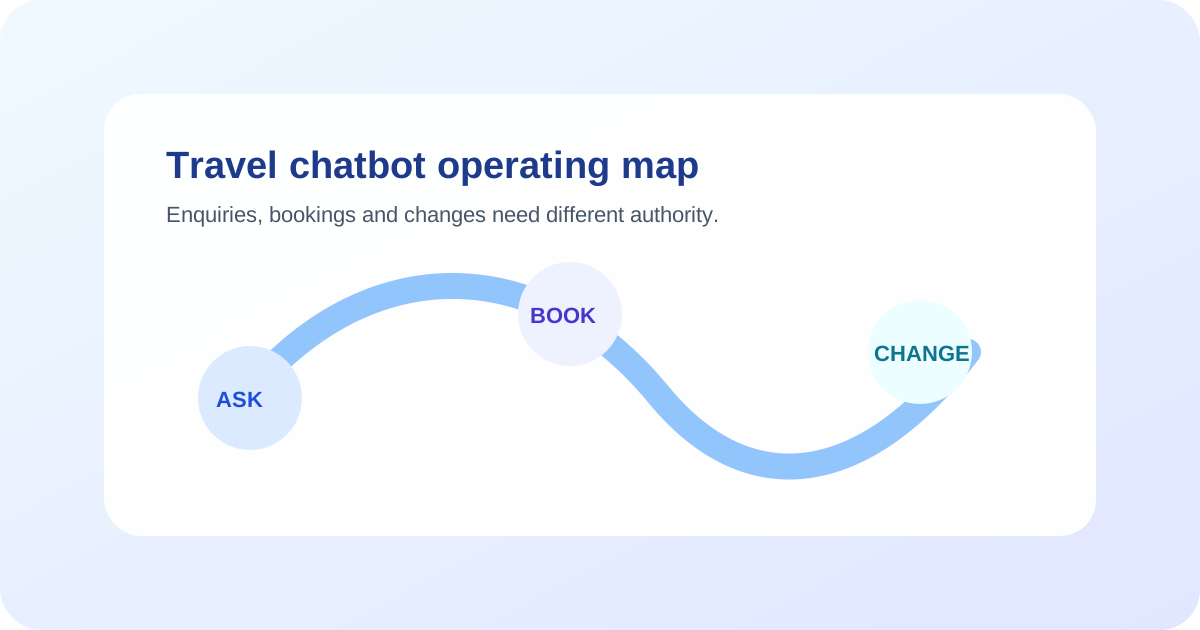
A travel chatbot can answer approved destination and service questions, collect booking requirements, retrieve permitted booking information and route change requests. It should distinguish guidance from live availability, verify customer and booking context where required, and hand exceptions to an operator with a complete request summary.
Key takeaways
- Separate general travel information from live inventory, customer records and supplier actions.
- Confirm dates, location, traveller count and local time before offering a next step.
- Treat a booking request as pending until the reservation system confirms it.
- Route disruptions, exceptions and urgent departures to an owned operator queue.
- Preserve the customer's goal and verified booking context across channels.
What is a travel chatbot?
A travel chatbot is a conversational interface that helps a traveller find approved information or move through an enquiry, booking or service workflow. It can work across web chat, WhatsApp and other supported channels, but its authority depends on the systems and policies connected to it.
The important distinction is between explaining, checking and doing. A chatbot may explain a tour’s published inclusions, check current availability through a connected system or submit a booking. Each state needs different evidence.
For the exception path, pair this guide with routing travel booking changes to an operator. If your travel team also uses messaging channels, compare the workflow with multichannel AI support across WhatsApp and web chat. For the commercial page, see the travel industry page when you need a landing page rather than a how-to article.
Map the traveller journey before automating it
Divide the journey into explicit stages:
| Stage | Customer need | System response |
|---|---|---|
| Explore | Destination, schedule or service questions | Approved public information |
| Qualify | Dates, party size, preferences and budget | Structured enquiry record |
| Check | Current availability or price | Time-bound result from source system |
| Book | Reserve the selected option | Confirmed reservation identifier |
| Prepare | Documents, meeting point or check-in steps | Booking-aware approved guidance |
| Change | Amend or cancel an existing booking | Policy check, action or operator route |
| Disruption | Delay, missed service or urgent exception | Priority handoff and status updates |
Do not collapse these into a single “booking complete” outcome. A collected enquiry is not a held option, and a submitted change request is not an accepted change.
Answer general enquiries from maintained sources
An AI travel chatbot can answer approved questions about destinations, itineraries, published inclusions, operating hours, meeting points and documented booking steps. Give each source an owner and review date.
Ask for enough context to select the right answer. The same tour name may operate in several cities, seasons or languages. Dates should include the year, and times should identify the local time zone.
Avoid turning general destination content into individualized safety, visa, health or legal advice. Link to the operator’s approved source and route questions requiring qualified review.
Collect a booking request without overpromising
A lead or booking intake typically needs:
- destination or service;
- preferred and alternative dates;
- number and type of travellers;
- departure or meeting location;
- accessibility or assistance requests that the operator can review;
- contact channel and consent required for follow-up; and
- the customer’s most important constraint.
Collect only fields needed for the next step. Explain why sensitive information is required and move payment or identity details into the approved secure process.
If the chatbot is not connected to live inventory, say that the request is being checked. Do not label a static schedule as current availability.
Use live systems for availability and confirmation
Availability and price can change between messages. When a connected system returns an option, retain its timestamp, currency, included items and expiry where applicable. Recheck before taking an action that depends on it.
A booking is confirmed only when the reservation system returns the defined success evidence, such as a booking reference and confirmed status. If the call times out, the state may be unknown. Check the source system or route the case instead of automatically submitting a duplicate.
The ZINQ integrations layer supports connections to business systems. The travel operator still defines which source is authoritative and which actions the workflow may take.
Handle booking changes as a separate workflow
Changes require the correct booking, verified customer context where needed, the requested modification and the applicable supplier or operator rules. A travel chatbot should not infer that a change is allowed from a general policy page.
Use states such as received, verification needed, eligibility being checked, operator review, action submitted, confirmed, declined or failed. Tell the customer which state applies and who owns the next step.
The companion guide on routing travel booking changes provides a detailed operator handoff design.
A worked example: family tour enquiry
Consider a hypothetical customer asking on WhatsApp for a three-day family tour next month. The chatbot asks for the destination, exact dates, number of adults and children, departure city and any accessibility needs the operator should review.
It answers published itinerary questions from the approved tour page. Because live inventory is connected, it checks the requested departure and returns a time-bound option. It does not say the seats are reserved.
The customer chooses the option and enters the approved booking flow. The reservation system returns a confirmation reference, so the chatbot can report the booking as confirmed and provide the documented next steps.
Later, the customer asks to move one traveller to another date. The chatbot identifies this as a change, retrieves only the permitted booking context and collects the requested date. Because the supplier rule requires review, it transfers the request to the operator with the original booking reference and stated change. The customer is told that the change is pending, not complete.
Design handoff around urgency and ownership
Transfer when the workflow cannot confirm current information, the customer asks for a person or the request involves an exception. Additional triggers can include:
- departure is approaching;
- a traveller is stranded or reports a missed service;
- payment status is unclear;
- a supplier record conflicts with the booking record;
- accessibility or special-service review is required;
- a change has an uncertain consequence; or
- the connected system is unavailable.
Pass the customer’s goal, relevant dates, verified booking reference, requested change, steps attempted, confirmed system results and urgency reason. The customer-service handoff guide explains how to confirm queue acceptance.
Test real travel failure modes
Test conversations that cross stages and systems:
- Dates are ambiguous or in different time zones.
- Availability disappears before booking.
- The booking call times out after possible submission.
- The customer uses another person’s booking reference.
- A supplier rule differs from a general operator page.
- A change affects only one traveller in a group.
- The departure is within the urgent-service window.
- The operator queue is closed or cannot accept the case.
Inspect the customer message, source result, system record and handoff state. A friendly response is not sufficient if the booking status is wrong.
Measure the full journey
Track resolved public questions, qualified enquiries, live checks, confirmed bookings, unknown-state recoveries, correctly routed changes, accepted handoffs, repeat contacts and staff corrections.
Review journeys rather than isolated messages. A fast first response has little value if a customer has to repeat dates, traveller details and the requested change to the operator.
Where ZINQ fits
ZINQ supports customer conversations, configured knowledge, workflow steps, integrations and human handoff across supported channels. A travel team can begin with one bounded journey, such as tour enquiries that lead to an operator-owned booking review.
Review ZINQ for travel and the multichannel support guide. Validate source freshness, live-system evidence and the handoff destination before adding more booking authority.
Frequently asked questions
Can a travel chatbot make bookings?
It can support booking when it has an approved connection to current inventory and the reservation system returns a confirmed result. Otherwise it should collect requirements or direct the customer to the booking flow.
How should a chatbot handle changing prices or availability?
Label live results with their applicable time, avoid guaranteeing an unconfirmed option and recheck availability before any committed action.
When should a travel chatbot transfer to an operator?
Transfer exceptions, supplier conflicts, failed changes, payment issues, accessibility needs requiring review, urgent departures and any request outside the workflow's approved authority.
Can the same travel chatbot work on WhatsApp and web chat?
Yes, if channel identity, message format, secure-data handling and handoff behavior are configured for each channel rather than assumed to be identical.
Conclusion
A useful travel chatbot keeps the state of the trip clear: enquiry, option, pending request, confirmed booking or operator-owned exception. Start with one journey, connect it to current information and make handoff part of the design.
READY TO SEE ZINQ IN ACTION?
From first enquiry to conversion, follow-up and support, ZINQ helps automate the next step while keeping your team in control.
Book a DemoRelated articles
-
Managing WhatsApp and web chat in one support operation
WhatsApp and web chat can share a support operation while retaining different identity, messaging and follow-up rules. Define queue ownership and supported contact association rather than assuming that every conversation automatically becomes one customer history.
Pavan · June 30, 2026 · Omnichannel -
How to implement customer service chatbot handoff
Implement customer service chatbot handoff by defining transfer triggers, conversation ownership, destination queues and the context a person needs to continue. Test explicit human requests, authority limits, missing information and system failures, then verify that the receiving team accepted the case.
The ZINQ team · September 21, 2026 · AI Chatbots -
Connecting an AI agent to your CRM and calendar
An AI-to-CRM or calendar integration needs supported operations, limited permissions, clear field mapping and a way to verify writes. Test duplicate requests and partial failures before letting a conversation change live records.
Pavan · June 30, 2026 · Integrations