Real Estate AI Agent: From Enquiry to Viewing
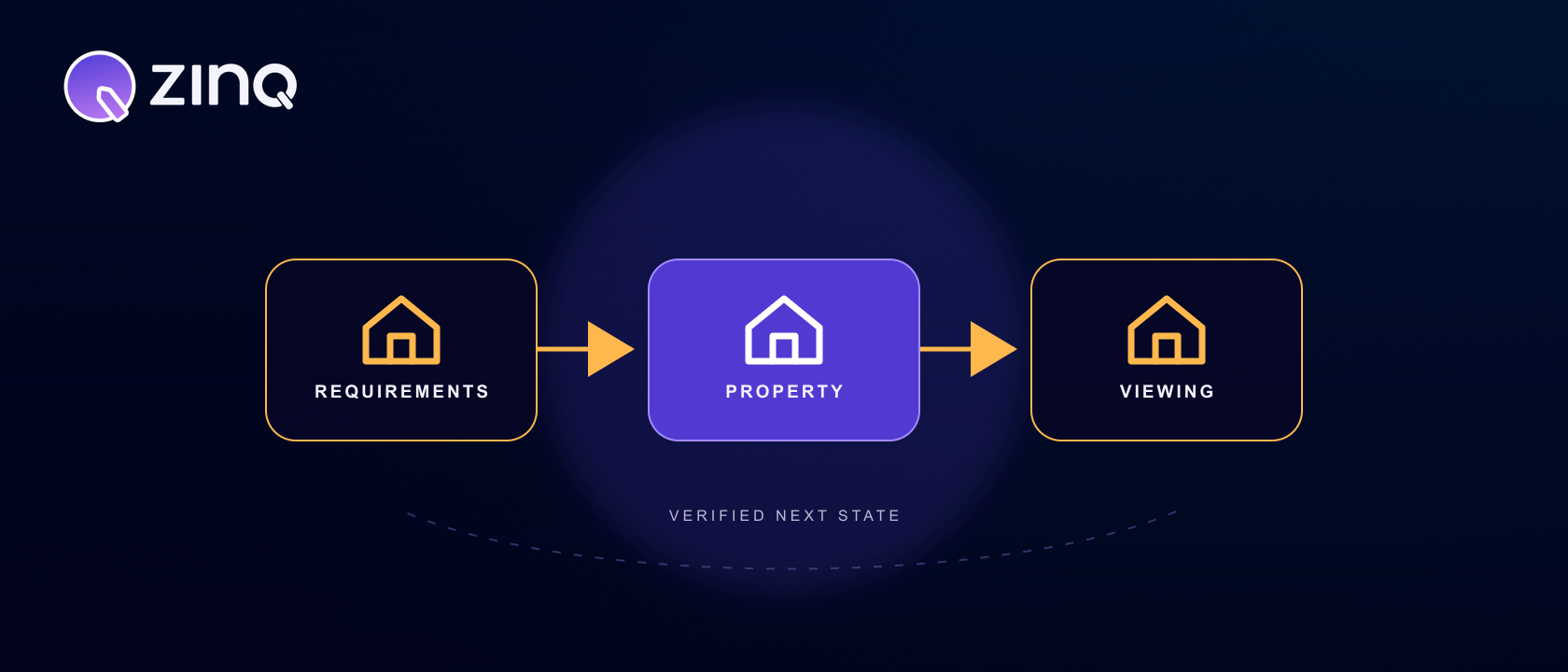
A real estate AI agent turns a property enquiry into an owned next step by answering from approved listing data, collecting buyer or renter requirements, coordinating a viewing request and handing the conversation to the right agent with context.
Key takeaways
- Define qualification as useful matching context, not a hidden score that blocks people from help.
- Use current listing and availability data; never imply that a stale property record is live.
- A viewing request becomes a booking only when the calendar or assigned person confirms it.
- Route each qualified enquiry to one owner and make duplicate follow-up visible.
What should a real estate AI agent own?
A useful first scope begins when someone enquires about a property and ends when the next step has an owner. The agent may answer from approved property information, collect requirements, find relevant records, coordinate a viewing request and prepare a handoff to the appropriate sales or leasing representative.
That scope is more specific than “respond to property leads.” It names the information required, the systems involved and what counts as complete. A contact captured with no property context is not equivalent to a person matched to current options and assigned to a representative.
People searching for a real estate chatbot often need this wider operating path. Conversation is the front end. Listing freshness, lead identity, assignment, scheduling and follow-up determine whether the enquiry progresses.
Which states need to be visible?
Property journeys fail when teams use the same label for different states.
| State | What it means | What it does not mean |
|---|---|---|
| Enquiry captured | Contact and stated interest recorded | Requirements are complete |
| Requirements collected | Key criteria are available | A matching property exists |
| Property suggested | Current data produced a plausible match | Availability is guaranteed |
| Viewing requested | The person proposed or selected a time | The viewing is confirmed |
| Viewing confirmed | Calendar or owner accepted the appointment | The person will attend |
| Human-owned | A named representative or queue accepted the case | The customer has received a response |
Build the workflow around transitions between these states. The agent should tell the person whether it is suggesting, requesting or confirming. Internally, the CRM or operating system should preserve the same distinction.
ZINQ for real estate can support approved property information, requirement collection, enquiry qualification, viewing workflows, follow-up and human handoff where the necessary data and integrations are configured.
What should qualification collect?
Qualification should help the next person or system act. Depending on the business, that may include:
- preferred location or project;
- property type and intended use;
- budget range;
- purchase or move-in timing;
- essential size, amenity or configuration needs;
- whether the person wants to buy, rent or invest; and
- the preferred next step and contact channel.
Ask progressively. If the enquiry names a specific property and asks for a viewing, do not force a full discovery interview before addressing availability. If the property is unavailable, a few constraints can help identify alternatives.
Avoid presenting qualification as a judgment about the person’s worth. The agent is structuring an enquiry and routing it under business rules. Financial, legal or eligibility decisions require the appropriate authorised process and evidence.
A hypothetical enquiry-to-viewing workflow
Imagine a renter asks on Instagram whether a two-bedroom property near a particular station is still available and allows a move-in next month.
The agent identifies the listing, checks the current property source and answers only the approved details. It asks for the budget range, desired move-in date and any non-negotiable requirement. If the original listing is no longer available, it offers current alternatives that match those constraints rather than pretending the first property remains open.
The renter chooses one alternative and requests a Saturday viewing. The scheduling workflow shows available times. After the renter selects one, the property representative or calendar confirms it. The agent shares the confirmed details and writes the requirements, property and appointment reference to the customer record.
If no slot is available, it creates an owned handoff containing the preferred windows and the alternatives already discussed. This hypothetical scenario shows the difference between conversational fluency and operational completion: the viewing exists only after the source of truth confirms it.
How should listing and availability data be governed?
Define the source of truth for property status, price, configuration, amenities, location and viewing availability. Record how frequently each field changes and what the agent should do when data is missing or stale.
Marketing descriptions can explain a project. They should not override a live status field. Likewise, a brochure may show a floor plan without proving that a matching unit is currently available. Knowledge and live connected systems serve different purposes; do not collapse them into one undifferentiated answer source.
When two records conflict, stop the claim that depends on them. The agent can say that availability needs confirmation and route the request. It should not choose the more attractive value because it sounds helpful.
Keep an audit trail of source changes that affect active workflows. When a project launches, sells out or changes price, the team should be able to update the controlling record and test common enquiries before the next campaign drives traffic.
How should viewing coordination work?
Model a viewing as a sequence: eligible property, available representative or site, proposed time, customer selection, confirmation, reminder and outcome. Decide which system controls each transition.
Protect against duplicate bookings and retries. If a calendar call times out, check whether a booking was created before submitting again. Use a stable request identifier when the connected system supports one. A second click or repeated customer message should not create two appointments.
Define rescheduling and cancellation as separate paths. A customer changing time should update the original appointment where possible, not create an unrelated lead. Stop old reminders after a change and confirm the new state.
Reminders need a clear purpose and suppression rules. End or adjust them when the viewing is cancelled, rescheduled, completed or taken over by a representative.
How should CRM ownership and handoff work?
Match the enquiry to an existing contact before creating a new one. Use approved identifiers and deterministic rules rather than relying on slightly different names. If a possible duplicate cannot be resolved safely, flag it for staff review.
Assignment may depend on project, geography, language, availability, lead type or an existing relationship. Write the rule down and specify the fallback. “Send to sales” is incomplete when several teams share the same inbox.
A good handoff includes the customer’s criteria, properties discussed, source campaign when available, actions attempted, viewing state and reason for escalation. Human handoff should deliver that packet to a visible owner.
Avoid simultaneous automated and manual follow-up. Once a representative accepts the conversation, pause sequences that could contradict them. Return ownership to automation only through an explicit state change.
What should the team measure?
Measure transitions rather than raw messages. Useful ratios include eligible enquiries that provide enough matching context, matched enquiries that request a viewing, viewing requests that become confirmed, and exceptions that receive an owner. Track duplicate records, stale-listing failures and scheduling errors separately.
Response time can matter, but it does not prove progress. A fast answer based on an unavailable property creates rework. Pair speed with the accuracy of the resulting state and sample conversation review.
Use the right denominator and segment. A campaign for one project may behave differently from an organic enquiry across a large portfolio. Conversation analytics can identify patterns by source, intent and failure reason; operational owners still need to inspect why the pattern changed.
How should a real estate team launch?
Choose one portfolio or enquiry type with reliable data and a known routing owner. Map the happy path and the cases most likely to break it: unavailable property, incomplete requirements, conflicting price, no viewing slot, tool timeout, duplicate contact, language change and direct request for a person.
Create test conversations from real enquiry wording, including listing nicknames and vague location descriptions. Confirm what the agent may say, which record supports it, which action it may take and what state proves success.
Launch with limited scope, review early conversations and keep a change log for listing sources, routing rules, calendar access and follow-up templates. Expand to another project only when its data and ownership model meet the same standard.
When evaluating a real estate AI agent, ask to see the unavailable-property path, the failed-booking path and the duplicate-lead path. A polished answer is easy to demonstrate. Maintaining current property truth and one accountable owner is the harder—and more valuable—part.
Frequently asked questions
What is a real estate AI agent?
A real estate AI agent supports approved property enquiry workflows by answering from current information, collecting requirements, coordinating viewings and handing the conversation to an assigned person.
How is it different from a real estate chatbot?
A basic real estate chatbot may provide fixed answers or capture a contact. An AI agent can preserve context, consult listing or CRM data and work toward a verified next step within its permissions.
Can it qualify buyer or renter leads?
It can collect criteria such as location, property type, budget range, timing and financing stage when relevant. The business should define how those details guide routing without presenting the agent as making a consequential eligibility decision.
Can it schedule property viewings?
It can coordinate a viewing when availability and calendar access are configured. It should call the viewing confirmed only after the relevant system or property representative accepts the slot.
What happens when listing information is out of date?
The agent should avoid asserting availability, explain that confirmation is needed and route or check the request against the current source of truth.
Conclusion
A real estate AI agent should shorten the distance between interest and an accountable next step. Current inventory, explicit confirmation and single-owner handoff matter more than a long list of conversational features.
READY TO SEE ZINQ IN ACTION?
From first enquiry to conversion, follow-up and support, ZINQ helps automate the next step while keeping your team in control.
Book a DemoRelated articles
-
AI real estate lead generation: measuring enquiry quality
AI can help real estate teams respond to inbound interest and collect useful enquiry details. It does not create demand by itself; the listing, acquisition channel and offer still determine who arrives and why.
Pavan · July 21, 2026 · Industries → Real Estate -
Real estate enquiries: an AI-assisted path to a site visit
An AI-assisted real estate journey can connect an enquiry to a viewing request by collecting preferences, checking approved inventory and coordinating the next step. Each stage needs a recorded outcome and an owner when automation cannot continue.
Pavan · August 11, 2026 · Industries → Real Estate -
What makes an AI property assistant useful?
A useful AI property assistant helps visitors understand current listings, narrow their choices and arrange a next step with the property team. Accurate inventory and clear viewing coordination matter more than a polished greeting.
Pavan · June 22, 2026 · Industries → Real Estate