Travel Chatbot for Bookings, Changes and Guest Support
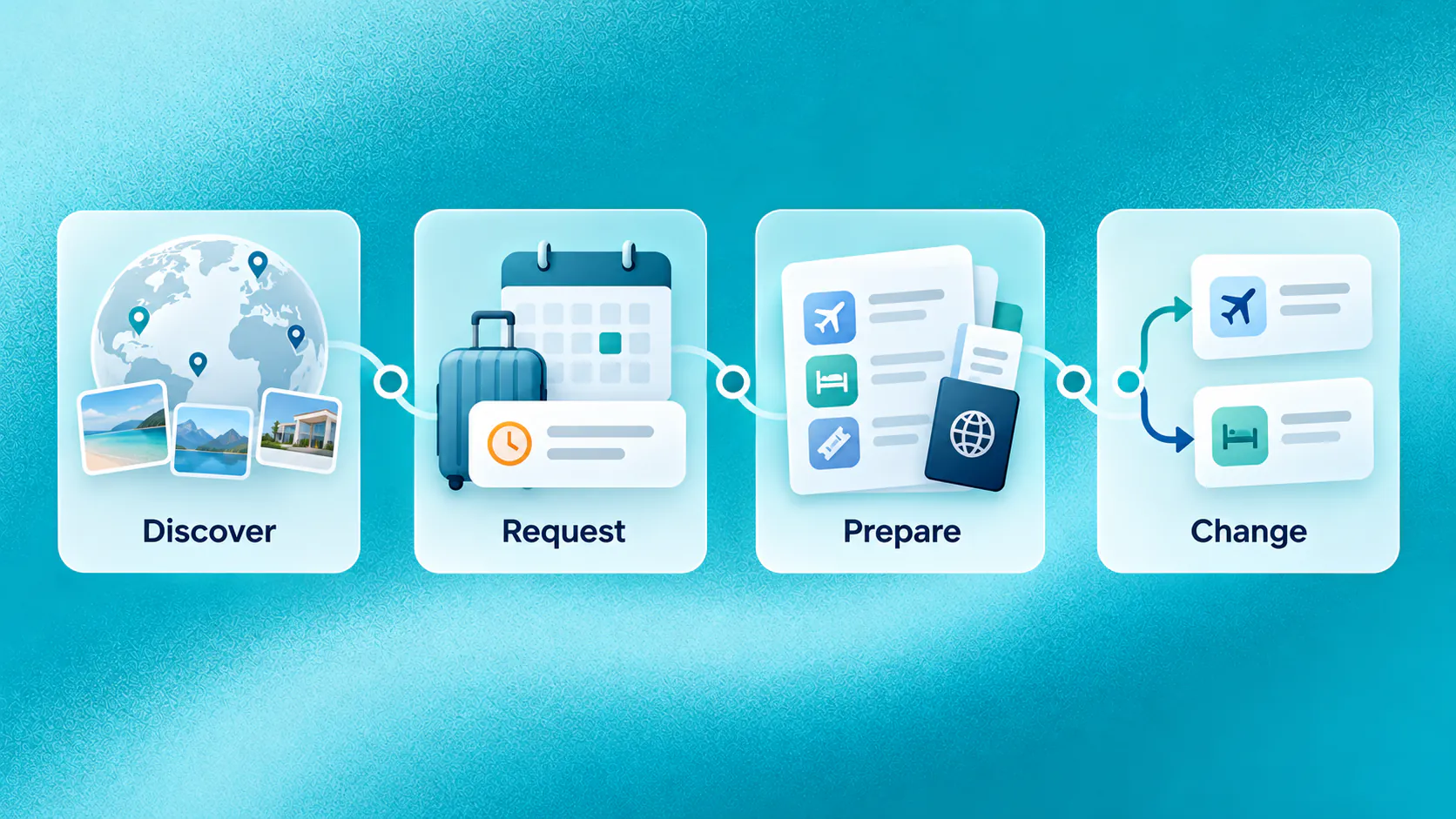
A travel chatbot can answer approved destination and service questions, collect booking requirements, support connected reservation steps, send permitted pre-trip information and route changes or disruptions to an operator. Live availability, rates, confirmations, refund approval and disruption decisions require verified systems or authorized people.
Key takeaways
- Keep enquiry, option, request, payment, confirmation and change states visibly different throughout the conversation.
- Use verified reservation data before presenting live availability, rates or booking status.
- Collect dates, party details and preferences once so reservation teams receive useful context.
- Route changes, disruptions, refunds and exceptions to the authorized operator with the itinerary context.
What role can a travel chatbot play?
A travel chatbot can help a traveller move from an initial question to the right booking or service path. It may answer approved destination, accommodation, package and policy questions; collect requirements; support connected booking steps; and route changes or exceptions to an operator.
The central requirement is state clarity. An option is not a reservation. A booking request is not confirmation. A payment attempt is not successful payment. A cancellation request is not a completed cancellation.
Consider an illustrative traveller asking about a three-night stay for two adults. A useful conversation collects dates and preferences, checks verified availability when connected and presents the next step honestly. It does not promise a room based on static content.
Related must-read articles
- What is a chatbot?
- Appointment booking chatbot guide
- Customer service chatbot guide
- WhatsApp chatbot guide
Why do travel enquiries fail to become bookings?
Travel decisions depend on dates, availability, party needs, inclusions, policies and changing prices. One unanswered question can send a traveller to another provider. Reservation teams also lose time collecting the same basics repeatedly.
Common friction includes:
- Enquiries arriving outside reservation hours
- Missing dates or party details
- Travellers unable to compare suitable options
- Static rates presented after they change
- Booking requests mistaken for confirmations
- Incomplete journeys receiving no useful follow-up
- Modification requests reaching the wrong team
- Guests repeating itinerary information during handoff
- Multilingual questions taking too long to route
A travel chatbot should reduce uncertainty without hiding the difference between information, availability and confirmed action.
How can it support destination and product discovery?
The conversation can ask about destination, dates, party size, trip purpose, preferences and accessibility needs where appropriate. It can then use approved information to narrow relevant options.
Helpful questions include:
- Which destination or property interests the traveller?
- What dates and flexibility apply?
- How many adults and children are travelling?
- Which inclusions matter?
- Are there room, activity or accessibility preferences?
- Is the traveller exploring or ready to book?
The travel chatbot should not ask for every possible preference before offering value. Start with the details that change the available path.
When recommendations depend on live inventory or pricing, use a verified connected source. The connectors layer provides the integration context; it does not make stale supplier data reliable.
How can it support a booking journey?
A configured conversation may collect requirements, retrieve current options, direct the traveller to secure payment and confirm the result returned by the reservation system.
Use explicit states:
| Journey state | What the traveller should understand |
|---|---|
| Enquiry | Requirements are being collected |
| Option | A possible product has been identified |
| Request | The traveller asked to proceed |
| Payment pending | Payment has not been confirmed |
| Confirmed | The reservation system returned confirmation |
| Exception | A person or supplier must review the request |
The travel chatbot must not invent availability, freeze a price or describe a reservation as complete before the connected system confirms it.
What happens when a booking is incomplete?
An eligible traveller may value a reminder when a booking stopped after a clear expression of interest. The message should reflect the known stage and avoid claiming that an option remains available.
For example, an illustrative traveller may have supplied dates but left before choosing a room. A useful follow-up asks whether help is needed and offers a fresh availability check. It should not repeat an expired rate.
Use consent, frequency, suppression and opt-out rules. Stop automated follow-up after the traveller completes the booking, requests no further messages or enters an operator-owned exception.
How can it help before arrival?
Pre-arrival conversations may provide approved check-in information, document reminders, directions, transfer instructions, service hours or links to permitted additional services. Messages should match the confirmed booking and channel permission.
The travel chatbot may also collect an initial request for an arrival time, meal preference or service need. It should distinguish a submitted request from an accepted request. If staff or a supplier must confirm it, say so.
Appropriate upgrades or additional services may be presented when relevant and permitted. Avoid pressure, unsupported availability or generic promotions that ignore the traveller’s itinerary.
How should it handle changes and cancellations?
Changes are stateful. The conversation needs the relevant itinerary, requested change, current policy, live availability and authority to act.
An illustrative traveller asking to move a departure date may face a fare difference, supplier rule or unavailable alternative. The travel chatbot can collect the request and show approved information. An operator should handle judgment, waivers, complex repricing, disruption and refund approval.
Do not describe a cancellation or refund as completed until the responsible system confirms it. If an action fails, create a visible exception with an owner rather than leaving the traveller with a reassuring but inaccurate reply.
How can it support in-trip service?
Travellers may ask about check-in, pickup points, schedule information, property services or an existing request. Account- or itinerary-specific answers require appropriate verification and current data.
Urgent safety issues, missed connections, severe disruptions, accessibility failures and emotionally sensitive complaints should move promptly to the approved human or emergency route. A travel chatbot cannot make operational or safety decisions merely because it is available outside normal hours.
The tickets and tasks capability can preserve ownership when service work continues beyond the conversation.
When should a person step in?
Transfer when the traveller asks, live information is unavailable, a supplier exception appears, a change affects price or eligibility, payment fails, a complaint becomes sensitive, a disruption requires judgment or a connected action fails.
Provide the operator with:
- Traveller goal and current journey state
- Dates, party and itinerary context
- Options or policies already shown
- Verification status where required
- Actions attempted
- Failure or exception details
- Requested next step
The human handoff capability should reduce repetition without exposing protected itinerary data.
What must remain outside chatbot authority?
Keep these activities with responsible systems and people:
- Dynamic pricing decisions
- Inventory allocation
- Visa or immigration advice
- Refund approval
- Disruption and re-accommodation judgment
- Supplier exception decisions
- Safety decisions
- Unverified booking confirmation
The travel chatbot can make the administrative path clearer. It should not make a changing travel state appear settled when it is not.
How do you measure useful outcomes?
Measure journey progress and operational clarity:
- Enquiries with complete booking requirements
- Relevant options retrieved from current data
- Booking requests reaching confirmation
- Incomplete journeys receiving an appropriate outcome
- Pre-arrival requests reaching the correct owner
- Change requests collected with itinerary context
- Transfers accepted without repeated information
- Failed reservation, payment or service actions
- Questions that current knowledge could not answer
- Follow-up replies, failures and opt-outs
The analytics layer can support configured journey review. Do not claim direct-booking uplift or revenue attribution without verified evidence.
Who should own journey accuracy?
Reservation teams may own booking rules, operations may own service paths, marketing may own permitted outreach and customer service may own exceptions. Assign sources, owners and review dates for rates, policies, inclusions and arrival information.
Test unavailable inventory, changed prices, duplicate requests, payment failure, modification rules, cancellations, multilingual ambiguity and requests for staff. Retest when suppliers, policies or reservation connections change.
Start with one journey that has reliable data and clear ownership. A travel chatbot that accurately qualifies enquiries and routes changes can be more useful than a broad experience that blurs every state.
What should the first travel workflow cover?
Choose one booking or service journey with current data and a responsible operator. Enquiry qualification may be suitable when teams repeatedly collect dates, party size and preferences. A pre-arrival information path may fit when guests ask the same approved questions after confirmation.
Define what the travel chatbot can retrieve, what it can request and which system provides the final confirmation. Map the language for unavailable, pending, confirmed, changed and failed states before launch.
Test the travel chatbot with:
- Dates with no current availability
- A rate that changes during the conversation
- A payment that remains pending
- A traveller requesting a supplier exception
- A booking change that affects price
- A cancellation requiring refund approval
- A multilingual question with ambiguous meaning
- A disruption requiring operator judgment
Review whether the travel chatbot preserved the itinerary context and created an owned exception when an action failed. Do not allow a friendly response to hide an unresolved booking or service task.
Assign review dates for policies, inclusions, arrival instructions and connected reservation data. Retest the travel chatbot when supplier rules, payment paths, service hours or operator responsibilities change. The first travel chatbot workflow is ready to expand only when travellers receive accurate states and staff can see every unresolved next action.
Additional resources
- ZINQ for travel
- Appointment booking
- Follow-up and aftercare
- Customer service
- Omnichannel inbox
- Book a ZINQ demo
Frequently asked questions
Can a travel chatbot make a booking?
It may support a configured booking journey when live availability, rates, payment and confirmation come from verified connected systems. A request is not a confirmed reservation.
Can it change or cancel a trip?
It may collect the request and complete only explicitly authorized connected actions. Rules, price changes, refunds and disruption decisions may require an operator.
Can it answer travellers in several languages?
It may support configured languages, but translated answers still require current approved information, clear limits and a route to staff when meaning or risk is uncertain.
Conclusion
A travel chatbot should keep every journey state clear, use live systems for changing facts and give operators the context needed to own exceptions.
READY TO SEE ZINQ IN ACTION?
From first enquiry to conversion, follow-up and support, ZINQ helps automate the next step while keeping your team in control.
Book a DemoAdditional resources
-
What Is a Chatbot? Business Uses and Examples
A chatbot is software that holds a text or voice conversation with a person. Businesses use one to answer common questions, collect information, guide a customer through a defined task and bring in a person when the request needs judgment.
The ZINQ team · October 30, 2026 · Comparisons & Guides -
Appointment Booking Chatbot: Scheduling and Confirmation
An appointment booking chatbot turns an enquiry into a confirmed slot by identifying the requested service, collecting the minimum required details, checking authorised availability and recording the booking in the connected system. If confirmation is unavailable, it should create a pending request and set an honest expectation.
The ZINQ team · October 30, 2026 · Sales & Conversion -
Customer Service Chatbot: Use Cases, Benefits and Handoffs
A customer service chatbot can improve support by answering routine questions, collecting issue details, retrieving authorised status information and routing exceptions with context. It becomes a dead end when it blocks human help, uses outdated information or claims an action succeeded without confirmation.
The ZINQ team · October 30, 2026 · Customer Support & CX