Chatbot Platform: How to Choose the Right One
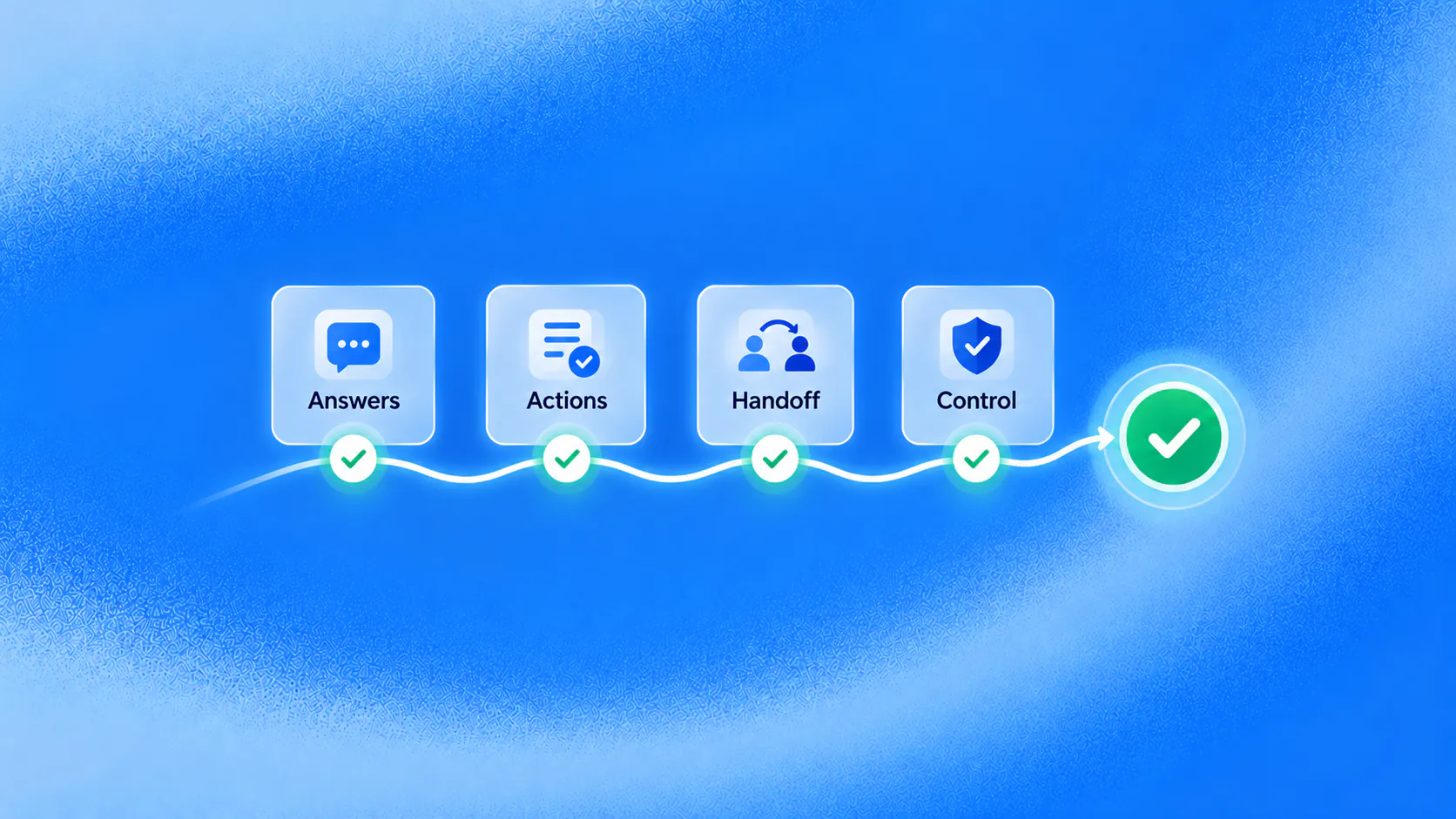
Choose a chatbot platform by testing it against one real customer journey, including answer quality, permitted actions, channel fit, integrations, human handoff, governance, analytics and failure recovery. A convincing demo is not enough unless the platform can complete and evidence the work your team needs.
Key takeaways
- Evaluate a platform against a real customer journey rather than comparing feature checklists in isolation.
- Separate fluent answers from verified actions, connected records and accountable human ownership.
- Test channel behavior, integrations, permissions, failure recovery and reporting before signing a long-term agreement.
- Include implementation, maintenance, messaging and operating effort when comparing cost.
What should a chatbot platform help your business accomplish?
A chatbot platform should help a customer complete a useful task and help the responsible team operate what happens next. That may mean answering an approved question, qualifying an enquiry, requesting an appointment, retrieving a status or transferring an exception with context.
Start with the customer journey, not the software category. A platform that produces elegant replies but cannot confirm a booking, preserve a handoff or show why a workflow failed may add another interface without solving the operating problem.
Consider an illustrative enquiry that asks about suitability, availability and price in one message. During a demo, ask the vendor to show how the chatbot platform interprets the request, uses approved information, collects only necessary details, attempts the next action and handles an unavailable system. The failed path often reveals more than the successful demonstration.
Related must-read articles
- What is a chatbot?
- How to create a chatbot
- Chatbot examples for sales and service
- Customer service chatbot guide
- Lead generation chatbot guide
Which customer journey should you use for evaluation?
Choose one frequent, valuable journey with a visible outcome. Bring anonymized examples of how customers actually ask for help, including vague wording, missing information and exceptions.
Good evaluation journeys include:
- Qualifying an inbound enquiry and assigning the correct owner
- Finding a suitable product or service path
- Requesting, confirming or changing an appointment
- Answering a bounded service question and retrieving status
- Recovering an incomplete journey with appropriate consent
- Transferring a complaint or sensitive request to a person
Define the start, completion state, failure state and human owner. Without that baseline, every chatbot platform can appear capable because the demo never has to finish real work.
How should you evaluate answer quality?
Ask what sources the system uses, who approves them and how changes are reviewed. Then test the same question in several forms. Include a question that the source material does not answer.
A dependable response should be:
- Grounded in an approved source
- Appropriate to the customer’s stated context
- Clear about uncertainty or missing information
- Consistent with current policy and availability
- Able to route questions requiring judgment
The knowledge capability illustrates why answer ownership matters. The chatbot platform should make unsupported or conflicting answers reviewable rather than hiding them inside conversation logs.
Can the platform complete actions or only discuss them?
Ask the vendor to distinguish between generating a reply and completing an action. If the conversation books an appointment, creates a case or updates a record, the connected system should confirm the result. The customer should see whether the action is completed, pending or failed.
Evaluate:
- What actions can be configured
- Which systems provide the authoritative status
- How identity and authorization are checked
- What happens when a connection is unavailable
- Whether duplicate actions are prevented
- Who owns recovery when the action fails
A chatbot platform should never describe an action as successful merely because it produced a reassuring sentence. Review workflows and connectors when mapping the required systems.
Which channels does your business actually need?
Channel count is less important than channel behavior. Website chat, WhatsApp, Instagram, Telegram and email have different entry points, policies, message formats and customer expectations. Test the channels where the target journey genuinely occurs.
For each channel, ask:
- Can the conversation recognize the entry context?
- Which message types and proactive journeys are permitted?
- Does the customer history remain available to the team?
- How does a person take over?
- What happens when a message cannot be delivered?
- Can consent and opt-outs be respected across journeys?
The channels overview and omnichannel inbox provide the ZINQ product context for supported customer conversations. A buyer should still verify the exact capability and policy requirement for each implementation.
What should human handoff look like?
During the demo, type “I want to speak to someone” and introduce an exception the automation cannot resolve. The chatbot platform should stop the automated path, explain what happens next and transfer usable context to the correct queue or owner.
Check whether staff receive:
- The customer’s stated goal
- Information already collected
- Answers and actions already attempted
- Current completion or failure state
- Relevant channel and contact context
- A reason for the transfer
Also ask what happens outside staffed hours. A message that says “someone will reply” without creating an owned task is not a handoff. The human handoff capability should support continuity rather than a restart.
How should you assess governance and control?
A chatbot platform may handle business information, customer data and connected actions. That makes governance part of the buying decision, not a later technical task.
Review:
- Roles and permissions
- Approved knowledge and change ownership
- Action limits and approval steps
- Consent and data-retention controls
- Conversation and change history
- Identity and authorization requirements
- Testing and release process
- Incident and failure recovery
Regulated or consequential journeys need additional review by the appropriate legal, security, compliance or professional owner. Do not accept a broad compliance badge as proof that your specific workflow is appropriate.
What analytics should the platform provide?
The best reporting starts with the customer journey. A chatbot platform should help the operating team see what customers tried to do, whether they progressed and where work stopped.
Useful measures may include:
- Incoming conversations by supported source
- Journey stage and next-step outcome
- Abandonment and repeated contact
- Unanswered or corrected questions
- Transfers and time to human ownership
- Connected actions completed, pending or failed
- Opt-outs and message failures
- Workload by queue or assigned team
Ask the vendor to show how each measure is derived. Avoid treating conversation volume, reply rate or “AI resolution” as a business outcome unless the definition and source are explicit. The analytics layer should support review and improvement, not merely a dashboard screenshot.
How do you compare implementation and operating effort?
Platform price is only one part of cost. Compare the work needed to prepare information, connect systems, design journeys, test exceptions, train staff, review conversations and maintain changing policies or content.
Use a simple comparison table:
| Evaluation area | Evidence to request |
|---|---|
| Initial journey | Working flow using your anonymized scenario |
| Knowledge | Source ownership, updates and unsupported-question behavior |
| Actions | Connected-system confirmation and failure handling |
| Handoff | Staff view, queue ownership and customer status |
| Channels | Live behavior on required channels |
| Governance | Roles, approvals, history and limits |
| Analytics | Journey definitions and source records |
| Ongoing work | Named owners, review process and change effort |
The lowest subscription price may be expensive if the team must manually repair actions or inspect every conversation. A broader product may also be unnecessary when the first use case is narrow.
Ask each chatbot platform to separate included capability from implementation work. A transparent chatbot platform proposal should identify assumptions, dependencies and ongoing business ownership.
What questions should you ask shortlisted vendors?
Use the same questions for every chatbot platform:
- Show our selected journey from first message to verified outcome.
- Show what happens when the customer asks something unsupported.
- Show a failed integration and the recovery record.
- Show the handoff as the employee and customer experience it.
- Explain which information, permissions and systems we must provide.
- Define every metric in the reporting view.
- Explain what changes require vendor, developer or business-team work.
- List channel, messaging, implementation and service costs separately.
- Explain data access, retention and deletion options.
- Describe support and ownership after launch.
Request written answers for claims that matter to the decision.
How should you run a chatbot platform pilot?
Limit the pilot to one journey, a defined audience and an agreed review period. Establish success and stopping conditions before launch. Record corrections, failed actions, handoff quality and staff effort, not only customer completion.
At the end, decide whether to improve, expand or stop. A successful pilot should show that the chatbot platform can support a customer outcome and that the team can operate its exceptions. Expansion without that evidence only increases the number of uncertain conversations.
What is the final selection test?
The final question is simple: can this chatbot platform help a customer complete the selected task while giving your team accurate information, appropriate control and a recoverable path when something goes wrong?
If the answer depends on a perfect demo script, unclear future features or manual work that nobody owns, the platform is not ready for that journey. Choose based on demonstrated behavior, not the longest feature list.
Additional resources
- ZINQ platform overview
- AI agents and customer operations
- Supported channels
- Lead qualification
- Appointment booking
- Customer service
- Book a ZINQ demo
Frequently asked questions
What is a chatbot platform?
A chatbot platform is software used to configure, deploy and manage automated customer conversations, including knowledge, workflows, channels, integrations, handoff and reporting depending on the product.
What should you test in a chatbot platform demo?
Test a real customer journey, an unsupported question, a failed integration, a request for a person and the records staff receive. Ask the vendor to show evidence of completion rather than only a polished reply.
Should a business choose the platform with the most features?
Not necessarily. The better choice is the platform that reliably supports the required customer journeys, channels, controls and team workflows without creating unnecessary operating complexity.
Conclusion
The right chatbot platform is the one your team can operate responsibly around a valuable customer journey. Test completion, exceptions and ownership with your information and systems before comparing polish or feature count.
READY TO SEE ZINQ IN ACTION?
From first enquiry to conversion, follow-up and support, ZINQ helps automate the next step while keeping your team in control.
Book a DemoAdditional resources
-
What Is a Chatbot? Business Uses and Examples
A chatbot is software that holds a text or voice conversation with a person. Businesses use one to answer common questions, collect information, guide a customer through a defined task and bring in a person when the request needs judgment.
The ZINQ team · October 30, 2026 · Comparisons & Guides -
How to Create a Chatbot for Your Business
To create a chatbot for a business, choose one customer task, define the information and actions it needs, write the successful and exception paths, connect only the required systems, provide human ownership and test real conversations before launch.
The ZINQ team · October 30, 2026 · AI Chatbots -
Chatbot Examples for Sales and Customer Service
Useful chatbot examples solve a defined customer task, such as qualifying an enquiry, finding a suitable product, requesting an appointment, checking an order or preparing a support handoff. The strongest examples end with a visible outcome rather than an automated reply alone.
The ZINQ team · October 30, 2026 · Comparisons & Guides