Ecommerce Chatbot for Product Discovery and Cart Recovery
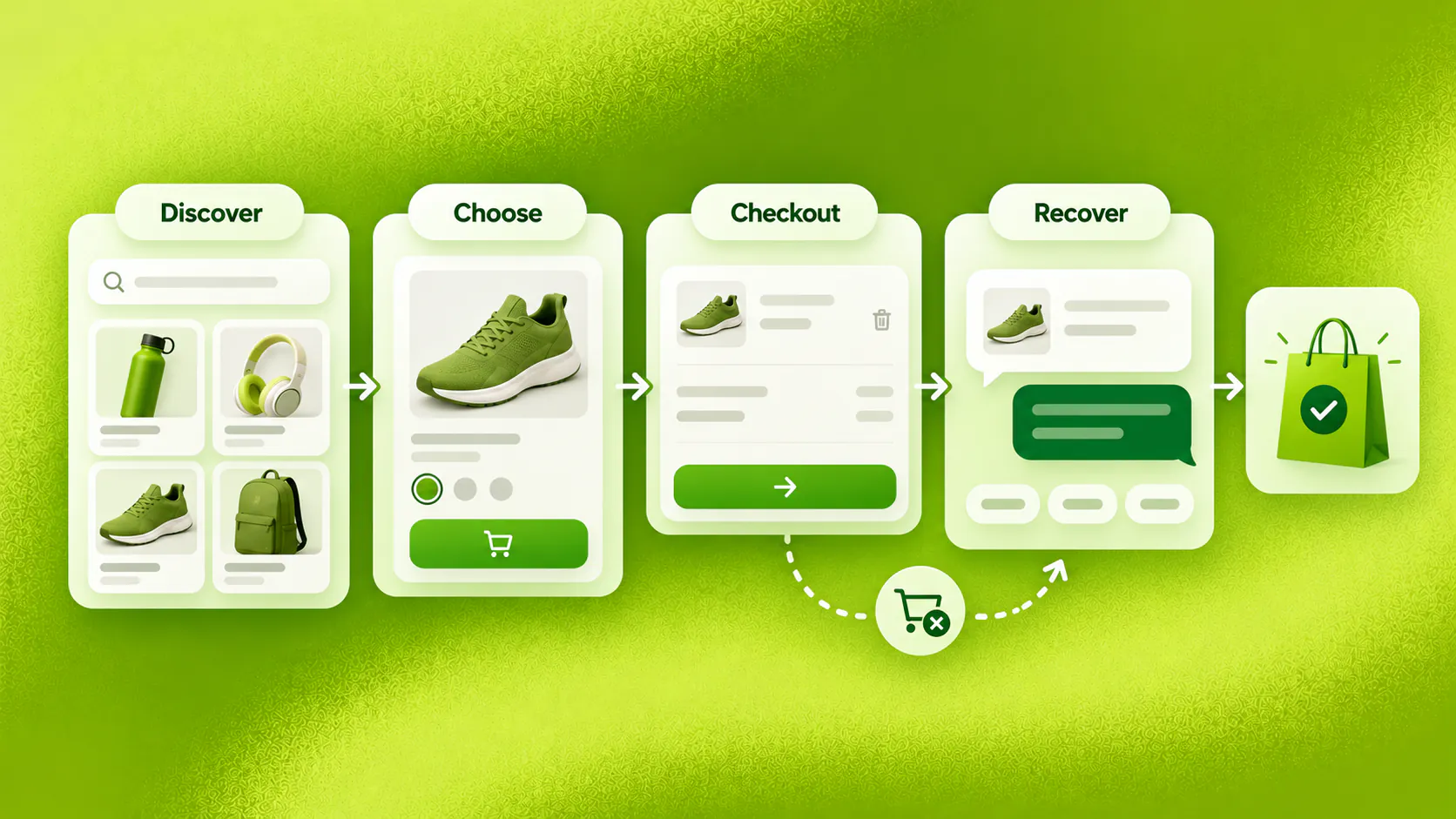
An ecommerce chatbot can help shoppers find suitable products, resolve questions that delay checkout, recover eligible incomplete carts and support order, return or exchange enquiries. It needs current catalogue and commerce data and should transfer exceptions with the cart or order context intact.
Key takeaways
- Start with the shopper's stated requirement and explain why a product or path is relevant.
- Use current connected data for stock, price, delivery, orders, returns and completed actions.
- Cart recovery should address the reason for hesitation instead of automatically sending a discount.
- Measure completed shopping and service tasks alongside unresolved questions and failed actions.
What does an ecommerce chatbot change for a shopper?
An ecommerce chatbot helps a shopper resolve the uncertainty between browsing and buying. It can answer product questions, narrow suitable options, explain delivery or return information and continue towards checkout or a person.
Consider an illustrative shopper comparing two products for a specific use. The product pages list many features but do not explain which differences matter. A useful conversation asks one clarifying question, compares current approved attributes and explains the return condition. It does not claim a perfect match or invent a discount.
After purchase, the same conversational entry point may support order status, returns or exchanges when the implementation can retrieve the correct order context. The customer should not have to repeat everything when staff take over.
Related must-read articles
- What is a chatbot?
- Chatbot examples for sales and service
- Customer retention chatbot guide
- Conversational AI in ecommerce
- Abandoned-cart recovery workflow
Why do ready shoppers leave without buying?
Shoppers abandon journeys for more than price. They may be uncertain about size, fit, compatibility, ingredients, delivery, payment, returns or whether another option is more appropriate. A generic reminder that repeats the cart does not resolve those concerns.
An ecommerce chatbot can help at the moment the question appears, provided it has accurate information and a clear next step. The conversation should distinguish between:
- A shopper who needs product information
- A shopper comparing options
- A shopper blocked by checkout or payment
- A shopper who needs delivery clarity
- A customer returning to an existing order
- A person asking for staff help
Treating every visitor as an abandoned-cart target creates noise rather than assistance.
How can conversational product discovery work?
The ecommerce chatbot should begin with the shopper’s own requirement. Ask about intended use, size, compatibility, budget or another relevant preference only when it changes the options shown.
A useful discovery flow:
- Understand the intended use. Let the shopper describe the need naturally.
- Ask one decisive question. Narrow the catalogue without creating a survey.
- Use approved product attributes. Retrieve current information from the responsible source.
- Explain the shortlist. Show why each option matches the stated criteria.
- Continue the journey. Move to the product page, checkout or staff help.
Do not infer sensitive traits or hide sponsored priorities inside an unexplained recommendation. The ecommerce industry page provides ZINQ context for supported shopping and service journeys.
Which questions should the chatbot answer before checkout?
An ecommerce chatbot can support questions about product details, stock, price, delivery, payment, return eligibility and warranty when the information comes from current responsible systems.
Static content should not be presented as live data. If availability varies by size, location or time, retrieve the relevant state or say that confirmation is required. If a promotion has conditions, explain them rather than creating false urgency.
Teams should review unanswered questions because they reveal missing product information and recurring purchase barriers. The knowledge layer should make those gaps visible to the responsible owner.
How should checkout assistance work?
The conversation can explain supported payment or delivery options, restore a checkout path and route technical or policy exceptions. It should not ask customers to share full payment credentials in chat.
If the ecommerce chatbot performs an action, such as applying an eligible code or updating a supported cart field, the commerce system should confirm the result. The customer should see whether the action completed, remains pending or needs staff help.
Use the workflow layer and connectors to define which system provides the authoritative status.
How should abandoned-cart recovery differ from a reminder?
Cart recovery works when it addresses the reason the shopper stopped. An eligible follow-up can ask whether help is needed, answer a product or policy question and restore the relevant path.
An ecommerce chatbot should not assume that discounting is the answer. The shopper may need delivery clarity, another size, a different payment route or no further contact.
Define:
- Which incomplete journeys are eligible
- What consent and channel rules apply
- When the message should stop
- How purchase completion suppresses further reminders
- How opt-outs are processed
- Who owns replies and exceptions
- Whether discounts require approval
The campaigns and broadcasts use case can support permitted first-party outreach. It does not imply paid-ad management.
Can the chatbot support repeat purchase and win-back?
For suitable categories, a customer may value replenishment, back-in-stock, product-update or repeat-purchase communication. The ecommerce chatbot can answer questions and continue towards a relevant order when the contact is appropriate and permitted.
Use known customer context carefully. Purchase history can help identify a relevant journey, but it should not become intrusive profiling. Exclude completed, suppressed and opted-out contacts. Give customers an easy way to change preferences.
The win-back and re-engagement use case provides the operating context for structured recovery without contacting every dormant record identically.
How can it support orders, returns and exchanges?
After appropriate verification, an ecommerce chatbot may retrieve supported order status, explain current return or exchange steps and collect the initial details for a service request.
Different exceptions need different ownership:
- A delayed delivery may require carrier or fulfilment review
- A missing item may need order investigation
- A damaged product may require evidence and staff assessment
- A cancellation may depend on fulfilment status
- A refund may require confirmation from the commerce or payment system
Do not describe a refund, replacement or cancellation as complete until the responsible system confirms it. See the customer service use case for owned service paths.
When should a person step in?
Transfer when the shopper asks, the question exceeds approved information, an exception requires judgment, a connected action fails or the business needs to make a discretionary decision.
The employee should receive the stated need, relevant product or cart context, order reference after appropriate checks, information already collected and the action attempted. The human handoff capability should prevent the customer from restarting the conversation.
How do you measure ecommerce chatbot value?
Measure the shopping or service outcome:
- Product questions answered from approved information
- Shoppers who reached a relevant product path
- Checkout issues resolved
- Eligible carts that resumed or completed
- Order-status requests completed correctly
- Returns or exchanges routed with usable context
- Unanswered questions and knowledge gaps
- Failed connected actions
- Transfers and time to staff ownership
The analytics layer can help teams review supported journey stages. Do not attribute revenue or advertising performance without a verified measurement setup.
What should you test before launch?
Test the ecommerce chatbot with unavailable products, changed prices, split shipments, invalid order details, expired promotions, duplicate messages, return exceptions and a direct request for a person. Use mobile and desktop experiences and include customers who refuse optional data.
Review whether merchandising, ecommerce operations and service teams can see and own the resulting work in the omnichannel inbox.
What is a sensible first ecommerce use case?
Choose a high-friction journey with current data and a visible result. Product discovery may fit when shoppers repeatedly ask similar comparison questions. Checkout support may fit when policy or delivery uncertainty is common. Order status may fit when the required systems are reliable.
The first ecommerce chatbot journey should solve one meaningful barrier, recover failures and give a person clear ownership. Expand after reviewing real shopping conversations rather than copying a generic retail feature list.
Who should own the shopping conversation?
An ecommerce chatbot sits across merchandising, ecommerce operations, marketing and customer service. Assign ownership by outcome instead of letting every team assume another group will repair the failure.
Merchandising should own product attributes and comparison rules. Ecommerce operations should own checkout, stock and order connections. Marketing should own permitted outreach, audience rules and promotional accuracy. Customer service should own exceptions, returns and complaints that need a person.
Create one review process for questions that the ecommerce chatbot could not answer. Some gaps require a better catalogue field, some need clearer policy content and others reveal a workflow problem. Treating every gap as a copy change hides the real cause.
Share those findings with the team that can correct the source, policy or fulfilment process, then confirm the revised answer against a realistic shopper question.
Record who owns each correction and its review date, so recurring gaps do not remain unresolved.
When products, prices, promotions, delivery promises or return terms change, retest the affected journeys. The ecommerce chatbot should not keep recommending an unavailable option or repeating a campaign after the shopper has purchased, opted out or entered staff support.
Additional resources
- Ecommerce customer operations
- Cart recovery
- Product discovery
- Order tracking and support
- Returns and exchanges
- Book a ZINQ demo
Frequently asked questions
What does an ecommerce chatbot do?
It supports conversational product discovery, product and policy questions, checkout, permitted cart recovery, order status and service-request intake.
Can an ecommerce chatbot recommend products?
It can narrow products using the shopper's stated requirements and approved catalogue attributes. It should explain the basis, avoid sensitive inference and use current availability information.
Can a chatbot recover abandoned carts?
It can support eligible follow-up, restore the checkout path and answer the question that stopped progress. It should respect consent, opt-outs, frequency and completion status.
Conclusion
An ecommerce chatbot should remove a real shopping obstacle and confirm the next step through current commerce systems. Useful product guidance, responsible recovery and contextual service matter more than adding another promotional widget.
READY TO SEE ZINQ IN ACTION?
From first enquiry to conversion, follow-up and support, ZINQ helps automate the next step while keeping your team in control.
Book a DemoAdditional resources
-
What Is a Chatbot? Business Uses and Examples
A chatbot is software that holds a text or voice conversation with a person. Businesses use one to answer common questions, collect information, guide a customer through a defined task and bring in a person when the request needs judgment.
The ZINQ team · October 30, 2026 · Comparisons & Guides -
Chatbot Examples for Sales and Customer Service
Useful chatbot examples solve a defined customer task, such as qualifying an enquiry, finding a suitable product, requesting an appointment, checking an order or preparing a support handoff. The strongest examples end with a visible outcome rather than an automated reply alone.
The ZINQ team · October 30, 2026 · Comparisons & Guides -
Customer Retention Chatbot: Re-engagement and Win-Back
A customer retention chatbot supports permitted onboarding, renewal, repeat-purchase, feedback and win-back conversations with existing customers. It uses known context to offer a relevant next step, records the response and routes exceptions without treating every inactive customer as the same.
The ZINQ team · October 30, 2026 · AI Chatbots