Conversational AI for Ecommerce
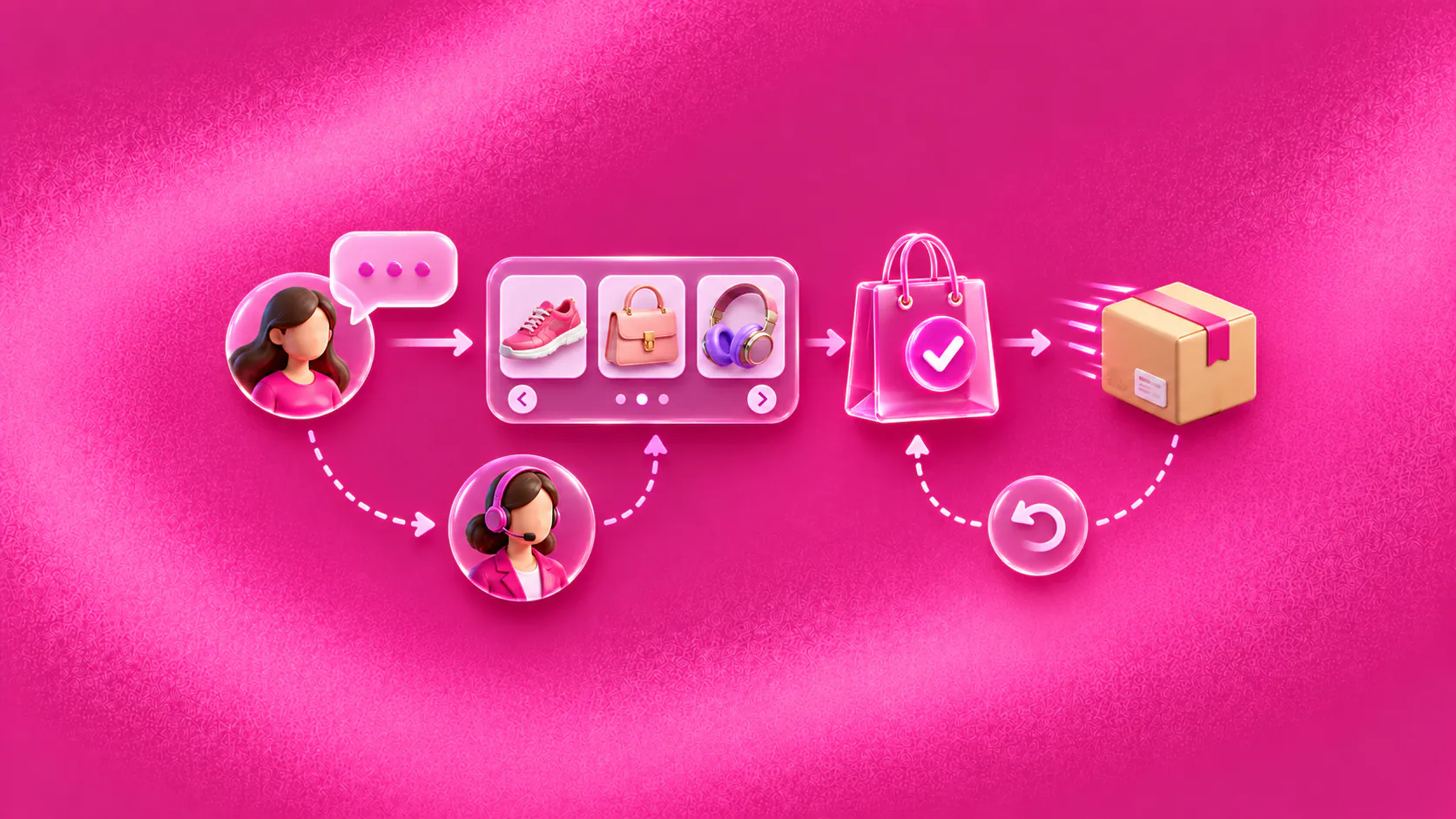
Conversational AI in ecommerce can help shoppers discover products, answer approved questions, check orders, start returns, recover carts and reach support. Reliable systems ground answers in catalogue and policy data, confirm connected actions and preserve context when a person takes over.
Key takeaways
- Connect product answers to current catalogue, inventory and policy sources rather than model memory.
- Treat recommendations as guided discovery and keep price, availability and eligibility verifiable.
- Confirm order, return and cart actions through the relevant commerce system.
- Measure completed shopping or service outcomes, corrections and handoff quality.
What is conversational AI in ecommerce?
Conversational AI in ecommerce helps shoppers and customers use ordinary language to find information, explore products and complete service tasks. It can operate through web chat, messaging applications, email and other supported channels.
The useful result comes from connections to current commerce data. A model may understand that “something waterproof for a three-day hike” is a product-discovery request, but catalogue attributes, inventory, price and delivery estimates must come from authoritative systems.
That distinction separates a helpful ecommerce AI chatbot from a fluent interface that invents product facts or promises an action it did not complete.
Related must-read articles
How can it support product discovery?
Product discovery begins with the shopper’s stated need. Conversational AI in ecommerce can ask about intended use, preferred features, size, budget or delivery requirement, then retrieve matching items from the catalogue.
The assistant should explain why an item appears. “This jacket matches your waterproof and packable requirements” is more useful than a generic “best choice” label. It should also expose uncertainty when catalogue attributes are incomplete.
Do not generate claims that are absent from approved product data. Suitability for health, safety or regulated uses may require stronger controls or a person. The product-recommendation guide explores this workflow in more detail.
How should product questions be answered?
Customers ask questions that span product specifications, fit, compatibility, materials, care, delivery and returns. Build a source hierarchy:
- product and variant records for structured facts;
- approved product documentation for detailed explanations;
- current policy sources for delivery, returns and warranties;
- a human route when the answer cannot be verified.
Conversational AI in ecommerce should state which variant or market an answer applies to. A policy may differ by location, product category or purchase date. Asking one clarifying question is safer than giving a broad answer that does not fit the order.
How does order support work?
For an order-status request, the system needs to locate the order through the retailer’s approved verification process, call the order or fulfilment system and return the current state.
A useful answer includes what is known and what happens next. If an order is delayed, the assistant can explain the approved process and offer available actions. It should not invent a delivery time because the customer wants certainty.
The order-tracking workflow and customer-support guide provide additional detail on verified status and exception ownership.
Can conversational AI handle returns and exchanges?
Conversational AI in ecommerce can explain the approved return policy, collect the order and item, check eligibility and start a permitted return or exchange.
The workflow should distinguish a policy answer from an eligibility decision. General content might say that most unworn items can be returned within a stated period. The order system decides whether this item and purchase meet the configured rules.
Exceptions such as damaged goods, missing items, final-sale products or conflicting records need a staff route. The returns and exchanges guide covers those decision points.
How should cart recovery work?
Cart follow-up should be helpful, consent-aware and tied to current cart state. A message may remind the shopper, answer a product question or make it easy to continue. It should stop when the purchase completes, the cart expires or the customer opts out.
Conversational AI can respond to the reason for hesitation. If the shopper asks about delivery, it can consult current policy and location information. If an item is unavailable, it can show an appropriate alternative from the catalogue rather than repeatedly promoting the original cart.
Avoid claiming that a conversation caused a sale without an appropriate attribution method. The cart-recovery page shows the workflow context.
What does an end-to-end scenario look like?
Imagine a shopper looking for running shoes under a stated budget that are available for delivery this week. The assistant asks for size and intended surface, then retrieves products whose structured attributes match.
The shopper selects one and asks whether it is in stock. The system checks the selected size and delivery postcode. It adds the exact variant to the cart only after confirmation.
Later, the shopper messages about the delivery. The system verifies the order and returns the current fulfilment state. If the carrier feed is unavailable, it creates a support case with the order reference instead of generating an estimate.
This scenario shows how conversational AI in ecommerce can span discovery and service while using different authoritative systems at each stage.
How do channels affect the experience?
Web chat is useful during product browsing because it can use page and cart context. Messaging applications support follow-up and order service, subject to current channel policies and consent. Email suits longer confirmations and asynchronous cases.
Preserve the workflow state across channels without assuming identity. An anonymous web visitor and a WhatsApp contact may be the same person, but order details should require the retailer’s verification process.
The omnichannel guide explains continuity, and ZINQ’s omnichannel inbox provides the operating view for teams.
Which controls matter most?
Use minimum system permissions and validate every action. Separate read access for product or order information from write access for cart, case or return operations.
Set boundaries for generated language. Product descriptions may be transformed for clarity, but price, availability, compatibility, eligibility and delivery status should remain grounded in current data.
Protect customer and order information. Define identity verification, access, retention and transcript rules with the appropriate security, privacy and legal stakeholders.
What should ecommerce teams measure?
Choose metrics by workflow:
- Successful product matches followed by a useful action;
- Product-answer corrections and missing catalogue attributes;
- Verified order-status completions;
- Return or exchange actions accepted by the commerce system;
- Failed integrations and recovery time;
- Repeated contacts about the same order;
- Handoffs reaching the right queue with context;
- Assisted conversion using a documented attribution method.
Read conversation samples with the numbers. A high click rate may hide irrelevant recommendations, and a low handoff rate may hide a difficult path to staff.
How should the first ecommerce workflow launch?
Choose one bounded task, such as order status for one market or product discovery in one category. Document data sources, permissions, completion evidence and exception ownership.
Test stale inventory, missing attributes, split shipments, invalid order references, unavailable integrations, policy exceptions and direct requests for a person. The implementation guide provides a staged approach.
ZINQ’s ecommerce industry page connects product discovery, support and follow-up with the wider platform. Its workflow layer can keep catalogue reads, order lookups and permitted service actions separate. Conversational AI in ecommerce should make each next step easier to verify, not merely easier to describe.
What should an ecommerce readiness audit check?
Sample products across categories and verify variants, attributes, inventory, price, delivery rules and policy links. Conversational AI in ecommerce cannot compensate for contradictory commerce data.
Map each intent to its system of record. Product facts may come from the catalogue, delivery status from fulfilment, return eligibility from the commerce platform and exceptions from support. Avoid copying live values into static knowledge.
Test an out-of-stock variant, a price change during checkout, split shipments, an incorrect order reference, a return outside ordinary rules, market-specific promotions, duplicate contacts and an early request for staff.
Review merchandising and service language separately. A product explanation can be persuasive, but order status must be exact. Set stricter generation boundaries for price, availability, compatibility and policy.
Use failures to improve the store. Repeated product questions may reveal missing attributes; repeated delivery questions may reveal unclear notifications. Conversational AI in ecommerce creates more value when conversation evidence improves catalogue and service operations too.
Frequently asked questions
How is conversational AI used in ecommerce?
It can support product discovery, product questions, order status, returns and exchanges, cart follow-up, delivery enquiries and support routing across supported channels.
Can an ecommerce chatbot recommend products?
It can ask about stated needs and retrieve suitable catalogue items. Recommendations should use current product attributes and avoid unsupported claims about suitability.
Can it process returns?
It can explain approved policy, collect the order and item, check eligibility through a connected system and start a return when permitted. Exceptions should go to staff.
How should ecommerce AI be measured?
Track verified product discovery, completed service tasks, action failures, correction rates, repeat contacts and assisted conversion with an appropriate attribution method.
Conclusion
Conversational AI in ecommerce is most useful when it connects shopper language to current product data and a confirmed next step. Keep recommendations grounded, actions traceable and exceptions easy to hand to a person.
READY TO SEE ZINQ IN ACTION?
From first enquiry to conversion, follow-up and support, ZINQ helps automate the next step while keeping your team in control.
Book a DemoAdditional resources
-
Ecommerce AI Agent: Before and After Checkout
An ecommerce AI agent helps shoppers move from product questions to a verified next step by using approved catalogue and policy information, checking connected order data, taking permitted actions and routing exceptions to the right team.
The ZINQ team · October 7, 2026 · Industries → Ecommerce -
How AI Product Recommendations Help Ecommerce Shoppers Choose
AI product recommendations help ecommerce shoppers narrow a large catalogue into a few relevant options. A conversational product discovery workflow asks what the shopper needs, retrieves suitable products from approved catalogue information, explains each recommendation, and helps the shopper continue toward purchase.
Shubham · September 18, 2026 · Industries → Ecommerce -
How to Automate Ecommerce Returns and Exchanges With AI
AI can support ecommerce returns and exchanges by verifying the order, collecting the item and reason, explaining approved policy rules, and identifying the next step. Refund approval, damaged-item decisions, policy exceptions, and unsupported actions should move to an accountable team member.
Shubham · September 18, 2026 · Industries → Ecommerce