Ecommerce AI Agent: Before and After Checkout
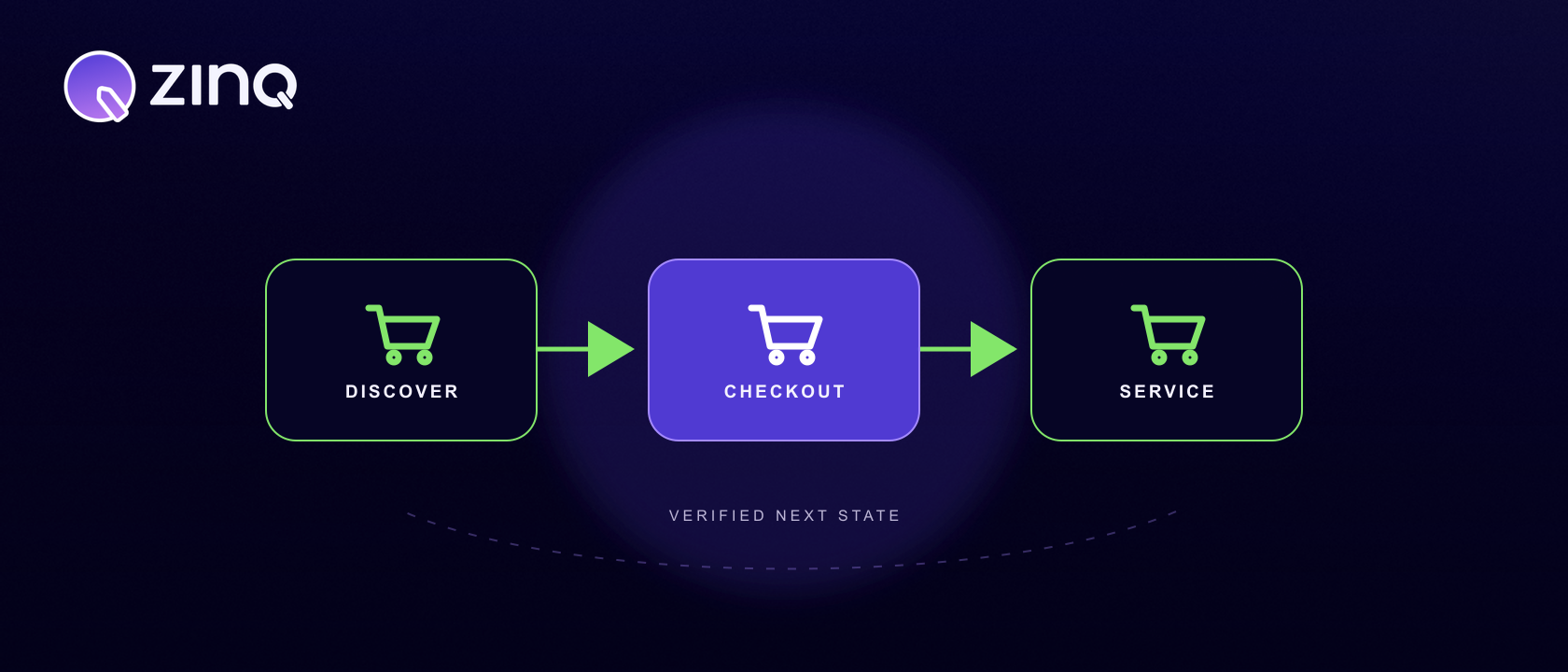
An ecommerce AI agent helps shoppers move from product questions to a verified next step by using approved catalogue and policy information, checking connected order data, taking permitted actions and routing exceptions to the right team.
Key takeaways
- Separate catalogue answers, live order lookups and actions because each needs different data and permission.
- Treat checkout, refund, return and replacement states as confirmed only when the source system reports success.
- Use stop rules so follow-up ends when a customer purchases, replies, opts out or enters support.
- Route policy exceptions and high-friction cases with the context already collected.
What does an ecommerce AI agent do?
An ecommerce AI agent connects a shopper’s question to a defined commerce workflow. Before checkout, that may mean narrowing a catalogue, explaining approved product details or finding the right policy. After checkout, it may mean checking an order state, collecting return details or routing an exception.
People often search for an ecommerce chatbot because the visible problem is conversation. The harder problem sits behind it: product information changes, inventory is live, orders have states, and some actions change money or fulfilment. A credible agent must know which source to consult, what it may change and when a person owns the decision.
The goal is not to automate every message. It is to make a useful next state—an appropriate product set, a confirmed order update, an eligible return request or an owned handoff—clear to both customer and team.
How should the journey be divided?
Different moments require different evidence and permissions.
| Journey stage | Typical customer intent | Reliable completion signal |
|---|---|---|
| Discovery | Find a product for a stated need | Relevant products returned from current catalogue data |
| Decision | Check size, compatibility, delivery or policy | Answer tied to an approved source or live lookup |
| Checkout | Resolve friction or recover a cart | Customer completes purchase or declines follow-up |
| Order service | Track, change or question an order | Commerce or fulfilment system returns the current state |
| Return or exchange | Start an eligible request | Returns system creates and confirms the request |
| Exception | Request falls outside rules | Named queue or person accepts ownership |
Do not combine those signals into “conversation resolved.” A shopper who receives a tracking explanation but still cannot find the parcel has not reached the same outcome as someone whose delivery state was verified.
ZINQ for ecommerce can support approved product information, discovery, configured cart and post-purchase workflows, retention communication and human handoff. The exact action depends on the connected system, business rules and permission model.
Why do knowledge, live data and actions need separate controls?
Catalogue copy and return policy are knowledge. Current stock, delivery status and customer-specific order details are live data. Cancelling an order, creating a return or changing an address is an action. Each layer creates a different failure mode.
An old product page can produce a wrong answer. A delayed inventory feed can imply stock that is no longer available. An action without confirmation can cause the agent to promise a cancellation that never occurred. Define a source hierarchy, freshness expectation and failure response for each layer.
Knowledge should contain owned, approved material. Connected systems expose the states and actions a workflow is allowed to use. If a connection fails, the agent should name the limitation, avoid guessing and create an owned recovery path.
Use least privilege. A discovery workflow may need read access to product attributes and availability, not permission to issue a refund. An order-status workflow may read fulfilment events but not change the delivery address. Smaller permissions reduce both accidental actions and testing complexity.
A hypothetical shopper journey
Imagine a shopper asks on web chat for a waterproof bag that fits a 15-inch laptop and can arrive before Friday.
The agent collects the important constraints and filters current catalogue data. It returns a small set with the attributes that match, then checks delivery availability for the shopper’s location. The shopper asks whether one bag is covered by the returns policy. The answer comes from the approved policy source, not a general assumption about ecommerce returns.
The shopper purchases. Two days later, they ask in WhatsApp for the order status. With an appropriate identity check, the agent reads the current fulfilment state and shares it. If the carrier state is delayed beyond the merchant’s defined threshold, the workflow creates a support handoff rather than repeating the same tracking line.
This is a hypothetical example. Its value is the state transition: discovery uses product data, delivery uses a live lookup, and the exception has an owner. The conversation can move across channels only if identity, context and system records remain coherent.
How should product discovery work?
Begin with attributes shoppers actually use: intended use, size, compatibility, budget, colour, material, delivery constraint or another category-specific factor. Ask only the questions that materially narrow the set.
Return a manageable choice with a reason for each result. “This fits your stated device size and delivery window” is more useful than a long list labelled “recommended.” If an attribute is missing or ambiguous, say so. The agent should not turn persuasive copy into a factual compatibility claim.
Product recommendation quality depends on catalogue hygiene. Standardise attributes, remove stale items, define availability fields and identify which variants can substitute for one another. A sophisticated conversation layer cannot repair an unreliable catalogue at answer time.
Include a clean path to a person for high-consideration products, unusual compatibility questions or shoppers who want advice beyond the approved product facts. Preserve the filters and products already discussed so the team can continue instead of restarting discovery.
How should order support and returns work?
For “where is my order?” requests, distinguish the merchant’s order state from the carrier’s event and the customer-facing explanation. Show the most current verified status available. If an event is stale or contradictory, route the case according to the merchant’s support rules.
Returns require policy evaluation and system confirmation. Collect the order, item, reason and any evidence the policy requires. Check eligibility against the current rule set. If eligible and permitted, create the request and share the returned reference or status. If the request is outside policy, do not invent an exception; send it to the authorised team.
Refund language needs equal care. “Your request has been submitted” and “your refund has been issued” represent different states. Match the customer message to the state returned by the source system.
What should proactive follow-up do?
Every outbound sequence needs a trigger, purpose, permitted audience and stop rule. A cart reminder may start after a qualifying checkout event. It should stop when the shopper purchases, replies, opts out, the product becomes unavailable or a support conversation takes ownership.
Separate service messages from promotional campaigns. An order update requested by a customer is not the same as a marketing message. Apply the relevant channel rules, consent choices and business policy to each workflow rather than treating a captured contact as blanket permission.
Avoid repeated nudges that ignore the reason a purchase did not happen. If a shopper reports a payment error or shipping restriction, continuing the same cart sequence creates friction. Route the underlying issue or suppress the campaign until it is resolved.
How should performance be measured?
Choose metrics that match the workflow. Discovery may use the share of eligible conversations that reach a product view, cart or owned sales handoff. Order support may use verified answers, exception rate, tool failures and time to human ownership. Returns may use requests created, policy exceptions and incomplete submissions.
Always keep the denominator. Ten automated returns mean little without the number of eligible return conversations. Segment by intent and failure reason so a rise in handoff can be understood: it may indicate poor knowledge, a broken integration or a genuine increase in policy exceptions.
Review conversations as well as dashboards. Check whether recommendations were supported by attributes, system states were described accurately, sensitive actions used confirmation and handoffs contained enough context. Conversation analytics helps find the pattern; operational reviewers decide whether the outcome was correct.
How should an ecommerce team start?
Select one workflow with steady volume, stable rules and a source system that can confirm completion. Map the happy path, then map unavailable stock, conflicting policy, unverified identity, tool timeout, duplicate request, customer change of mind and request for a person.
Build a test set from real customer language. Include model numbers, misspellings, ambiguous product names and messages containing two intents. Test read and write permissions independently. Verify that retrying an action cannot create a duplicate return, cancellation or customer record.
Launch with a named owner for every exception. Review early conversations frequently, record changes to sources and workflow rules, and expand only after the current journey reaches trustworthy states. Workflows should make those steps and recovery paths explicit.
When comparing vendors, ask for one complete demonstration before and after checkout. Require the difficult path: stale inventory, an ineligible return, a failed action and a customer who switches channel. The useful difference is not how fluent the agent sounds. It is whether the commerce state, permission and owner remain clear.
Frequently asked questions
What is an ecommerce AI agent?
An ecommerce AI agent supports a defined shopping or service workflow by using approved product and policy information, consulting connected systems, taking permitted actions and handing exceptions to a person.
Is it the same as an ecommerce chatbot?
A basic ecommerce chatbot may answer FAQs or follow a menu. An AI agent can also maintain context, use tools and work toward a product, order or service outcome, subject to configured permissions.
Can an ecommerce AI agent recommend products?
It can help shoppers narrow choices when product attributes, availability and recommendation rules are reliable. It should not invent fit, stock or compatibility when the underlying data does not support the answer.
Can it process returns or refunds?
It can collect the required details and trigger supported workflows when policy and system permissions allow. The commerce or returns system should confirm the resulting status before the agent promises an outcome.
Which ecommerce workflow should be automated first?
Start with a frequent, rules-based journey that has a verifiable end state, such as order tracking, product filtering or an eligible return request.
Conclusion
A useful ecommerce AI agent connects conversation to a trustworthy commerce state. The design work is deciding which source, permission, confirmation and human owner belong to each step before trying to cover the whole customer journey.
READY TO SEE ZINQ IN ACTION?
From first enquiry to conversion, follow-up and support, ZINQ helps automate the next step while keeping your team in control.
Book a DemoRelated articles
-
Abandoned Cart Recovery: A Practical Workflow for Ecommerce Stores
Abandoned cart recovery is the process of reconnecting with shoppers who added products to their cart but did not complete checkout. An effective cart recovery workflow identifies what stopped the purchase, answers the shopper’s questions, and gives them a clear path back to checkout.
Shubham · September 18, 2026 · Industries → Ecommerce -
How to Automate Order Tracking and Support With AI
An AI order-tracking workflow should verify the customer, retrieve the correct order, and explain the latest recorded status in clear language. When order data is unavailable, contradictory, or shows a delivery problem, the workflow should create an owned support request instead of guessing.
Shubham · September 18, 2026 · Industries → Ecommerce -
How to Automate Ecommerce Returns and Exchanges With AI
AI can support ecommerce returns and exchanges by verifying the order, collecting the item and reason, explaining approved policy rules, and identifying the next step. Refund approval, damaged-item decisions, policy exceptions, and unsupported actions should move to an accountable team member.
Shubham · September 18, 2026 · Industries → Ecommerce