Healthcare Chatbot for Patient Enquiries and Appointments
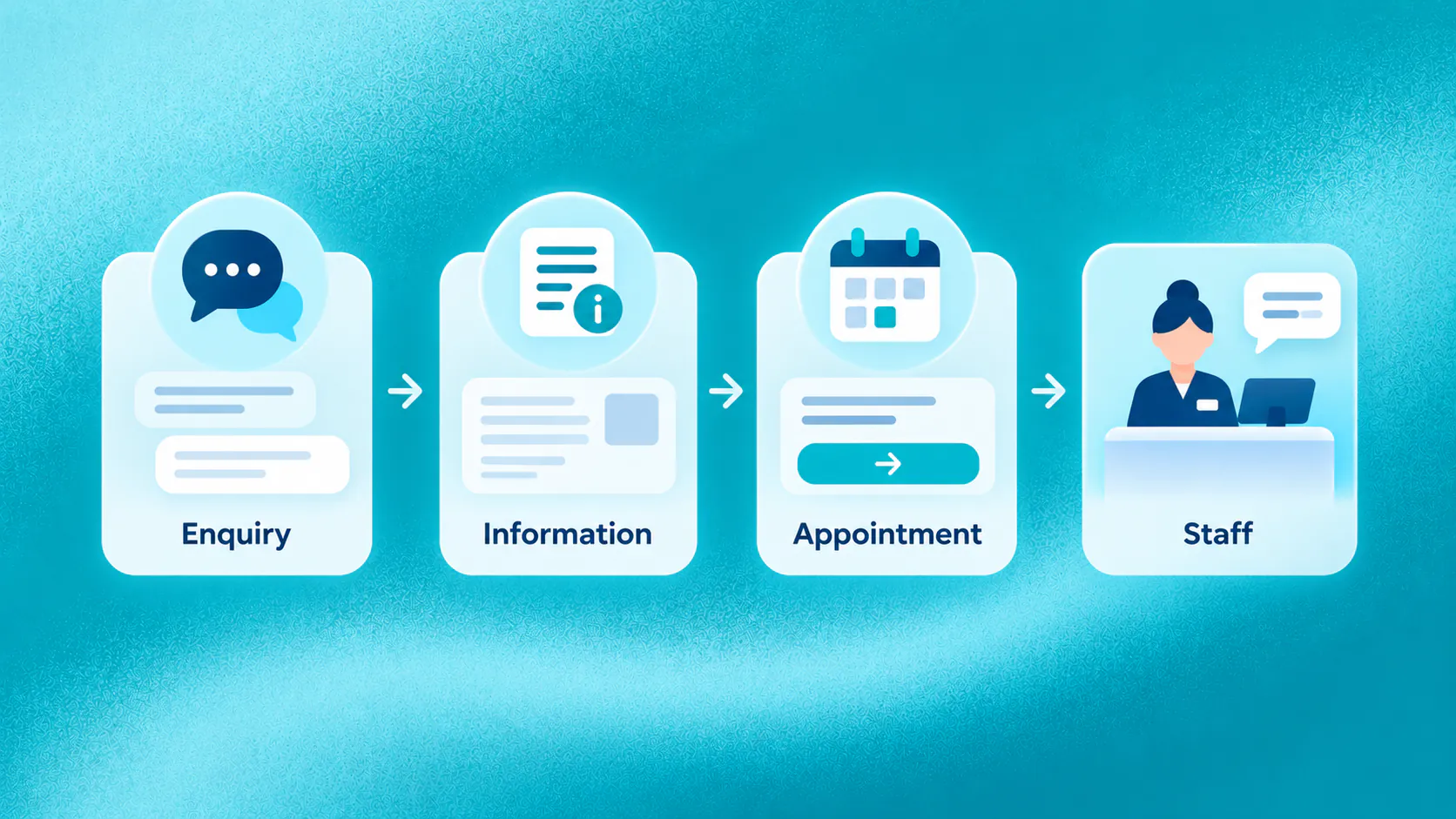
A healthcare chatbot can support approved non-clinical communication such as service information, administrative enquiry intake, appointment booking, reminders, rescheduling and status routing. Diagnosis, treatment selection, medication decisions, clinical prioritization and medical advice must remain with qualified professionals.
Key takeaways
- Use conversational automation for defined administrative work, not diagnosis or treatment decisions.
- Answer approved service and appointment questions while the prospective patient's intent is active.
- Confirm appointments through the responsible schedule and preserve requests that need staff review.
- Apply current jurisdiction-specific advertising, privacy, consent and professional requirements.
What role can a healthcare chatbot play in patient communication?
A healthcare chatbot can support defined administrative conversations before and after an appointment. It may explain approved public information, collect enquiry details, offer eligible appointment times, send permitted reminders and route requests to the appropriate team.
It must not diagnose, recommend treatment, prescribe, clinically prioritize or imply a medical outcome. Those decisions belong to qualified professionals working within the applicable legal and ethical framework.
Consider an illustrative prospective patient asking whether a clinic offers a service and whether a consultation is available on Saturday. A useful conversation can provide approved service information and check configured consultation availability. A question about individual suitability goes to qualified staff.
Related must-read articles
- What is a chatbot?
- Appointment booking chatbot guide
- Customer service chatbot guide
- Conversational AI for clinics
- Clinic appointment reminders
Where does clinic communication create avoidable friction?
Reception teams answer calls, help people at the desk, manage schedules and monitor digital enquiries. A new enquiry can arrive while staff are busy or after the clinic closes. By the time someone responds, the person may have contacted another provider or lost confidence in the process.
Common administrative gaps include:
- Unanswered service and consultation enquiries
- Missing service, location, timing or contact details
- Too much back-and-forth before a booking
- Booking links sent without follow-up when completion fails
- Enquiries routed to the wrong location or team
- Inconsistent confirmations, reminders and preparation information
- Difficult rescheduling or cancellation
- Patients repeating information during handoff
A healthcare chatbot can help with bounded parts of this work when the clinic has approved the information and assigned human ownership.
Which conversations can the chatbot support?
Approved service and appointment information
The healthcare chatbot can share clinic hours, locations, consultation steps, required administrative documents and approved public service information. It should clearly identify questions that need clinical staff.
Administrative enquiry intake
Collect the service of interest, preferred location, timing and contact details required for follow-up. Do not collect detailed medical information simply because the channel makes it easy.
Appointment booking
The conversation can identify an eligible appointment type, retrieve supported availability and offer a slot. It must distinguish a confirmed booking from a request awaiting clinic review. The appointment booking use case provides the operating context.
Reminders and rescheduling
Where permitted, the healthcare chatbot can send appointment confirmations, reminders and approved preparation information, then process simple rescheduling or cancellation requests. It should stop reminders after cancellation and route exceptions to reception.
Administrative status and support
After appropriate identity and authorization checks, the conversation may route report, referral, prescription-request or other administrative status questions. It should not interpret clinical results or advise what the patient should do medically.
How should the first patient enquiry work?
The first response should acknowledge the person’s stated question. Do not begin with a long form.
A practical administrative flow is:
- Understand the enquiry. Let the prospective patient describe the service or appointment need.
- Answer approved public questions. Explain the administrative process and available clinic information.
- Collect only necessary details. Ask about location, appointment type and timing when relevant.
- Offer an appropriate next step. Booking, reception follow-up or qualified clinical review may apply.
- Confirm the state. Make clear whether the appointment is booked, requested or transferred.
The healthcare chatbot should not ask a series of clinical questions to decide treatment suitability. When clinical judgment begins, a qualified person takes responsibility.
How should multiple clinic locations be handled?
Different locations may offer different services, staff and schedules. The healthcare chatbot should use current configured information and confirm the preferred location before presenting availability.
If the requested service is not available at that location, offer an approved alternative path without claiming that another clinic or service is clinically appropriate. Preserve the location, service and timing context when reception takes over.
The clinics industry page and multi-location clinic routing guide provide additional journey context.
How can reminders and missed appointments be handled responsibly?
Reminders can help patients remember an appointment and make changing it easier. They should use an appropriate channel, permitted timing, minimum necessary information and clear options to confirm, reschedule or cancel.
After a missed appointment, the conversation may offer an administrative rebooking path where appropriate. It should not pressure the person, disclose sensitive details or infer a clinical reason for the absence.
Use the no-show recovery use case to define the administrative workflow and human owner.
What should never be automated as a routine chat decision?
Keep these activities outside the chatbot’s authority:
- Diagnosis or symptom interpretation
- Treatment or procedure selection
- Medication advice or changes
- Clinical triage or urgency decisions
- Individual prognosis or expected outcomes
- Clinical consent decisions
- Interpretation of reports or test results
- Emergency guidance beyond an approved immediate safety route
If a message suggests an emergency or urgent clinical concern, follow the clinic’s approved escalation language and direct the person to the appropriate emergency service or qualified team. Do not improvise medical advice.
When should a person step in?
Transfer when the patient asks, the question is clinical or sensitive, the identity check fails, the booking needs judgment, a connected action fails or the information is uncertain.
The receiving person should see the administrative reason for contact, service and location requested, details already collected, action attempted and current status. The human handoff capability should reduce repetition while limiting access to appropriate staff.
What consent, privacy and advertising checks matter?
Healthcare communication is regulated differently across jurisdictions. Before launch, obtain the appropriate legal, privacy, medical-ethics and professional review for the target geography.
Confirm:
- Which information may be collected in each channel
- How consent and privacy notices are presented
- Which staff roles may access the conversation
- How long information is retained
- Whether promotional or re-engagement messages are permitted
- How opt-outs and communication preferences are applied
- Which claims about services, professionals or outcomes are prohibited
Do not assume that a tactic permitted in one country is acceptable in another.
How do you measure administrative value?
Measure whether the healthcare chatbot helped the patient reach an appropriate administrative next step:
- Enquiries receiving an approved first answer
- Complete appointment requests
- Confirmed bookings and reschedules
- Requests routed to the correct location or team
- Abandoned booking journeys
- Repeated administrative questions
- Transfers with usable context
- Failed calendar or messaging actions
- Time until staff own an exception
The analytics layer should support operational review without treating message volume as a patient outcome.
What should you test before launch?
Test unclear service names, multiple locations, unavailable schedules, a direct clinical question, identity-sensitive requests, cancellation, rescheduling, a failed calendar and a request for a person. Review every script with the responsible clinic and compliance owners.
The first healthcare chatbot journey should remain narrow. Administrative appointment enquiries are often easier to govern than broad patient communication. Expand only after the clinic can maintain information, recover failures and preserve clinical boundaries consistently.
How do clinic types change the administrative journey?
A healthcare chatbot needs a different scope for a general clinic, dental practice, diagnostic centre, aesthetic clinic or multi-specialty provider. The words may sound similar, but the booking rules, preparation information, locations and responsible staff can differ.
For example, a dental enquiry may need an approved consultation route without diagnosing the cause of pain. A diagnostic-centre conversation may explain administrative preparation information that the centre has approved, but it must not interpret results. An aesthetic-clinic enquiry may ask about suitability or outcomes; the healthcare chatbot should route those questions to qualified staff rather than make promotional clinical claims.
Document which appointment types the healthcare chatbot can offer, which information it may collect and which phrases trigger a clinical handoff. Multi-specialty clinics also need clear ownership when a patient is uncertain which department applies.
Who should own the system after launch?
Reception or operations may own administrative flow, but clinical and compliance owners must approve boundaries and public information. Assign separate responsibility for schedules, service descriptions, privacy controls and escalation language.
Review conversations for incorrect routing, repeated questions, over-collection and requests that should have reached a person sooner. A healthcare chatbot should become narrower when evidence reveals risk, not broader simply because it can generate an answer.
Retest after a schedule, location, service, consent process or communication rule changes. The healthcare chatbot remains useful only while its administrative information and human routes remain current.
Document the healthcare chatbot review date so clinic teams know when public and administrative information was last verified.
Additional resources
- ZINQ for clinics
- Clinic appointment booking
- Clinic lead intake
- Appointment booking
- Human handoff
- Book a ZINQ demo
Frequently asked questions
What can a healthcare chatbot do?
It can support approved administrative information, enquiry intake, appointment requests, confirmations, reminders, rescheduling and routing to appropriate staff.
Can a healthcare chatbot recommend treatment?
No. Diagnosis, treatment selection, medication decisions, clinical prioritization and medical advice remain with appropriately qualified professionals.
Can a chatbot book a clinic appointment?
Yes, when the clinic defines eligible appointment types, required administrative information, current availability, connected-calendar confirmation and exception handling.
Conclusion
A healthcare chatbot should remove administrative friction while keeping the boundary around clinical judgment unmistakable. Begin with one approved patient journey, verify current local requirements and give sensitive or uncertain requests a direct human route.
READY TO SEE ZINQ IN ACTION?
From first enquiry to conversion, follow-up and support, ZINQ helps automate the next step while keeping your team in control.
Book a DemoAdditional resources
-
What Is a Chatbot? Business Uses and Examples
A chatbot is software that holds a text or voice conversation with a person. Businesses use one to answer common questions, collect information, guide a customer through a defined task and bring in a person when the request needs judgment.
The ZINQ team · October 30, 2026 · Comparisons & Guides -
Appointment Booking Chatbot: Scheduling and Confirmation
An appointment booking chatbot turns an enquiry into a confirmed slot by identifying the requested service, collecting the minimum required details, checking authorised availability and recording the booking in the connected system. If confirmation is unavailable, it should create a pending request and set an honest expectation.
The ZINQ team · October 30, 2026 · Sales & Conversion -
Customer Service Chatbot: Use Cases, Benefits and Handoffs
A customer service chatbot can improve support by answering routine questions, collecting issue details, retrieving authorised status information and routing exceptions with context. It becomes a dead end when it blocks human help, uses outdated information or claims an action succeeded without confirmation.
The ZINQ team · October 30, 2026 · Customer Support & CX