AI Voice Bot vs AI Voice Agent: What’s the Difference?
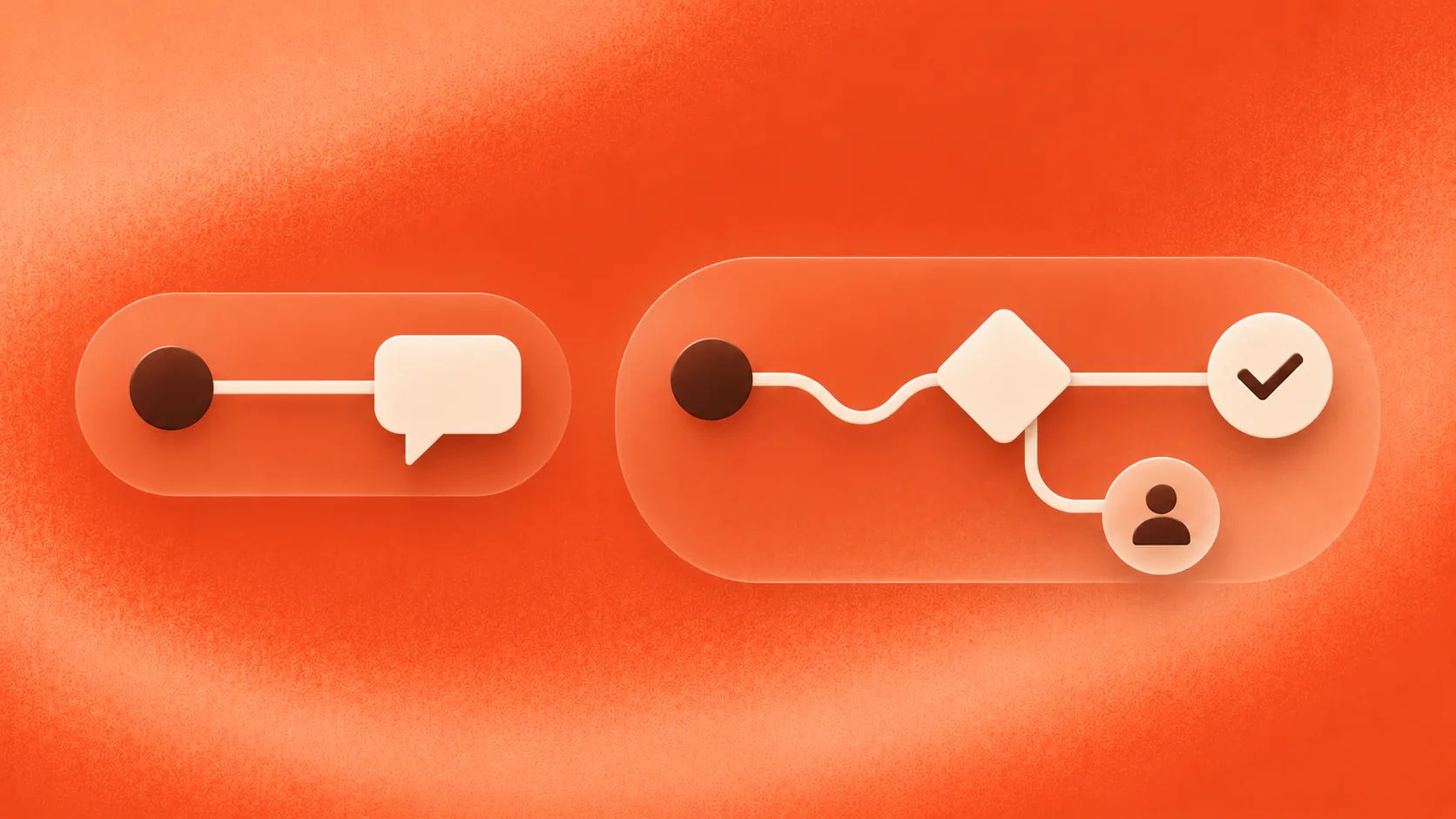
An AI voice bot usually answers or routes within a limited conversation, while an AI voice agent is expected to manage context and use connected tools to move a customer task toward completion; vendors use both labels loosely.
Key takeaways
- Product labels are inconsistent, so compare observable behaviour rather than the name.
- A bot may answer and route; an agent should carry context into a bounded action or handoff.
- Connected actions need confirmation from the responsible system.
- Both need clear knowledge, permissions, failure recovery and human ownership.
What is the difference between an AI voice bot and an AI voice agent?
An AI voice bot usually handles a limited spoken exchange: answer a common question, collect a detail or route the call. An AI voice agent is expected to retain more context and use connected tools to move a customer task toward a confirmed action or informed human handoff.
That distinction is useful, but it is not a standard. Vendors use “bot,” “assistant” and “agent” in different ways. A product called a bot may complete actions; a product called an agent may only answer questions. Compare the work the customer can finish, not the label on the page.
For the category definition, see what an AI voice agent is. For the narrower first-contact role, see what an AI receptionist does. The ZINQ Voice channel is the commercial product owner.
Related reading
- Knowledge-based AI agents vs scripted chatbots
- What is a conversational AI agent?
- How conversational AI works
- Where people remain in control
- Guardrails for customer conversations
Compare behaviour across the whole call
The quickest comparison is to follow one customer task from opening question to final result.
| Question | IVR | AI voice bot | AI voice agent |
|---|---|---|---|
| How does the caller respond? | Menu or keypad choice | Spoken request within a limited scope | Spoken request with contextual follow-up |
| What can it answer? | Prerecorded branch content | Configured or approved answers | Approved answers selected using conversation context |
| Can it use a connected system? | Sometimes, within a fixed flow | Sometimes; capability varies | Expected for configured actions, but must be verified |
| What happens on variation? | Returns to a menu or fallback | May clarify, route or fail | Should clarify, preserve context, act within bounds or hand off |
| How does the call end? | Route, message or fixed result | Answer, captured detail or route | Confirmed action, owned follow-up or contextual handoff |
This table describes typical roles, not a certification. Ask each supplier to demonstrate your real task and its failure cases.
When is a voice bot enough?
An AI voice bot can be the sensible choice when the business need is narrow. A caller may want opening hours, a location, a basic policy answer or the right team. If no connected action or extended context is required, a bounded conversation is easier to explain and test.
Consider an illustrative call to a service business. The caller asks whether Saturday appointments are offered. The system answers from approved knowledge and offers to route the call to booking. That may be enough. Adding more autonomy would not improve the customer’s immediate task.
The same is true of IVR. If callers need two clear routing choices, a menu may be faster and more predictable than open conversation. New technology is not automatically a better customer experience.
When does the agent model add value?
The agent model matters when the call needs several connected steps. A prospect asks about a service, provides their preferred location, chooses an available time and expects the booking to be recorded. Context must survive across questions, and the responsible system must confirm the result.
An AI voice agent may coordinate that bounded flow through configured workflows. It should not create policy, invent availability or claim success before the system of record responds.
This is the practical dividing line: the AI voice bot handles a conversation; the agent is expected to help progress the work. Both remain limited by their sources, permissions, tools and escalation rules.
Five questions expose the real capability
1. Where do answers come from?
Ask the supplier to show the source behind a customer answer and what happens when the source has no answer. A confident fallback is not evidence. Content ownership, approval and review frequency matter more than a long feature list.
2. Which actions are actually connected?
“Books appointments” can mean collecting a preferred time, sending a request or creating a confirmed calendar entry. Those are different outcomes. Map every action to the connected system and the result it returns.
For example, the appointment-booking workflow should distinguish a requested slot from a confirmed one. A customer should never leave the call believing an unverified action succeeded.
3. What context survives?
Test a caller who changes location, corrects a date and asks a related policy question before completing the task. The system should update the relevant detail without losing the original goal.
An AI voice bot may cope with that sequence, but do not infer it from the product name. Run the sequence more than once and vary the wording.
4. What happens when a tool fails?
Disconnect the calendar, CRM or service system in a test environment. The system should recognise the failure, avoid a false confirmation and offer an accountable next step.
A reliable human handoff includes what the caller wanted, what was verified, what the system attempted and why it stopped. Transfer quality is part of the product behaviour.
5. Who owns sensitive decisions?
Neither a bot nor an agent should make consequential decisions simply because the conversation is fluent. Clinical judgment, financial or insurance decisions, legal interpretation, disputed identity, negotiation and policy exceptions belong with qualified or authorised people.
Do not confuse an AI voice bot with an AI receptionist
“Receptionist” describes a business role. “Bot” describes a style of system. An AI receptionist may use bot-like answers, agent-like workflows or a combination. Its work usually centres on first contact: answering, capturing, booking and routing.
The role can still be useful without managing an entire customer journey. Decide what reception work should be completed and what should be passed to sales, service or operations.
What should a buyer put in a proof of concept?
Use calls drawn from actual demand, with personal information removed or protected. Include ordinary and difficult versions of the same task:
- A direct request using expected wording.
- The same request expressed indirectly.
- An interruption and a correction.
- A question missing from approved knowledge.
- A connected-system timeout.
- A request involving identity or authority.
- A complaint or a direct request for a person.
Review results through the analytics your implementation supports. Look for confirmed task outcomes, unsupported answers, failed actions, repeated questions, transfers and abandoned calls. Read or listen to samples; aggregate rates alone can conceal an important failure pattern.
Which option should you choose?
Choose IVR when fixed routing is clear and sufficient. Choose an AI voice bot when a bounded spoken exchange improves access but the task does not need extended orchestration. Choose an agent when the customer task genuinely requires context, connected actions and a designed exception path.
The best choice may combine them. A simple route can move into an agent workflow, which can then involve a person when authority changes. What matters is that the caller reaches a reliable next step and the business can explain who owns it.
Frequently asked questions
Is an AI voice bot the same as an AI voice agent?
Not always. The market uses the terms inconsistently. A useful comparison checks whether the system only answers or routes, or can also retain context, use connected tools, confirm actions and recover through a human handoff.
How is a voice bot different from IVR?
IVR usually relies on fixed menus or keypad choices. A voice bot can interpret a spoken request, although its conversation and actions may still be tightly limited.
Does a business always need an AI voice agent?
No. A simple menu, callback form or bounded bot may be the better choice when the task is narrow and no connected action is needed.
What should buyers test in a voice system?
Test real wording, interruptions, corrections, approved knowledge, connected actions, failed tools, identity boundaries and requests for a person.
Conclusion
Buy the smallest system that reliably completes the customer task. Require evidence for every claimed answer, action, confirmation and transfer path.
READY TO SEE ZINQ IN ACTION?
From first enquiry to conversion, follow-up and support, ZINQ helps automate the next step while keeping your team in control.
Book a DemoAdditional resources
What is conversational AI?
Conversational AI is technology that lets software understand and respond to spoken or written language. In business, it can also use approved knowledge, collect information, start permitted workflows and hand a conversation to a person when the request needs human judgment.
The ZINQ team·October 19, 2026·AI Agents & Conversational AIKnowledge-based AI agent vs scripted chatbot: what changes for customer conversations
A scripted chatbot follows predefined paths, while a knowledge-based AI agent uses approved business information, conversation context and guardrails to answer, ask, route and hand off more flexibly.
The ZINQ team·September 30, 2026·AI ChatbotsWhat Is an AI Receptionist?
An AI receptionist handles suitable first-contact conversations by answering approved questions, collecting intent, coordinating configured bookings or requests and passing exceptions to the right person with useful context.
The ZINQ team·November 19, 2026·AI Agents & Conversational AI