How Does Conversational AI Work
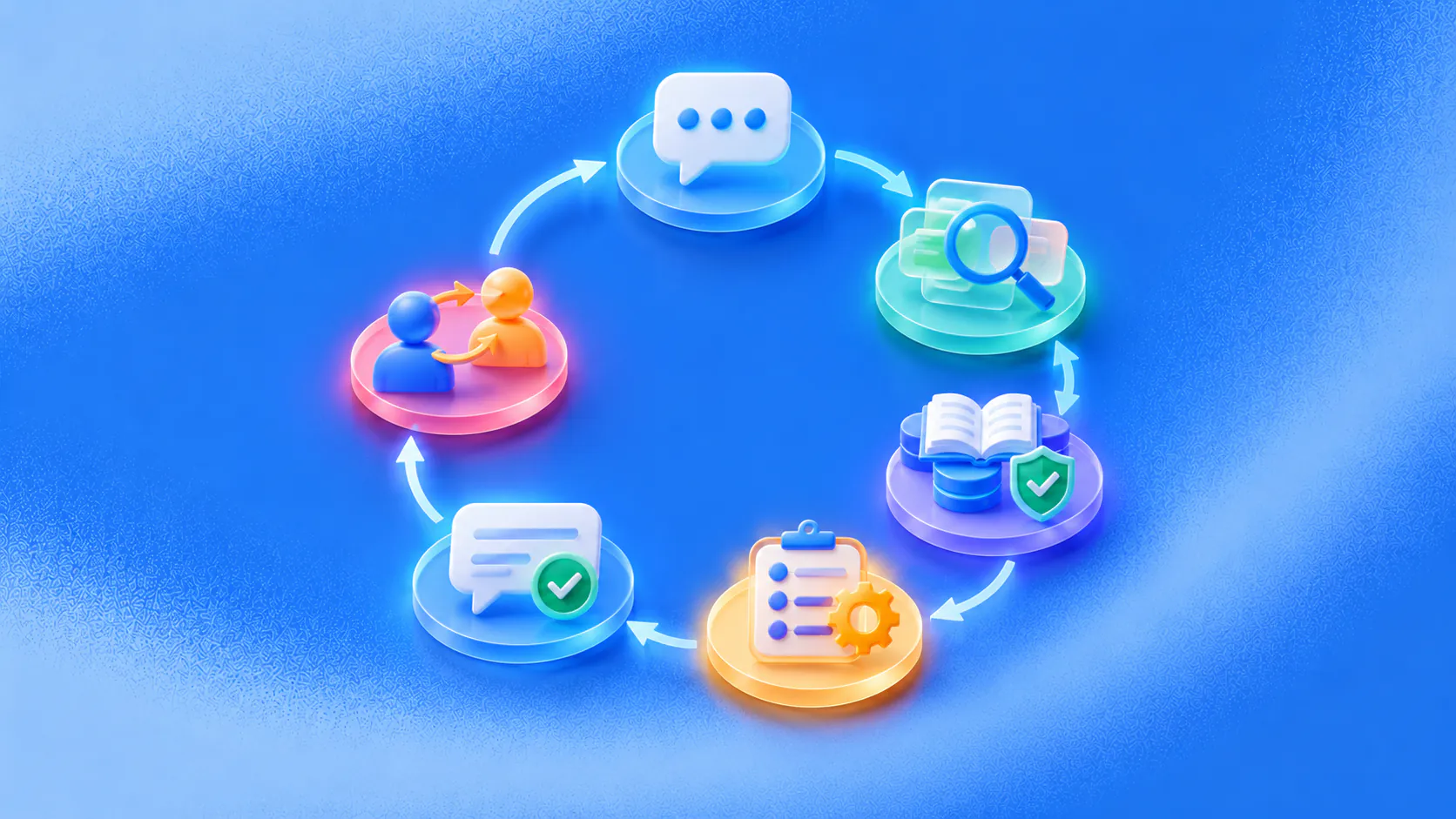
Conversational AI works by receiving text or speech, interpreting the user's intent and context, finding relevant information, choosing a permitted next step and generating a response. Business systems also need workflow state, action confirmation, guardrails and human handoff.
Key takeaways
- Conversational AI separates language interpretation from business knowledge and workflow execution.
- An LLM can help understand varied wording and draft a response, but it does not prove that business information is current or that an action succeeded.
- Dialogue state tracks the customer's goal, collected details, current step and unresolved exceptions across multiple turns.
- Reliable systems confirm tool results, limit permissions, test failure paths and transfer the conversation to a person with context.
How conversational AI works from message to outcome
Understanding how conversational AI works starts with one distinction. The language model is one component inside a larger application. The complete system receives a message, interprets the customer’s goal, finds relevant information, decides what it is allowed to do, executes a supported step and records the result.
This process is a loop rather than a single prompt and response. Each customer reply can add information, change the likely intent or expose an exception. The application must keep track of that state while deciding whether to answer, ask, act or involve a person.
That is the practical answer to how conversational AI works in production: each turn updates an operating state rather than producing an isolated reply.
AWS’s conversational AI overview explains the role of intent and context. IBM’s overview describes input analysis, dialogue management and response generation. A production business system adds two more concerns: the authority to use business systems and evidence that the requested action actually happened.
The broader conversational AI pillar covers definitions and types. This article focuses on the mechanics.
Related must-read articles
Step 1: receive text or speech
Text from web chat, messaging applications or email can enter the language layer directly. Voice needs two additional steps. Automatic speech recognition converts audio to text, and text-to-speech converts the response back into audio.
Those voice steps introduce uncertainty. Names, addresses, numbers, accents and background noise may change the transcription. A well-designed system repeats or confirms details that affect the outcome. It should not silently turn an uncertain transcription into a booking, account update or payment-related instruction.
Channel information also matters. The application may need the sender, timestamp, permitted response window, conversation identifier and available message formats. A channel connector should pass that context without letting channel-specific rules leak into every part of the dialogue.
ZINQ’s channel overview describes the supported conversation surfaces. Availability and behavior still depend on the configured channel.
Step 2: interpret intent, entities and context
Natural language processing is the broad set of methods used to work with human language. In conversational AI, it may support intent recognition, entity extraction, language detection, speech processing and response generation.
Intent describes the customer’s goal. “Can I come Saturday?”, “Do you have anything this weekend?” and “I need the first available appointment after Friday” may all point to booking. Entities are the details needed to progress the task, such as Saturday, a service type or a location.
Modern systems often use an LLM to interpret varied wording. Other systems use an intent classifier, rules or a hybrid design. The method matters less than the result: the application should identify the likely task, track uncertainty and avoid inventing missing details.
At this stage, how conversational AI works depends on both model capability and the state the application chooses to preserve.
Context includes more than the last sentence. It may include:
- Earlier messages in the same conversation;
- Confirmed customer details;
- The active workflow and its current state;
- Which questions have already been answered;
- The channel and language;
- Information returned by approved tools;
- Whether the case has an assigned human owner.
This is a key part of how conversational AI works across multiple turns. Without state, the system repeats questions, loses corrections and treats every message as a new request.
Step 3: retrieve approved knowledge
An LLM generates language from patterns learned during training. It should not be the source of truth for a business’s current prices, policies, stock, schedules or customer records.
Retrieval-augmented generation, often shortened to RAG, adds a search step. The application finds relevant passages from approved sources and supplies them to the model as context for the answer. The source might be a policy, product guide, service description or internal procedure.
Retrieval is different from training. Updating a document in a managed knowledge base does not retrain the general model. It changes the information the application can retrieve for a particular request.
Knowledge retrieval changes how conversational AI works by giving the response a current, business-controlled source instead of relying on general model memory.
Good retrieval depends on source quality. Teams should know:
- Who owns each source?
- When was it last reviewed?
- Which customers or agents may use it?
- What should happen when sources conflict?
- How does the system show that it found no reliable answer?
The guide to how AI agents use business knowledge goes deeper into preparation and maintenance. The comparison between a knowledge-based agent and a scripted chatbot explains when retrieval helps.
Step 4: manage the dialogue state
Dialogue management decides what the conversation needs next. A customer task rarely arrives with every required field in one message. The system may need to ask a follow-up question, confirm an interpretation or explain why it cannot continue.
For an appointment request, the state might include:
| State field | Example value |
|---|---|
| Customer goal | Book a consultation |
| Service | Dental consultation |
| Location | Central branch |
| Preferred date | Saturday |
| Contact details | Phone confirmed |
| Availability check | Not run |
| Booking status | Requested, not confirmed |
| Exception | Customer asks a clinical question |
| Owner | Unassigned |
This structure prevents a common failure. The assistant can acknowledge a request without falsely claiming that the booking exists. It should say which step is complete and which one still depends on the calendar or staff.
Clear state also makes handoff useful. A person can see what the customer wants, which details are verified and why the system stopped.
Step 5: choose a response or permitted action
The application now decides what it may do. The next step can be one of four broad options:
- Answer from approved knowledge;
- Ask for a missing or ambiguous detail;
- Call a permitted workflow or tool;
- Transfer ownership to a person.
This is where conversational AI and AI agents begin to overlap. The conversation interprets the request. The workflow layer gives the application a supported way to act. The AI agent versus chatbot guide helps buyers compare that boundary.
A tool call should use a structured contract. For example, a booking function might require a service identifier, location, date range and customer record. The connected system returns a result with a status and relevant details. The conversation layer should not infer success from the fact that it sent the request.
This is how conversational AI works with business software: the language layer requests a permitted operation, while the connected system remains the authority on the result.
ZINQ workflows and connectors provide the product layer for configured actions. The exact systems and operations must be verified for the intended deployment.
Step 6: generate a grounded response
The response should reflect the actual state of the task. If the knowledge source answered the question, the system can explain the answer. If a tool returned available slots, it can present them. If the action failed, it should say what happened and offer a safe next step.
Natural language generation can adapt wording to the conversation. It should remain constrained by the retrieved evidence, tool result and conversation policy. Tone is secondary to correctness.
Useful response rules include:
- Do not claim an action succeeded before the connected system confirms it;
- Do not fill a missing detail with a guess;
- Distinguish public information from customer-specific data;
- State a limitation plainly when the source is missing;
- Preserve the customer’s chosen language where supported;
- Avoid exposing internal instructions, hidden data or system errors.
These rules explain why how conversational AI works cannot be reduced to “send the message to an LLM.” The surrounding application determines what the response means.
Step 7: hand off with context
Human handoff is an ordinary workflow state. It should not appear only after the system has failed several times.
The transfer packet should include the customer’s stated goal, collected details, source information used, actions attempted, returned statuses and the reason for handoff. It should also identify the receiving person or queue.
Good handoff triggers may include a policy exception, a complaint, sensitive information, uncertainty above the allowed threshold, a failed action or a request that requires professional judgment. The human handover guide explains the operating design. ZINQ’s Human Handoff page describes the supported product behavior.
What can fail in the conversational AI pipeline?
Every layer can fail differently. Testing only the final response hides the cause.
A useful review of how conversational AI works traces each failure to the layer that owned the decision, source or action.
| Layer | Example failure | Safer response |
|---|---|---|
| Input | Voice system hears the wrong date | Ask the customer to confirm the date |
| Intent | Support request is classified as sales | Allow correction and reroute the case |
| Knowledge | Old policy is retrieved | Use versioned sources and review dates |
| Dialogue | A confirmed detail is requested again | Preserve state and test multi-turn cases |
| Tool | Calendar request times out | Keep status unconfirmed and create recovery work |
| Generation | Answer adds an unsupported promise | Constrain response to source and tool evidence |
| Handoff | No team accepts ownership | Assign a queue and track acknowledgement |
NIST’s AI Risk Management Framework recommends continuous work across governance, mapping, measurement and management. Applied here, that means defining the task, documenting likely harms, testing the complete system and reviewing production behavior.
How should a team test how conversational AI works?
Build an evaluation set from real request patterns. Remove personal data, then include normal requests, ambiguous wording, missing information, contradictions, unsupported questions and connected-system failures.
For each test, define:
- The expected intent;
- Required details;
- Permitted sources;
- Allowed actions;
- The evidence of completion;
- The point where a person should take over;
- The wording that must never be used.
Measure the workflow outcome rather than reply quality alone. A response can sound excellent while the case remains unresolved. Review wrong answers, wrong actions, unnecessary handoffs, missed handoffs, repeated contacts and abandoned workflows separately.
The conversational AI implementation guide turns this architecture into a rollout sequence. The platform evaluation guide shows how to test the same scenarios across vendors.
To see how ZINQ handles knowledge, workflows and handoff for one customer task, book a demo and bring an ordinary case with a difficult exception.
Frequently asked questions
How does conversational AI understand a question?
It analyses the words, likely intent, important details and conversation history. Modern systems may use an LLM, an intent classifier, rules or a combination of these methods.
What role does NLP play in conversational AI?
Natural language processing helps the system work with human language. It can support intent recognition, entity extraction, sentiment signals, translation, speech processing and response generation.
Does an LLM contain a company's business knowledge?
A general model may know broad public information, but it should not be treated as the source of truth for current prices, policies, availability or customer records. Those need approved sources and connected systems.
How does conversational AI take an action?
The application sends a structured, permitted request to a workflow or connected tool. It should then read the returned result and distinguish a requested action from a confirmed completion.
Why is human handoff part of the architecture?
Some requests need judgment, sensitive access, an exception or information the system cannot verify. A designed handoff gives a person the reason, details and conversation history needed to continue.
Conclusion
How conversational AI works is easier to understand when language, knowledge and actions are treated as separate layers. Build the conversation around a defined task, verify every source and action, and make human ownership part of the workflow rather than an emergency fallback.
READY TO SEE ZINQ IN ACTION?
From first enquiry to conversion, follow-up and support, ZINQ helps automate the next step while keeping your team in control.
Book a DemoAdditional resources
-
How AI agents use your business knowledge
An AI agent can use business documents by retrieving relevant information when answering a question. Uploading a document does not necessarily retrain the underlying model, and a conversation does not automatically become approved knowledge.
Pavan · August 21, 2026 · AI Agents & Conversational AI -
Knowledge-based AI agent vs scripted chatbot: what changes for customer conversations
A scripted chatbot follows predefined paths, while a knowledge-based AI agent uses approved business information, conversation context and guardrails to answer, ask, route and hand off more flexibly.
The ZINQ team · September 30, 2026 · AI Chatbots -
AI agent guardrails for customer conversations
AI agent guardrails define what an agent may answer, ask, change, promise, escalate and log so customer conversations stay useful without letting automation exceed its authority.
The ZINQ team · September 30, 2026 · AI Agents & Conversational AI