Conversational AI vs Generative AI
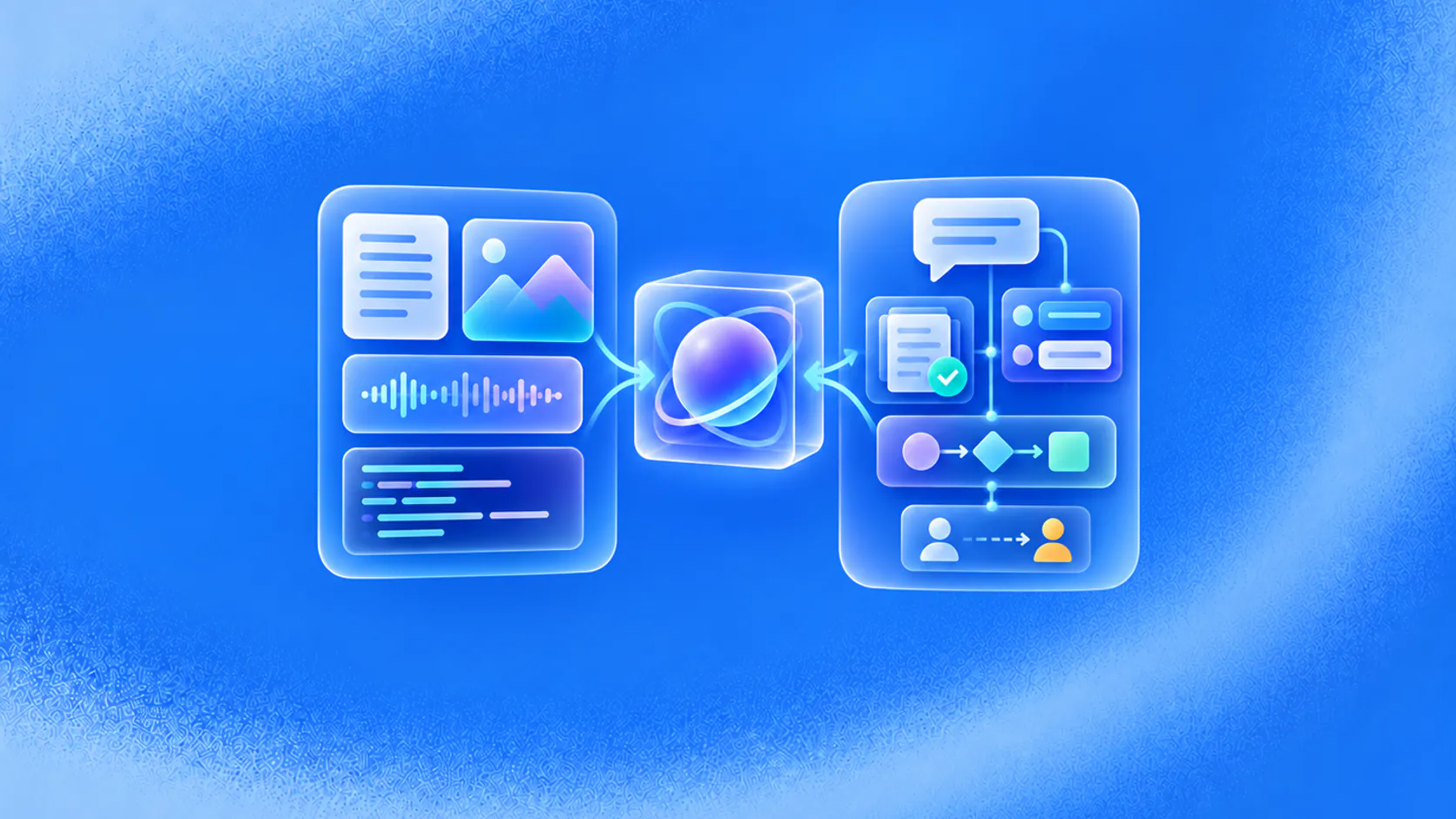
Conversational AI is a system designed to manage an exchange with a user, while generative AI creates new content such as text, images, audio or code. Modern conversational systems may use generative models, but they also need dialogue state, business knowledge, workflow controls, integrations and human handoff.
Key takeaways
- Generative AI describes a content-creation capability; conversational AI describes an interactive system and experience.
- A conversational application may use a generative model, rules, classifiers, retrieval and connected tools together.
- Fluency is not evidence that business information is current or a requested action succeeded.
- Choose architecture from the required outcome, risk and operating controls rather than from a model label.
What is the difference between conversational AI and generative AI?
The difference between conversational AI vs generative AI is easiest to see through purpose. Conversational AI manages an exchange: it receives a message, keeps relevant context and responds or advances a task. Generative AI creates new content, including text, images, audio, video or code.
The categories overlap. A modern conversational assistant may use a large language model to interpret varied wording and generate a natural response. The full application still needs to know what information it may use, which actions it may take and when a person must continue.
Generative AI can also work without a conversation. A user might ask a model to draft a report, produce an image or summarise a document in one interaction. Conversely, a simple conversational system can use rules and intent classification without generating original prose.
Related must-read articles
Conversational AI vs generative AI at a glance
| Dimension | Conversational AI | Generative AI |
|---|---|---|
| Primary purpose | Manage an interactive exchange or task | Create new content from input |
| Typical input | Messages or speech across multiple turns | A prompt, document, image, audio or structured context |
| Typical output | A response, question, route or workflow step | Text, code, image, audio, video or another generated artifact |
| State | Tracks conversation and task progress | May be stateless unless an application adds memory |
| Business knowledge | Needs approved sources or connected systems | A model’s learned knowledge is not a current business source |
| Actions | Uses tools and permissions defined by the application | Generation alone does not confirm an external action |
| Human involvement | Handoff is part of the operating design | Review depends on the content and consequence |
The table describes system roles, not mutually exclusive products. A customer-service assistant can contain generative AI, retrieval, workflow logic and a shared inbox.
What is conversational AI designed to do?
Conversational AI is designed around turns. Each customer message may add a detail, correct an assumption or change the request. The system needs to maintain the relevant state and choose whether to answer, clarify, act or escalate.
For example, a customer may begin with “I need to move it to Friday.” A useful application must determine what “it” refers to, locate the appointment through an approved process, ask which Friday time works and submit the change to the scheduling system.
The conversational AI pillar explains the category, and how conversational AI works follows the message through language, knowledge, actions and handoff.
What is generative AI designed to do?
Generative AI models learn patterns that allow them to produce new outputs. Text models can draft, transform, summarise and classify language. Other models generate or edit images, audio, video and code.
This flexibility is useful inside conversations. A model can recognise that “the parcel never showed up” and “my delivery is missing” express similar needs. It can explain an approved policy in clearer language or produce a concise handoff summary.
Generation is probabilistic. The model produces a likely output based on its input and configuration. It does not, by itself, prove the response is factually current or that an external action occurred.
Where do the technologies overlap?
Modern conversational systems often use generative AI in four places:
- Understanding: interpret varied or incomplete wording.
- Retrieval support: create a search query or select useful passages from approved sources.
- Response generation: turn verified information into a natural answer.
- Summarisation: prepare a concise record for a person or system.
The surrounding application adds dialogue state, identity and access controls, knowledge, workflow actions, integrations, analytics and human handoff.
That surrounding layer is why the conversational AI vs generative AI comparison cannot be reduced to “chatbot versus model.” One describes the interactive system; the other describes a capability that the system may use.
How does this difference appear in a customer workflow?
Consider a customer asking, “Has my refund gone through?”
A generative model can understand the wording and draft a response. It should not invent the status. The conversational application verifies identity according to the business process, calls the order or payment system with limited permissions and reads the returned state.
If the system says the refund completed, the response can explain the expected next step from approved policy. If the tool is unavailable, the assistant should say that it cannot verify the status and create a case or transfer the conversation.
Generation makes the exchange easier to understand. The business system supplies the fact, and the workflow controls what happens next.
What are the different risks?
Generative AI risk often centres on unsupported content, sensitive data in prompts, bias, unsafe output and inconsistent results. Conversational AI inherits those concerns when it uses generation and adds interaction-specific risks.
Those added risks include mistaken identity, loss of conversation state, inappropriate system access, unconfirmed actions, poor routing and failed handoff. A conversation can also encourage a user to disclose more information than a one-time tool would collect.
Use-case controls should therefore cover both model output and operational behavior. NIST’s AI Risk Management Framework offers a general structure for mapping, measuring and managing risk. Specific deployments still require appropriate legal, security, privacy and domain review.
Which should a business choose?
Start from the task rather than the label.
Choose a generative capability when the main need is producing or transforming content and a person or downstream control can review the output. Choose a conversational application when the user needs a multi-turn exchange, contextual questions, channel delivery, workflow state or a live handoff.
Many customer operations need both. A lead-qualification flow uses conversation to collect needs and generation to handle varied answers. An appointment flow uses conversation to negotiate times and a deterministic scheduling action to create the booking.
The conversational AI use-case guide provides operational examples. The platform buyer’s guide turns these requirements into evaluation tests.
When comparing products, check whether the AI agent layer can use governed knowledge and whether its connectors expose only the actions required for the chosen workflow. A language model alone does not provide either control.
What should you test in a combined system?
Test each layer separately and together:
- Whether the system recognises the customer’s goal;
- Whether it retrieves the correct approved source;
- Whether the response stays within that evidence;
- Whether required details remain correct across turns;
- Whether tools receive valid, permitted inputs;
- Whether the returned result is communicated accurately;
- Whether uncertainty and failure trigger the right handoff;
- Whether sensitive data is handled according to policy.
Use normal examples, incomplete messages, contradictory details, unavailable tools and requests outside scope. A fluent normal-path demonstration cannot show how the system behaves when evidence is weak.
How should the decision be implemented?
Document the role of every component. State what the generative model may interpret or draft, which sources are authoritative, which tool controls actions and who owns exceptions.
Then establish an evaluation set and review process. Model or prompt changes should not silently alter important workflow behavior. The implementation guide explains how to launch with one bounded task and expand from observed results.
The practical conclusion to conversational AI vs generative AI is not that one replaces the other. The useful question is where generation improves the exchange and where the business needs stronger evidence, permissions and ownership.
What should appear in an architecture decision record?
Document why each component is present. For the language model, state whether it interprets intent, rewrites approved information, summarises context or performs another bounded function. For retrieval, list the authoritative sources and freshness rules.
For workflow tools, record the permitted operations, verification and returned evidence. For conversation state, define what persists, for how long and who can see it. For handoff, name the trigger and receiving role.
This record makes the conversational AI vs generative AI distinction operational. It prevents a model upgrade from being treated as a replacement for knowledge, workflow or access controls.
Record alternatives too. A form, search interface, rules engine or human process may suit a narrow or consequential task better. Generation earns its place when language variation or explanation adds useful flexibility.
Review the decision after real usage. If generation creates more corrections than value, constrain it. If users repeatedly need follow-up questions, add conversation state. Conversational AI vs generative AI is a component decision that should remain tied to evidence.
Keep the record available to procurement and operations as well as engineers. Conversational AI vs generative AI affects vendor evaluation, data review, testing and ongoing ownership. When everyone uses the same distinction, teams can ask whether a claimed feature generates language, manages a conversation or reliably completes a business task.
That question gives the conversational AI vs generative AI comparison a practical purpose: it reveals which controls and owners are still needed after the model is selected.
Frequently asked questions
Is conversational AI a type of generative AI?
Not necessarily. Conversational AI existed before modern generative models and can use rules, intent classifiers and scripted dialogue. Many current systems add generative AI for flexible understanding and response creation.
Can generative AI hold a conversation?
A generative model can produce conversational text, but a business application also needs memory boundaries, current knowledge, permissions, workflow state, action confirmation and handoff.
Which is better for customer service?
The choice is not either-or. Customer service usually needs a conversational application, which may use generative AI inside a controlled system with approved sources and service workflows.
What is the main risk of combining them?
Teams may mistake a confident generated response for a verified answer or completed action. Separate language generation from authoritative data and tool results.
Conclusion
The conversational AI vs generative AI distinction is about system purpose, not competing labels. Use generation where flexibility helps, then add the knowledge, workflow, permission, confirmation and human controls the customer task requires.
READY TO SEE ZINQ IN ACTION?
From first enquiry to conversion, follow-up and support, ZINQ helps automate the next step while keeping your team in control.
Book a DemoAdditional resources
-
AI agent vs chatbot: which does your workflow need?
A chatbot is a conversational interface, while an AI agent can use tools and choose steps toward a task. The capabilities overlap, so compare what a system can actually complete rather than relying on its label.
Pavan · June 17, 2026 · AI Agents & Conversational AI -
Knowledge-based AI agent vs scripted chatbot: what changes for customer conversations
A scripted chatbot follows predefined paths, while a knowledge-based AI agent uses approved business information, conversation context and guardrails to answer, ask, route and hand off more flexibly.
The ZINQ team · September 30, 2026 · AI Chatbots -
What is agentic AI? Choosing autonomy for a business task
Agentic AI describes systems that can choose steps and use tools toward a goal with some degree of autonomy. For a business task, the useful question is which decisions the system may make and how people can verify or interrupt them.
Pavan · June 17, 2026 · AI Agents & Conversational AI