Knowledge-based AI agent vs scripted chatbot: what changes for customer conversations
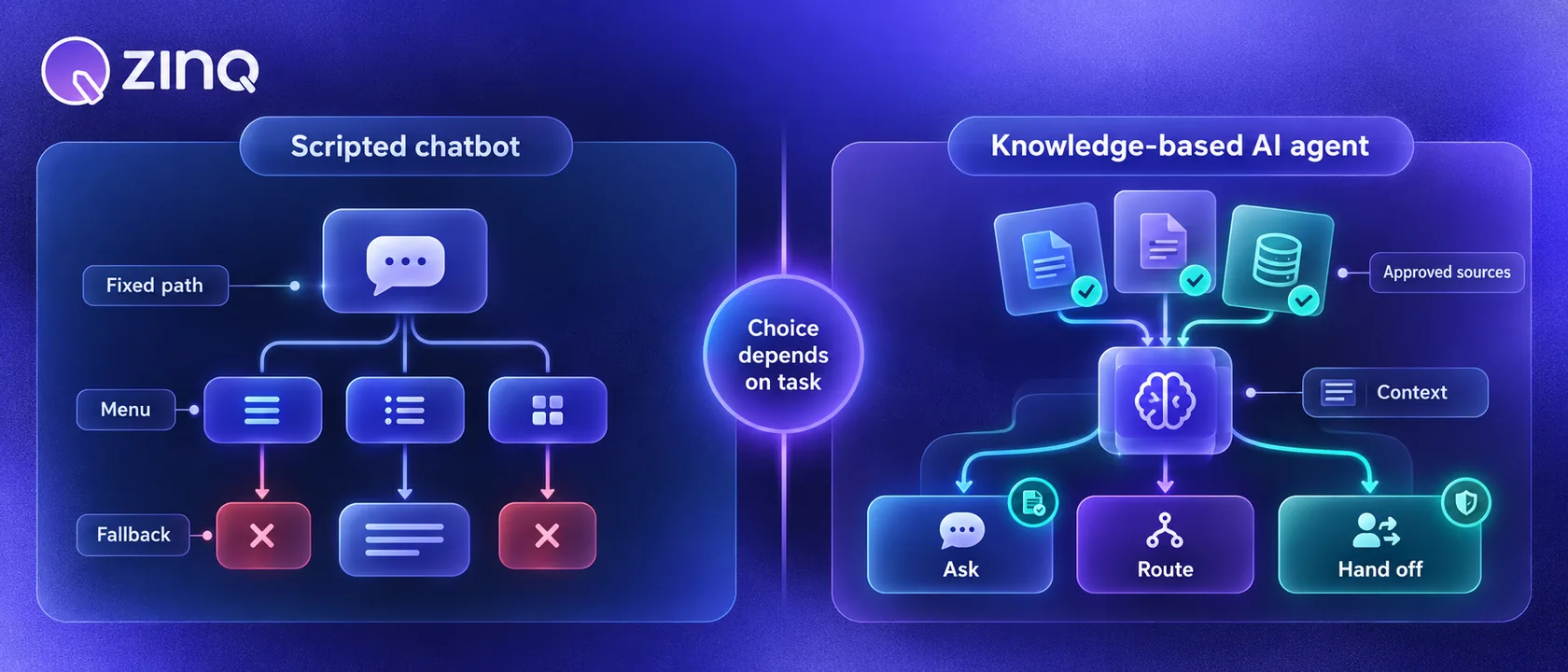
A scripted chatbot follows predefined paths, while a knowledge-based AI agent uses approved business information, conversation context and guardrails to answer, ask, route and hand off more flexibly.
Key takeaways
- Scripted chatbots work for narrow flows with predictable inputs.
- Knowledge-based AI agents are better when customers ask varied questions from approved information.
- The risk moves from broken paths to source quality, permissions and answer boundaries.
- Human handoff is still required when confidence, authority or customer emotion changes.
The short version
A scripted chatbot follows a path someone wrote in advance. A knowledge-based AI agent answers from approved business information and decides what to ask, answer, route or hand off inside defined limits.
Both can be useful. The mistake is using the wrong one for the conversation.
If customers usually choose from a small set of options, a scripted chatbot may be enough. If customers ask varied questions, use different wording and need a next step after the answer, a knowledge-based AI agent is usually a better fit.
What a scripted chatbot does well
Scripted chatbots are predictable. They use buttons, decision trees, fixed intents or predefined rules. That predictability is useful when the business wants tight control.
A scripted chatbot can work well for:
- selecting a department
- collecting a fixed set of details
- showing business hours
- starting a return request
- routing simple support categories
- answering a small FAQ set
The strength is control. The weakness is brittleness. If the customer asks in a way the script did not expect, the flow can break or fall back to a generic message.
What a knowledge-based AI agent changes
A knowledge-based AI agent starts from the customer’s actual message. It identifies the intent, checks approved information and forms an answer inside the limits you set. It can ask follow-up questions when the next step needs missing details.
For example, a customer might ask, “Can I move my appointment to Saturday and still use the same offer?” A scripted bot may need the customer to choose from “reschedule” or “offers.” A knowledge-based agent can recognize that this is both a booking and policy question. It can answer what the policy allows, collect the appointment details and hand off if the change needs staff approval.
The strength is flexibility. The risk is that the knowledge and boundaries must be well managed.
Comparison table
| Area | Scripted chatbot | Knowledge-based AI agent |
|---|---|---|
| Best for | Fixed paths | Varied customer questions |
| Source of truth | Scripted answers | Approved knowledge sources |
| Customer wording | Must match expected paths | Can handle more natural wording |
| Next action | Usually predefined | Can ask, route, book or hand off inside rules |
| Main risk | Broken or frustrating paths | Unsupported answers if sources and guardrails are weak |
| Review focus | Flow completion | Answer quality, source quality and handoff quality |
When a scripted chatbot is enough
Use a scripted chatbot when the conversation is narrow and the business wants low variation. A menu-style bot can be the right choice for a simple routing question. It can also be safer for flows where every response must follow a fixed sequence.
For example, “Choose sales, support or billing” does not need a flexible AI agent. A simple flow can do the job.
The same is true for a small number of predictable form-style questions. If the only goal is to collect name, phone number, location and preferred time, a scripted path may work.
When a knowledge-based AI agent is better
Use a knowledge-based AI agent when customers ask real questions in their own words. That includes product questions, clinic enquiries, delivery issues, appointment changes, policy questions and service-fit questions.
The agent is especially useful when the answer depends on approved knowledge and the next step depends on the customer’s situation. It can collect missing context, explain the next step and send the customer to a person when needed.
This is where ZINQ’s knowledge layer matters. The agent should use business-approved content, not guess from general web knowledge. It should also preserve human handoff when the request needs judgment.
Guardrails matter more with knowledge-based answers
With a scripted chatbot, most risk is in the path. With a knowledge-based AI agent, risk also sits in the sources and permissions.
Before launch, define:
- which knowledge sources the agent may use
- which topics it must not answer
- when uncertainty triggers handoff
- which actions require confirmation
- what answer evidence is logged
- who reviews wrong or incomplete answers
Do not rely on the agent sounding confident. Confidence is not proof. The system should be designed so unsupported cases stop, ask for clarification or hand off.
A practical decision rule
Ask three questions.
First, can the customer’s need be handled by a fixed set of options? If yes, a scripted chatbot may be enough.
Second, does the customer need an answer from business knowledge? If yes, consider a knowledge-based AI agent.
Third, does the answer need a next step such as booking, routing, follow-up or handoff? If yes, the agent needs workflow rules, not only knowledge.
This decision keeps the system honest. Some businesses need a better chatbot. Others need an AI agent platform.
Conclusion
Scripted chatbots and knowledge-based AI agents solve different problems. A scripted chatbot is useful when the path is fixed. A knowledge-based AI agent is useful when customers ask varied questions and the business needs approved answers, context collection and a safe next step. Choose based on the work the customer is trying to complete, not the label on the tool.
Frequently asked questions
What is a scripted chatbot?
A scripted chatbot follows predefined buttons, rules, intents or flows. It works when the customer choices are predictable and the business wants a tightly controlled path.
What is a knowledge-based AI agent?
It is an AI agent that answers from approved business knowledge, uses conversation context, asks for missing details and routes or hands off when the request leaves its scope.
Is a knowledge-based AI agent always better?
No. A simple scripted chatbot can be better for a narrow, regulated or menu-style flow. The right choice depends on risk, variation and the next action.
How do you reduce hallucination risk?
Use approved sources, limit answer authority, review unanswered questions, require handoff for uncertain cases and log which source supported each answer where possible.
Conclusion
Choose a scripted chatbot when the path is fixed. Choose a knowledge-based AI agent when customers ask varied questions and the business needs answers, routing and handoff from approved information.
READY TO SEE ZINQ IN ACTION?
From first enquiry to conversion, follow-up and support, ZINQ helps automate the next step while keeping your team in control.
Book a DemoRelated articles
-
AI agent vs chatbot: which does your workflow need?
A chatbot is a conversational interface, while an AI agent can use tools and choose steps toward a task. The capabilities overlap, so compare what a system can actually complete rather than relying on its label.
Pavan · June 17, 2026 · AI Agents & Conversational AI -
Judge conversational AI by what it completes
A conversational system should be judged by whether it helps the customer finish the task. The labels "chatbot" and "agent" do not establish that result: either can expose tools, and either can fail after producing a convincing reply.
The ZINQ team · June 2, 2026 · AI Agents & Conversational AI -
How AI agents use your business knowledge
An AI agent can use business documents by retrieving relevant information when answering a question. Uploading a document does not necessarily retrain the underlying model, and a conversation does not automatically become approved knowledge.
Pavan · August 21, 2026 · AI Agents & Conversational AI