Best conversational AI platforms: a buyer's guide
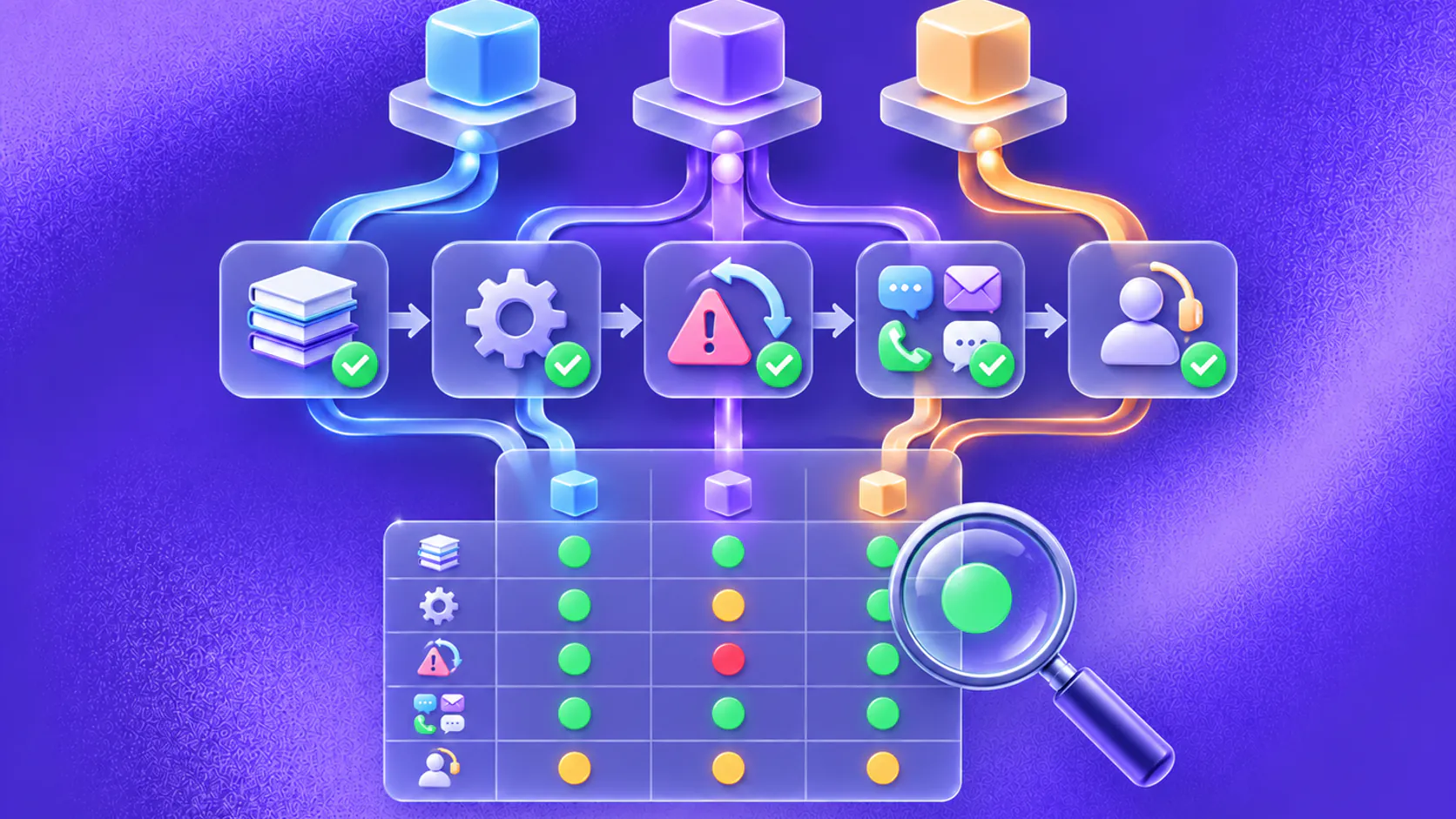
The best conversational AI platforms are the ones that complete your chosen customer workflows with reliable knowledge, controlled actions, useful human handoff and measurable results. Compare vendors with the same source documents, test conversations, integrations and failure scenarios.
Key takeaways
- There is no universal best platform. The right choice depends on the customer workflow, channels, systems, risk and operating team.
- Build evaluation scenarios before vendor demonstrations so every platform faces the same normal path, exception and failed-action test.
- Separate language quality from source accuracy, action reliability, human ownership and reporting.
- Verify current product capabilities, connector operations, pricing and contractual commitments directly with each shortlisted vendor.
Key terms
- Conversational AI platform
- Software for designing, running and managing automated conversations across supported channels, knowledge sources and workflows.
- Evaluation scenario
- A realistic customer request with expected behavior, required evidence and clear pass or fail conditions.
- Total cost of ownership
- The combined cost of licenses, usage, implementation, integrations, maintenance, monitoring and human operations.
- Observability
- The records and tools used to understand what the system interpreted, retrieved, attempted, returned and handed off.
What makes a conversational AI platform the best fit?
The best conversational AI platforms are not defined by the longest feature list. They are defined by how well they handle the customer tasks your business intends to run, including the difficult paths that do not appear in a polished demonstration.
Start with the workflow. A support team may need knowledge answers, case creation and human handoff. A sales team may need qualification, routing and appointment booking. A multi-channel operation may also need shared ownership and channel-specific controls.
The platform should make those jobs reliable and maintainable. It should show which source supported an answer, whether an action succeeded, why the system handed off and what the team needs to fix after a failure.
The July 2026 Gartner market overview reflects a market shaped by multimodality, agentic AI and changing governance needs. That movement makes a task-specific evaluation more important. Category labels are converging while implementation quality still varies.
The conversational AI pillar explains the category. This guide focuses on buying evidence.
Related must-read articles
- Conversational AI implementation
- How does conversational AI work?
- AI agent platforms for customer-support operations
Do you need a platform, a chatbot or a point solution?
Define the scope before comparing the best conversational AI platforms.
A simple menu or knowledge assistant may be enough when customers ask a limited set of questions and no connected action is required. A point solution may be suitable for one channel or workflow when the team accepts a separate operating surface.
A broader conversational AI platform becomes more relevant when the business needs several of these capabilities together:
- Text or voice across supported channels;
- Shared business knowledge;
- Multi-turn state and information capture;
- Permitted actions in connected systems;
- Workflow sequencing and recovery;
- Human ownership in the same operation;
- Analytics across answers, actions and outcomes;
- Controls for multiple teams, agents or use cases.
The AI agent versus chatbot guide helps clarify the capability boundary. The AI chatbot buyer guide is better when the need is primarily a chatbot purchase.
Define the evaluation workflow before the demo
Write one or two realistic scenarios before speaking to vendors. Each scenario should include the customer goal, required sources, expected action, likely exception and evidence of completion.
For an appointment workflow, the scenario might be:
- A customer asks for a Saturday appointment in ordinary language.
- The system explains the service using an approved source.
- It collects the minimum required details.
- It checks availability through the supported calendar path.
- It offers only returned options.
- It confirms the booking only after the calendar returns success.
- It transfers a sensitive question to staff with context.
- It records the final workflow state.
Add difficult variants. The customer changes the date, omits a detail, asks an unsupported question and requests a slot while the calendar is unavailable. Use the same cases for every platform.
The best conversational AI platforms should pass these shared scenarios without changing the success criteria between demonstrations.
This scenario-first approach prevents the most confident presenter from winning through style. It also exposes the difference between a generated answer and an operational result.
1. Evaluate language understanding and conversation state
Test how the platform handles varied phrasing, corrections, references to earlier messages and more than one intent. The goal is not to reward human-like small talk. It is to determine whether the system preserves the information needed for the task.
Ask:
- Can the customer correct a date or product without restarting?
- Does the system distinguish missing information from a negative answer?
- Can it manage two related requests in one conversation?
- Does it preserve state across a longer asynchronous exchange?
- Can the team inspect why the system chose a path?
The article on how conversational AI works explains intent, entities and dialogue state.
2. Test knowledge accuracy and source management
The best conversational AI platforms should provide a controlled way to use business information. Uploading files is not enough.
Check whether the platform supports source ownership, update workflows, access boundaries and useful behavior when no answer exists. Test similar policies with different conditions. Replace or expire a source, then verify that the new answer appears when expected.
Ask the vendor to show:
- Which source passages supported an answer;
- How conflicting sources are resolved;
- How access is limited by agent, team or use case;
- How stale content is found and reviewed;
- What the system does when retrieval confidence is weak;
- Whether customer-specific data remains separate from public information.
The best conversational AI platforms make those source and access decisions inspectable by the team that owns the content.
ZINQ’s Knowledge Base is designed around approved business information. The business knowledge guide explains the maintenance questions buyers should ask.
3. Verify workflow actions and completion evidence
Many platforms can describe an action. Fewer make it easy to define permissions, handle returned statuses and recover when a connected system fails.
Test the exact operations your workflow needs. Reading a calendar, creating a booking and cancelling a booking are different permissions. A connector name on a marketplace page does not prove that every operation is available.
For each action, verify:
- Required inputs and validation;
- Read and write permissions;
- Identity and approval requirements;
- Success, partial-success and failure results;
- Retry and duplicate-prevention behavior;
- Audit records;
- Customer wording for each returned state.
The best conversational AI platforms distinguish an attempted action from a confirmed result and expose the recovery path when it fails.
ZINQ Workflows and Integrations describe the product areas. Specific connectors and operations still require verification.
4. Inspect human handoff and team ownership
Human handoff should transfer work, not send a transcript into an unowned queue.
Run a case that must reach a person. Check whether the receiving team sees the customer’s goal, verified details, sources used, attempted actions and reason for transfer. Confirm how ownership, priority and service expectations are recorded.
The best conversational AI platforms should let teams define handoff triggers and keep AI and human work visible. The exact design may differ, but the customer should not need to repeat the entire story.
Use the human handover guide to design the scenario. ZINQ’s Human Handoff page describes the supported transition.
5. Compare channel coverage with channel depth
A list of channels does not tell you whether the workflow behaves correctly on each one. Test identity, consent, message windows, attachments, asynchronous replies and escalation on the channels you actually use.
Ask whether one customer can continue a workflow across channels and how identity confidence is handled. Automatic merging can create privacy and ownership problems when identifiers do not match reliably.
ZINQ supports customer operations across its documented channels and provides an Omnichannel Inbox for supported connected conversations. Confirm the channel configuration needed for your use case.
The omnichannel AI agent guide covers shared state and ownership in more detail.
6. Review governance, security and authority controls
Security review should follow the actual use case. A public FAQ assistant and a system that reads customer records have different risks.
Evaluate:
- Data access and retention;
- Role-based permissions;
- Environment separation;
- Audit records;
- Model and subprocessor disclosures;
- Source-level access controls;
- Approval for consequential actions;
- Incident response and rollback;
- Testing for unsafe or unsupported requests;
- Contractual commitments and current certifications.
NIST’s AI Risk Management Framework is a voluntary framework for managing AI risk. Its govern, map, measure and manage functions offer a useful structure for vendor and use-case review. A certification or vendor claim does not replace that assessment.
The AI agent guardrails guide provides scenario-level checks.
7. Check evaluation, monitoring and observability
The platform should help the team understand what happened inside a conversation. Look for records of interpreted intent, retrieved sources, tool calls, returned statuses, handoff reasons and final workflow state.
Ask whether you can build and rerun an evaluation set before changes. A prompt, model, source or workflow update can fix one case and break another. Regression testing should be part of the operating process.
Useful measures include unsupported requests, source errors, customer corrections, action failures, repeated contact, avoidable handoffs, missed handoffs and completion by workflow state.
Do not accept a single accuracy or containment score without its definition, population and review method. A high containment rate can hide unresolved customers if the system makes handoff difficult.
8. Assess implementation and ongoing maintenance
Compare the work required after the contract is signed. The best conversational AI platforms should fit the team’s ability to configure, review and improve the system.
Ask who will:
- Prepare and approve source material;
- Define workflow states and actions;
- Build the evaluation set;
- Configure channels and integrations;
- Review failed conversations;
- Update knowledge after business changes;
- Manage permissions and incidents;
- Train the receiving human team.
Vendor-managed, assisted and self-serve implementations place work in different locations. None is automatically better. The right model matches your internal capacity and risk.
The conversational AI implementation guide provides the full rollout sequence.
9. Compare the full cost of ownership
Pricing pages rarely use the same unit. Build one demand model and ask every vendor to price the same scope.
Include:
- Platform or workspace licenses;
- Conversation, message, token or minute usage;
- Telephony and channel charges;
- Implementation and migration;
- Integration development;
- Premium connectors or environments;
- Support and service levels;
- Evaluation and monitoring tools;
- Internal content, operations and review time;
- Expected maintenance after source or workflow changes.
Use realistic low, expected and high volumes. Ask what happens when a conversation spans several messages or channels. Record which third-party charges pass through separately.
Use the ZINQ demo request to confirm the scope, channel costs and commercial terms for the workflow under consideration.
10. Verify vendor evidence and product claims
Treat every capability claim as a question to test. Request current documentation, supported operations, implementation prerequisites and customer references relevant to your use case.
For measured case studies, check the baseline, measurement period, population and definition of success. A reduction in messages is not the same as resolved customer work. A faster reply does not prove a booking, sale or retained customer.
Future named comparisons should use dated primary vendor sources and the same criteria. This guide does not rank vendors because the repository does not contain comparable hands-on test results for every platform.
A scorecard for the best conversational AI platforms
Set weights before demonstrations. Adjust them to the use case rather than copying a generic total.
| Criterion | Suggested evidence | Example weight |
|---|---|---|
| Workflow fit | Pass rate on normal and exception scenarios | 20% |
| Knowledge quality | Source accuracy, ownership and no-answer behavior | 15% |
| Action reliability | Confirmed tool results, recovery and audit trail | 15% |
| Human handoff | Context, routing, ownership and acknowledgement | 10% |
| Governance and security | Use-case controls, permissions and reviewed evidence | 15% |
| Channel fit | Required channel behavior and cross-channel state | 10% |
| Evaluation and analytics | Regression tests and outcome-level reporting | 5% |
| Implementation fit | Required skills, timeline and maintenance model | 5% |
| Total cost | Comparable multi-year operating cost | 5% |
The numbers are a starting point, not an industry standard. A regulated or sensitive workflow may place more weight on governance. A single-channel lead workflow may place more weight on qualification and CRM action.
Score evidence, not presentation quality. Keep notes and unresolved questions beside every score.
This process turns a search for the best conversational AI platforms into a documented buying decision rather than a preference for one polished demo.
Red flags during platform evaluation
Pause the evaluation when a vendor cannot show the difficult path.
Common red flags include:
- Every answer looks correct only with a curated demonstration source;
- The product claims an action completed without showing the returned status;
- Handoff ends with “someone will follow up” and no visible owner;
- A connector is listed, but the required operation is not demonstrated;
- Pricing cannot be mapped to the same demand model as other vendors;
- Security answers rely on a badge without addressing the use case;
- Analytics count messages but cannot show workflow outcomes;
- The vendor will not explain how sources, prompts, models or policies are updated;
- The proposed rollout begins with every channel and use case at once.
How does ZINQ fit the evaluation?
ZINQ is a horizontal AI agent platform for customer operations. Its documented platform covers AI Agents, approved knowledge, workflows, connected channels, an omnichannel inbox and human handoff. It is designed for customer journeys such as enquiries, qualification, booking, follow-up and support.
That description is not a reason to skip evaluation. Use the same source documents, workflow contract and failure scenarios you give every shortlisted vendor. Verify the channels, connectors, permissions and measures required for your business.
To run that test with ZINQ, book a demo and bring one normal customer request, one exception and one connected action that must return a confirmed result.
Frequently asked questions
Which is the best conversational AI platform?
No platform is best for every business. The right choice is the one that passes your workflow, source, integration, governance, handoff and cost tests with evidence.
What should I test in a conversational AI demo?
Test a normal request, ambiguous wording, missing information, an unsupported question, a failed connected action and a case that must reach a person. Use the same scenarios for every vendor.
Should I choose a chatbot platform or an AI agent platform?
Choose based on the work required. A knowledge or menu assistant may be enough for simple questions. Workflows that read or update business systems need stronger action controls, state management and handoff.
How should conversational AI pricing be compared?
Model the same traffic, channels and workflow for every vendor. Include implementation, model or message usage, telephony, connectors, support, maintenance, monitoring and internal operating time.
Do certifications prove a platform is safe for our use case?
Certifications may support vendor review, but they do not replace use-case risk assessment, permission design, testing, contractual review and ongoing monitoring.
Conclusion
The best conversational AI platforms earn a place on the shortlist by passing the same real workflow tests. Define the outcome, test the hard cases, verify current claims and compare the full operating cost before choosing a vendor.
READY TO SEE ZINQ IN ACTION?
From first enquiry to conversion, follow-up and support, ZINQ helps automate the next step while keeping your team in control.
Book a DemoAdditional resources
-
AI chatbot for business: a practical buyer guide
Choose an AI chatbot for business by starting with the customer task it must complete, then test its knowledge, actions, handoff, channels, integrations, data controls and operating requirements. The best option is the one that completes your verified workflow reliably, not the one with the longest feature list.
The ZINQ team · September 21, 2026 · AI Chatbots -
AI agent platform for customer support operations
An AI agent platform for customer support operations connects conversations, knowledge, workflows, channels and human handoff so support teams can resolve repeatable requests without losing control of exceptions.
The ZINQ team · September 29, 2026 · Customer Support & CX -
AI agent guardrails for customer conversations
AI agent guardrails define what an agent may answer, ask, change, promise, escalate and log so customer conversations stay useful without letting automation exceed its authority.
The ZINQ team · September 30, 2026 · AI Agents & Conversational AI