What is a conversational AI agent?
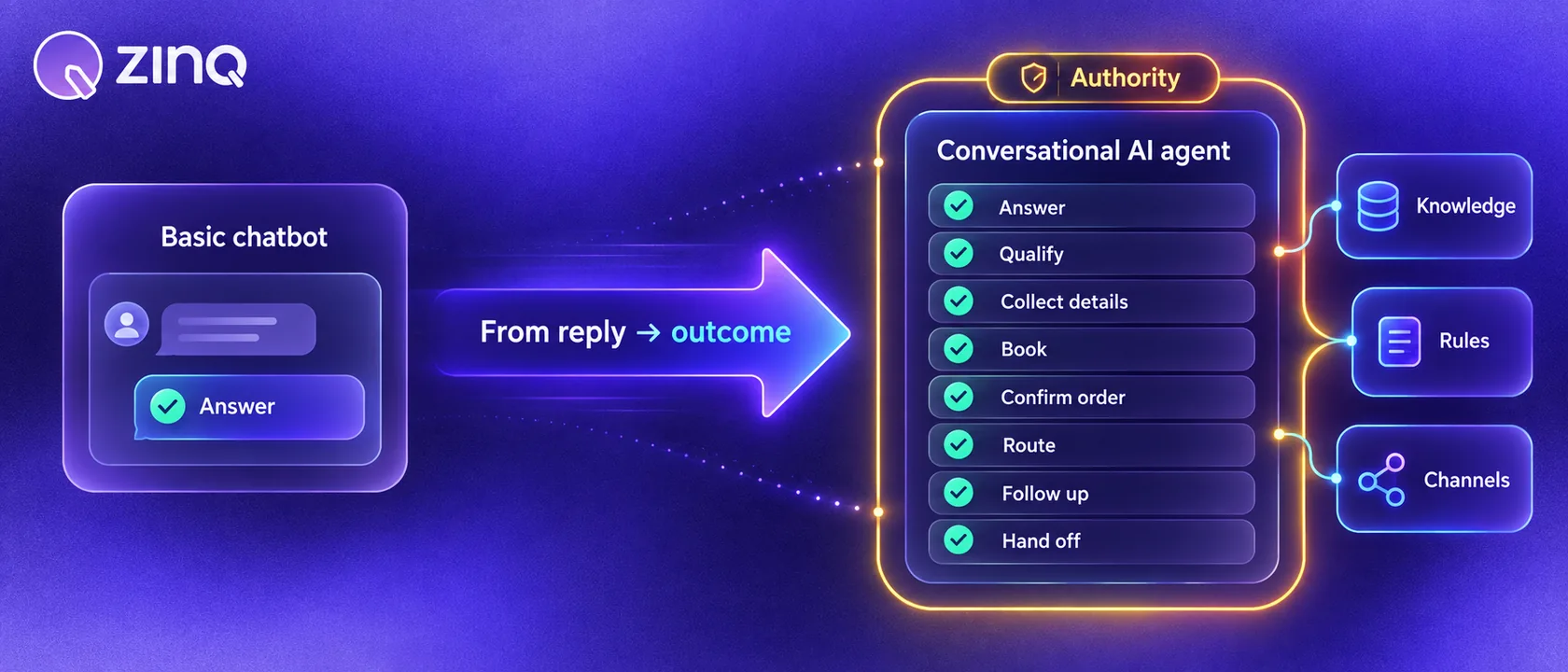
A conversational AI agent is software that understands a customer message, checks approved knowledge, asks useful follow-up questions, takes permitted workflow actions and hands the conversation to a person when needed.
Key takeaways
- A conversational AI agent should be judged by the customer outcome it can complete, not only by how natural the reply sounds.
- The useful boundary is authority: what the agent can answer, ask, update, book, route or escalate.
- Chatbot keywords matter for search, but the buying decision is usually about workflows, channels, knowledge and handoff.
- Start with one narrow conversation type before expanding into a broader customer operation.
What a conversational AI agent means in practice
A conversational AI agent is an AI system built for customer conversations where the message is only the start of the job. It reads the request, identifies what the customer is trying to do, checks approved knowledge, asks for missing details and moves the conversation to a useful next step.
That next step may be an answer, a booking, a qualified lead record, a follow-up message or a handoff to a person. The important part is that the agent has a defined operating boundary. It should know what it can answer, what it can change and when it must stop.
This is why a conversational AI agent is usually evaluated differently from a basic FAQ chatbot. A customer does not care whether the software sounded impressive. They care whether the appointment was booked, the order question was answered, the enquiry was routed or the support case reached the right person.
How it differs from a basic chatbot
Many buyers still search for terms like AI chatbot, customer support chatbot or conversational AI chatbot. That language is useful because it describes the starting point: a customer wants an automated conversation.
The difference appears after the first answer.
| Capability | Basic chatbot | Conversational AI agent |
|---|---|---|
| Main job | Answer common questions | Move a customer request through a workflow |
| Knowledge | Fixed FAQ or scripted flows | Approved knowledge sources and business context |
| Follow-up questions | Usually scripted | Asked when the next step needs missing details |
| Actions | Limited or none | Can trigger permitted steps like booking, routing or follow-up |
| Human handoff | Often a fallback button | A designed route with context and reason |
The practical test is simple. If the system can only reply, treat it as a chatbot. If it can answer, collect the right details, use business rules and trigger the next safe step, it is closer to an AI agent.
Where it fits in customer operations
Conversational AI agents are most useful where customer messages repeatedly start the same operation. A WhatsApp enquiry about pricing, an Instagram DM asking for an appointment, a website chat asking for delivery status and an email asking for a quote all begin as conversation. They become work when the business has to qualify, check information, book, update, route or follow up.
That is where a platform such as ZINQ’s AI agents should connect conversation to operations. The agent should use approved knowledge, work across relevant channels and preserve a clean human handoff when the case needs judgment.
For a support team, the agent may answer policy questions, ask for an order number and route unresolved cases. For a clinic, it may collect enquiry details and propose booking options. For a sales team, it may ask qualifying questions and pass the record to a human when the lead is ready.
A concrete workflow example
Imagine a potential customer sends a WhatsApp message at 9:20 pm: “Do you have appointments this week, and what do I need to bring?”
A basic chatbot might answer with opening hours or a generic contact link. A conversational AI agent can handle a more useful path:
- Identify that the customer wants an appointment.
- Ask which service or location they mean.
- Check approved booking rules or available slots if connected.
- Share suitable options or collect the details needed for staff review.
- Confirm the next step and send a reminder if the workflow allows it.
- Hand off to the team if the customer asks a question outside approved knowledge.
The agent does not need unlimited autonomy. It needs the right authority for this workflow. That may be enough to reduce missed enquiries without letting software make decisions it should not make.
What to evaluate before choosing one
Start with the conversation types you want to improve. Then check whether the agent can support the full path.
- Can it use your approved business knowledge, not generic web answers?
- Can it ask for missing details in the customer’s channel?
- Can it work on WhatsApp, web chat, Instagram, email or the channels your customers actually use?
- Can it pass structured context into your CRM, inbox, task list or booking process?
- Can your team review handoffs, failed answers and repeated gaps?
- Can you limit what the agent is allowed to do?
These questions matter more than a demo that only shows a smooth chat transcript. The transcript is the front. The operating model behind it decides whether the agent is safe and useful.
When an AI chatbot is enough
A simpler chatbot can be enough when the job is narrow and low-risk. A static FAQ, office hours, basic product information or a simple link menu may not need a full agent workflow.
The agent becomes more useful when the conversation needs context, branching, follow-up questions or a next action. If the customer expects a booking, a qualified reply, a routed support case or a callback, a basic answer often creates another step for the team.
This is the buyer’s real decision. Do you need a reply engine, or do you need a customer operation to move forward?
How ZINQ frames conversational AI agents
ZINQ is built around customer operations across channels. A conversation can start in WhatsApp, Instagram, web chat, Telegram, email or voice, but the business outcome is usually the same: capture the request, qualify it, answer what is approved, book or route the next step, follow up and hand off when a person should take over.
That means the first setup question should not be “How smart can the bot sound?” It should be “Which customer request should this agent complete, and what authority does it need?”
If the first workflow is customer support, start with customer service. If the first workflow is appointment handling, start with appointment booking. If the first workflow is qualification, start with lead qualification.
How to start without overbuilding
Pick one conversation type. Write down the source of truth, the questions the agent may ask, the action it may take, the handoff rule and the success check.
For example, an appointment enquiry may need service type, preferred date, location and contact details. The agent can collect those details, share approved availability rules and hand off when the customer asks about a special case.
Once that works, add adjacent requests. That may mean follow-up after no response, reminders before an appointment or routing complex support cases. Expansion should follow observed customer needs, not a long feature wish list.
Frequently asked questions
Is a conversational AI agent the same as a chatbot?
No. People may search for an AI chatbot when they need automated customer conversations, but a conversational AI agent usually covers a wider job: interpreting intent, using business knowledge, collecting missing details, triggering workflow steps and handing off with context.
What can a conversational AI agent do?
It can answer approved questions, qualify an enquiry, book a slot, collect missing information, start a follow-up, route a case and prepare a human handoff. The exact scope depends on the systems and rules connected to it.
Where should a business start?
Start with a frequent conversation that has clear source information, a known next step and a safe escalation path. Appointment booking, lead qualification and simple support triage are common starting points.
What should be handed to a human?
Hand off requests that require judgment, sensitive data, policy exceptions, a complaint, a high-value sale or information the agent cannot verify.
Conclusion
A conversational AI agent is useful when it moves the customer to the next step with clear authority and visible guardrails. Define the outcome first, connect only the knowledge and systems needed for that outcome, and give the team a clean handoff when the request leaves the agent's scope.
READY TO SEE ZINQ IN ACTION?
From first enquiry to conversion, follow-up and support, ZINQ helps automate the next step while keeping your team in control.
Book a DemoRelated articles
-
What is an AI agent, and how does it work?
An AI agent is software that uses a model, instructions and available tools to work toward a task. It can interpret a request, obtain information, choose an allowed action and check the result, within the limits of its configuration.
Pavan · August 21, 2026 · AI Agents & Conversational AI -
AI agent vs chatbot: which does your workflow need?
A chatbot is a conversational interface, while an AI agent can use tools and choose steps toward a task. The capabilities overlap, so compare what a system can actually complete rather than relying on its label.
Pavan · June 17, 2026 · AI Agents & Conversational AI -
Judge conversational AI by what it completes
A conversational system should be judged by whether it helps the customer finish the task. The labels "chatbot" and "agent" do not establish that result: either can expose tools, and either can fail after producing a convincing reply.
The ZINQ team · June 2, 2026 · AI Agents & Conversational AI