What Is an AI Receptionist?
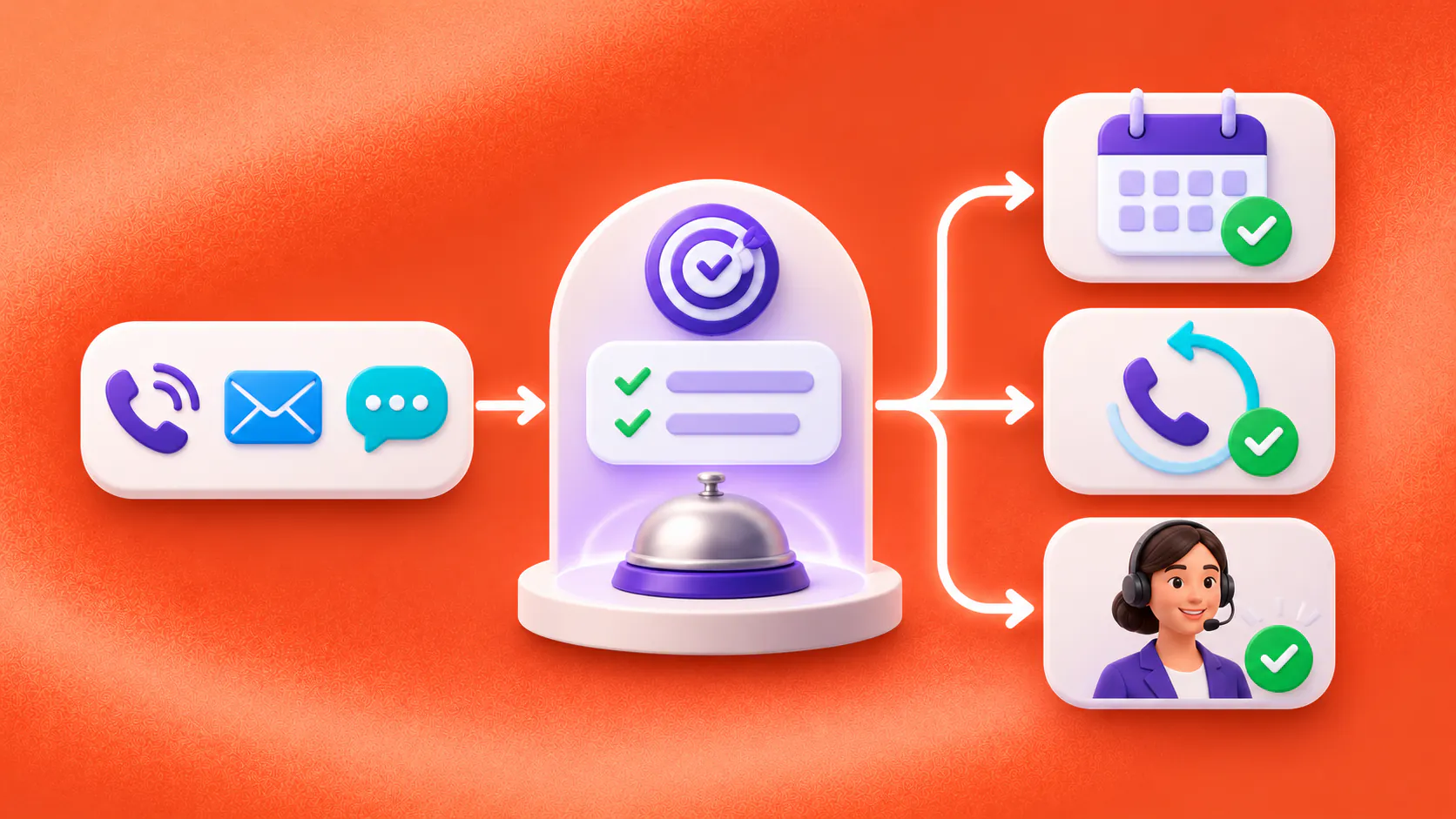
An AI receptionist handles suitable first-contact conversations by answering approved questions, collecting intent, coordinating configured bookings or requests and passing exceptions to the right person with useful context.
Key takeaways
- Use an AI receptionist for frequent first-contact tasks with approved answers and clear next steps.
- Connect bookings, callbacks and requests to the responsible system before describing them as complete.
- Keep complaints, negotiation, sensitive decisions and unusual exceptions with accountable people.
- Measure completed outcomes, failed actions, missed enquiries and handoff quality instead of call volume alone.
What is an AI receptionist?
An AI receptionist handles suitable first-contact conversations when a customer calls, messages or starts a web chat. It can answer from approved business information, ask why the person is getting in touch, collect the details required for the next step and continue into a configured booking, callback, request or human handoff.
The useful outcome is not a natural-sounding reply. It is an enquiry that no longer sits unanswered, a customer who knows what happens next and a team that receives the right context when it needs to take over.
An AI receptionist should have a defined job. It may handle routine questions and appointment requests, but it should not negotiate, make sensitive decisions or claim that an action succeeded when the connected system did not confirm it.
The boundary changes in regulated settings. The healthcare reception guide covers administrative patient enquiries, appointment coordination, privacy questions and the point where qualified staff must take responsibility.
Related must-read articles
- What is a conversational AI agent?
- How an AI booking agent supports appointment journeys
- How AI supports lead qualification
- Why human involvement matters
- How conversational AI works
Why does first contact break down?
Most reception problems look ordinary. The phone rings while the team is helping someone else. A new enquiry arrives after closing time. A caller asks for an appointment but leaves before anyone collects the preferred day. A customer explains the issue, gets transferred and has to start again.
These moments create more than inconvenience. Sales enquiries lose momentum. Service requests remain unowned. Staff return calls without knowing what the person wanted. Customers make a second contact because the first one produced no clear next step.
An AI receptionist can handle the repetitive opening layer while interest is active. It should capture the customer’s stated need, use current approved information and move only the permitted part of the journey. The point is to remove avoidable waiting, not to keep people away from the team.
What work can an AI receptionist complete?
Answer routine business questions
Opening hours, locations, service availability, basic preparation, public policies and the steps in a booking process are common first-contact questions. An AI receptionist can answer them when the business maintains an approved knowledge source.
Answers need boundaries. A public policy question may be suitable. A request for an exception, personal advice or a promise about a result needs a person. When the source does not contain a reliable answer, the system should say so and route the question.
Identify the reason for contact
“I need help” is not enough context for the next employee. An AI receptionist can ask a small number of relevant questions to distinguish a new sales enquiry, an appointment request, an existing customer issue, a cancellation or a request for a person.
The questions should follow the business’s real routing rules. A long interrogation defeats the purpose. For a new enquiry, the useful details may be the requested service, location, time frame and preferred next step. The lead qualification workflow should collect declared needs, not make sensitive inferences.
Coordinate appointments and callbacks
An AI receptionist may ask for a preferred day, location or time window, check permitted availability and submit the selected option through a connected appointment workflow.
A calendar suggestion is not a confirmed booking. The assistant should wait for the responsible system to return a successful state. If the calendar is unavailable or no slot fits, it can collect alternatives or create an owned follow-up instead of inventing availability.
Create an owned service request
Some conversations need a ticket, task or callback rather than an immediate answer. An AI receptionist can collect the minimum details and create the configured request through a workflow. The customer should hear whether the request was submitted, is waiting for review or could not be completed.
That distinction prevents a friendly conversation from hiding unfinished work. It also gives the team a queue it can manage instead of a transcript someone must discover later.
Continue permitted follow-up
When a caller asks for a callback or a prospect pauses before booking, a permitted follow-up can continue from the last useful state. It should stop when the customer replies, declines, completes the action, opts out or moves to a person.
The system does not create or manage paid advertising campaigns. Its role starts when an enquiry reaches the business or when the business contacts an appropriate person already held in its first-party records.
Hand the conversation to a person
Complaints, negotiation, sensitive questions, repeated misunderstanding, unusual exceptions and direct requests for staff need human ownership. The handoff should include the customer’s goal, details already collected, answers already given, actions attempted and the reason a person is required.
Human involvement is not a failure. It is the last use case in a well-designed reception journey.
A missed call becomes a confirmed next step
Consider an illustrative service business that receives a call after hours. The caller wants an appointment next week and asks whether a particular service is available.
The AI receptionist answers from the approved service list, asks for the preferred location and time window and checks the connected calendar. The requested time is unavailable, so it offers two valid alternatives. The caller chooses one, the calendar confirms it and the system sends the appointment details.
Now change one fact. The caller asks whether the service is suitable for a personal situation that requires professional judgment. The AI receptionist does not turn general information into advice. It records the question, explains that the appropriate team member needs to respond and creates an owned callback with the booking context attached.
Both journeys are useful. One ends in a confirmed appointment. The other reaches the right person without asking the caller to repeat the opening conversation.
What business value should you expect?
The strongest value comes from work the business can observe:
- More suitable enquiries receive an immediate first response;
- Staff spend less time repeating opening questions;
- Appointment requests reach a confirmed or visibly pending state;
- Callbacks arrive with the reason for contact and relevant details;
- After-hours conversations remain visible and owned;
- Customers have a clear route to a person;
- Managers can see where enquiries fail or wait.
Do not treat every answered call as success. An AI receptionist that responds quickly but routes customers incorrectly creates hidden work. Measure confirmed appointments, qualified next steps, accepted handoffs, failed actions, repeat contact, abandoned conversations and staff corrections.
The analytics layer should report only the outcomes and states the implemented workflow can capture.
How is it different from voicemail or a call menu?
Voicemail records a message for later. A call menu asks the caller to choose from fixed options. A live answering service depends on a person being available. An AI receptionist can hold a more flexible conversation, ask follow-up questions and connect suitable requests to configured business actions.
That flexibility adds responsibility. The business must control what information the system uses, what it may do, how it confirms actions and when it stops. NIST’s AI Risk Management Framework treats defined roles, accountability and ongoing review as part of responsible AI risk management. Those ideas apply directly to customer-facing reception work.
How should you evaluate an AI receptionist?
Start with real conversations rather than a feature list. Give each vendor or internal team the same examples: an after-hours enquiry, a full calendar, a request for a person, an unclear question, a failed integration, a complaint and a caller who changes their mind.
Then review:
- Scope. Which enquiries can it complete, and which must it route?
- Knowledge. Can the team approve, update and review the information used in answers?
- Actions. Which calendars, CRMs, ticketing tools or workflows can return a verified state?
- Handoff. Does the next employee receive enough context to continue?
- Failure recovery. What happens when speech is unclear, a tool fails or the customer gives an unexpected answer?
- Privacy and control. Can the business limit data, roles, permissions, retention and access?
- Review. Can staff inspect conversations, corrections, outcomes and unresolved work?
Price matters, but a lower subscription does not help if the team must repair missed bookings or misleading answers. Evaluate the full operating cost, including setup, integrations, maintenance, review and staff recovery time.
How should the first workflow launch?
Choose one frequent journey with a visible result. Appointment requests, new-enquiry qualification or routine service callbacks are stronger starting points than “answer every call.”
Write down the approved answers, required details, permitted actions, confirmation state, owner, handoff triggers and stop conditions. Test the common path, then spend equal time on failures. Use unclear requests, unavailable calendars, old customer records, background noise, changed contact details and direct requests for a person.
An AI receptionist should earn a wider role. Expand after the team can explain what it answered, what it attempted, what the connected system returned and who owns anything unfinished. ZINQ’s voice channel can support configured phone conversations alongside other customer channels, while the omnichannel inbox helps teams manage supported conversations and assignments.
Additional resources
- Explore AI voice agents for customer calls
- See appointment-booking workflows
- Learn how customer-service conversations are handled
Frequently asked questions
What is an AI receptionist?
An AI receptionist is software that handles suitable first-contact conversations by answering approved questions, collecting the reason for contact, supporting configured actions and involving a person when the request needs judgment or authority.
Can an AI receptionist answer phone calls?
Yes, when voice is part of the implemented setup. It may also support approved conversations on web chat or messaging channels, depending on the platform and configured workflow.
Can it book appointments?
It can coordinate an appointment when calendar access, availability rules and confirmation steps are configured. It should call the appointment confirmed only after the responsible scheduling system returns a successful state.
Does it replace a human receptionist?
It can take repetitive first-contact work and after-hours enquiries, but people remain responsible for exceptions, judgment, sensitive conversations, negotiation, complaints and failed workflows.
How should a business choose one?
Compare the real customer journeys it must handle, knowledge controls, integrations, failure recovery, handoff quality, reporting, privacy controls and the effort required to maintain it.
Conclusion
An AI receptionist is valuable when it gives each suitable enquiry a verified next step while making human ownership obvious. Start with one bounded journey, test failures as carefully as successful calls and expand only after the team can inspect what happened.
READY TO SEE ZINQ IN ACTION?
From first enquiry to conversion, follow-up and support, ZINQ helps automate the next step while keeping your team in control.
Book a DemoAdditional resources
-
What is a conversational AI agent?
A conversational AI agent is software that understands a customer message, checks approved knowledge, asks useful follow-up questions, takes permitted workflow actions and hands the conversation to a person when needed.
The ZINQ team · September 29, 2026 · AI Agents & Conversational AI -
AI booking agent: automate appointment requests without losing control
An AI booking agent handles appointment or reservation requests by collecting the right details, checking approved booking rules, confirming the next step, sending reminders and handing complex cases to a person.
The ZINQ team · September 29, 2026 · Workflows & Automation -
AI lead qualification agent: qualify enquiries before sales follows up
An AI lead qualification agent asks approved qualifying questions, records fit and intent evidence, identifies missing answers, routes ready leads and hands uncertain or high-value opportunities to sales with context.
The ZINQ team · September 29, 2026 · Sales & Conversion