AI Receptionist for Healthcare: Enquiries and Booking
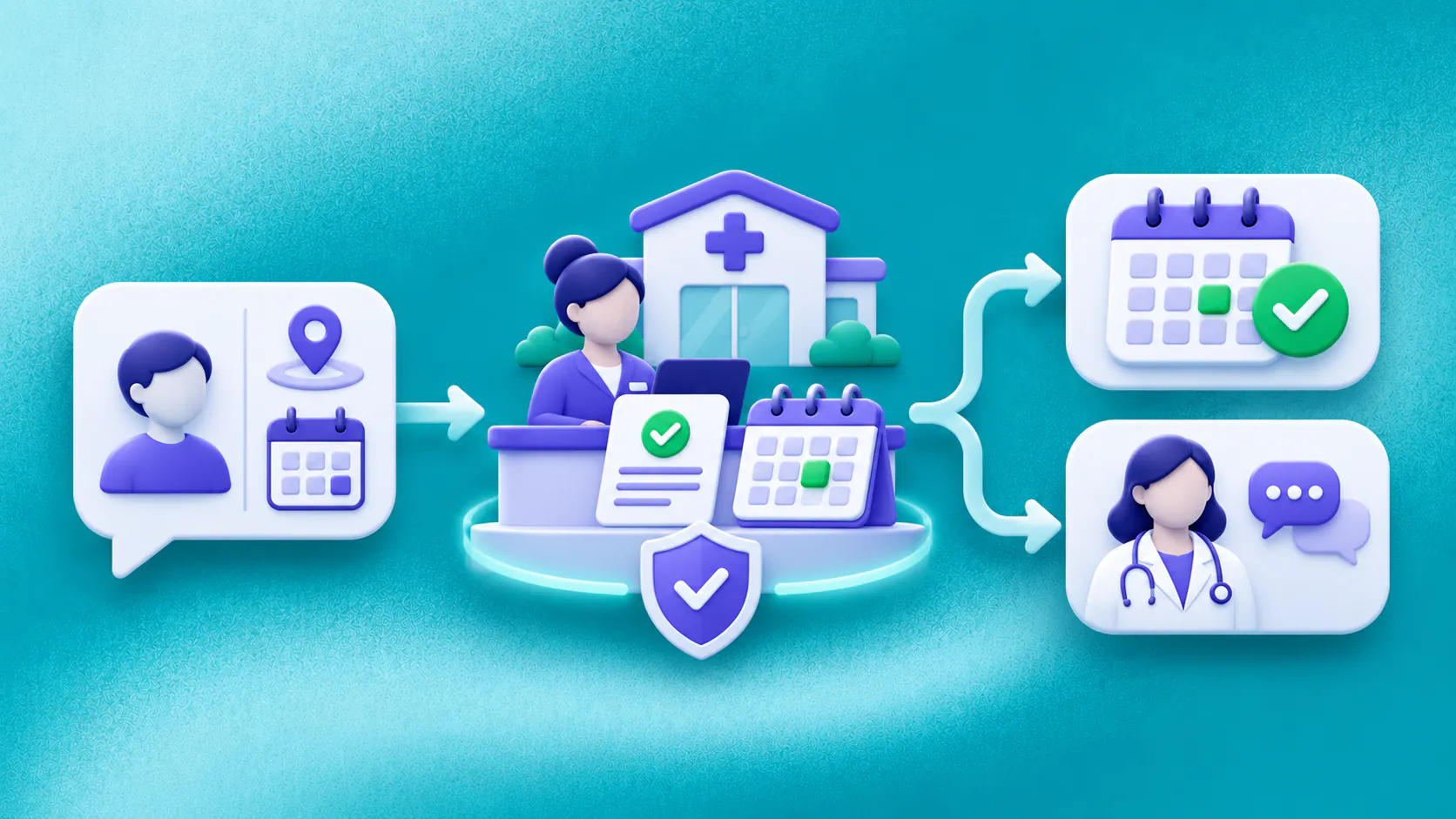
An AI receptionist for healthcare supports suitable administrative patient conversations such as approved service questions, appointment coordination, reminders and staff handoff while leaving clinical judgment, urgency decisions and treatment advice to qualified people.
Key takeaways
- Keep the first scope administrative: approved information, appointment coordination, reminders and staff routing.
- Do not use a general reception workflow for diagnosis, treatment recommendations or urgency decisions.
- Collect only the information needed for the next administrative step and protect sensitive health data.
- Treat a booking as complete only after the responsible scheduling system confirms it.
What is an AI receptionist for healthcare?
An AI receptionist for healthcare supports suitable administrative conversations before and after a patient visit. It can answer from approved service information, collect the minimum booking details, coordinate a configured appointment request, send permitted reminders and bring clinic staff into the conversation when a person needs to take responsibility.
It should not diagnose, recommend treatment, assess symptoms or decide whether a situation is urgent. Those decisions belong to qualified people and the healthcare organisation’s approved clinical or emergency pathway.
For the broader business category, start with the general AI receptionist guide. This article narrows that operating model to healthcare administration and its clinical, privacy and professional boundaries.
The practical value is easier to see at 8:30 p.m. A prospective patient asks whether a service is available and wants an appointment. The front desk is closed, but the enquiry does not need to wait unanswered until morning. The administrative part can continue, while any clinical question goes to staff.
Related must-read articles
- Clinic AI agents for administrative workflows
- AI appointment booking for clinics
- Why human handoff matters in healthcare
- Conversational AI in healthcare
- Clinic appointment reminders
Where does patient access slow down?
Reception teams work across phone calls, messaging, forms, calendars and practice systems. A single enquiry may need several pieces of information before anyone can offer the next step. When the team is busy, routine questions and incomplete booking requests queue beside sensitive conversations.
The delays are familiar:
- A new enquiry arrives after hours and receives no useful answer;
- A patient asks about location, availability or preparation and waits for a callback;
- Staff call back without knowing the requested service or preferred time;
- A booking link is sent, but nobody follows up when the patient stops;
- A patient repeats details after the conversation moves to another employee;
- Clinical questions sit in the same queue as routine appointment changes.
An AI receptionist for healthcare can separate suitable administrative work from requests that need qualified judgment. That distinction matters more than how human the conversation sounds.
Which healthcare reception tasks are suitable?
Answer approved administrative questions
Patients often ask about opening hours, locations, services offered, documents to bring, public preparation information and the booking process. A healthcare AI receptionist can use current, organisation-approved sources to answer those questions.
The source must define the boundary. A public statement about a service is different from telling someone whether that service is suitable for them. The first may be administrative information. The second requires professional judgment.
The knowledge layer should make approved information maintainable and reviewable. When no reliable answer exists, the system should route the question rather than improvise.
Collect the minimum booking details
An AI receptionist for healthcare may collect the service requested, preferred location, time window, contact details and other information the organisation has approved for that administrative step.
More data is not automatically better. Do not ask for symptoms, medical history, images or identity documents unless the workflow needs them, the channel is suitable and the organisation has established the required legal, privacy and access controls.
Coordinate appointments
The assistant can check permitted availability, present suitable times and submit a selection through a connected appointment-booking workflow. It should describe the appointment as confirmed only after the responsible scheduling system returns that state.
If the calendar is unavailable, an AI receptionist for healthcare should not guess. It can collect alternatives, mark the request as pending and create an owned task for reception staff.
Support reminders and administrative follow-up
Configured confirmations, reminders, preparation information and rescheduling messages can reduce manual chasing. A permitted follow-up may also continue an incomplete booking from the last valid step.
Timing, consent, channel rules and opt-out handling still apply. Healthcare organisations should be especially careful with message content that may reveal sensitive information on a shared device or lock screen.
Route requests to the right staff
Clinical questions, possible urgency, medication requests, test-result discussions, treatment choices, complaints and sensitive exceptions need a person. The human-handoff workflow should carry only the context required to continue safely.
Human involvement is the final use case. An AI receptionist for healthcare should make it easier to reach qualified staff, not create another barrier.
A patient enquiry after the front desk closes
Consider an illustrative prospective patient who messages after hours. They ask whether the organisation offers a particular service and whether appointments are available on Saturday.
The AI receptionist for healthcare checks the approved service and location information. It confirms that the service is offered, asks for the preferred location and checks the scheduling system. The system returns two available times. The patient selects one, and the scheduling system confirms the appointment.
The conversation then changes. The patient asks whether the service is appropriate for a symptom they are experiencing. The assistant does not interpret the symptom or recommend care. It explains that qualified staff must answer the clinical question and follows the organisation’s approved route for clinical or urgent requests.
The administrative work still has value. Staff receive the confirmed appointment details, the patient’s stated question and the reason a person is needed. The patient does not have to repeat the entire enquiry.
What should remain with people?
Use a clear boundary when planning healthcare reception automation.
| Type of work | Examples | Responsible next step |
|---|---|---|
| Approved administrative information | Locations, opening hours, services listed, public preparation guidance | Answer from current approved sources |
| Confirmation-dependent action | Appointment request, reschedule, reminder or document request | Wait for the responsible system or staff to confirm |
| Qualified judgment | Symptoms, urgency, diagnosis, treatment, medication or clinical suitability | Route through the approved clinical pathway |
| Sensitive exception | Complaint, safeguarding concern, unclear identity or unusual policy request | Assign an authorised person |
An AI receptionist for healthcare should be designed around the handoff boundary from the start. Adding escalation after launch often leaves the most important conversations with the weakest route to help.
What privacy questions should the organisation answer?
Healthcare conversations may contain sensitive information even when the workflow begins as a simple booking request. The organisation should document what information is collected, why it is needed, where it is stored, who can access it, how long it is retained and what happens when a patient asks for a person.
Rules differ by jurisdiction and organisation. In the United States, the Department of Health and Human Services explains that the HIPAA Privacy Rule protects medical records and other individually identifiable health information for covered entities and their business associates. In the United Kingdom, the Information Commissioner’s Office treats health information as special category data with additional processing requirements.
Those links are starting points, not legal advice or a claim that any product configuration is compliant. Each organisation needs appropriate privacy, security, legal and clinical review for its locations and workflows.
Practical questions include:
- Does the conversation need this information to complete the administrative step?
- Is the chosen channel appropriate for the information requested?
- Can staff see who accessed or changed the workflow?
- Does a third-party provider have the required contract and controls?
- Can the organisation correct, retain or delete information as required?
- What happens if identity cannot be established?
The safest default is to collect less and route sooner when the purpose or authority is unclear.
How should healthcare teams measure value?
Do not measure success through the number of automated messages. Track whether suitable administrative journeys reach a reliable next state.
Useful measures may include:
- Enquiries answered from approved information;
- Appointment requests confirmed by the scheduling system;
- Requests left pending because an integration or calendar failed;
- Patients who complete, abandon or reschedule a booking journey;
- Handoffs accepted with enough context for staff to continue;
- Clinical or sensitive requests routed through the correct path;
- Questions the approved knowledge could not answer;
- Staff corrections, privacy concerns, opt-outs and complaints.
An AI receptionist for healthcare should reduce avoidable reception work without hiding unresolved patient needs. A short response time means little if the question reached the wrong team.
The analytics platform should report only information the implemented workflow can capture and staff are authorised to review.
How should the first workflow launch?
Start with one administrative journey, such as a new-service enquiry that leads to an appointment request or an existing appointment that needs rescheduling. Map the approved information, minimum details, scheduling action, confirmation state, owner and handoff triggers.
Test more than the happy path. Include unavailable appointments, failed calendar access, unclear identity, sensitive questions, possible urgency, a patient who changes their mind and a direct request for staff. Review each conversation with reception, clinical, privacy and product owners before expanding scope.
An AI receptionist for healthcare earns trust through visible limits. The team should be able to explain what it answered, what information it collected, which system action occurred and who owns anything unfinished.
ZINQ for clinics supports approved administrative communication, appointment journeys and staff handoff across configured channels. The clinic lead-intake workflow shows how an incoming enquiry can move towards an owned next step without turning administrative automation into clinical decision-making.
Additional resources
- Explore ZINQ for clinics and healthcare teams
- See clinic appointment-booking workflows
- Review post-visit communication boundaries
Frequently asked questions
What is an AI receptionist for healthcare?
It is software that supports suitable administrative patient conversations by answering from approved information, collecting booking details, coordinating configured appointment workflows and routing clinical or sensitive requests to qualified staff.
Can it give medical advice?
A general healthcare reception system should not diagnose, recommend treatment, assess symptoms or decide urgency. Those requests need the organisation's approved clinical or emergency pathway and qualified people.
Can it book patient appointments?
It can coordinate an appointment when scheduling access, availability rules and confirmation steps are configured. It should describe the appointment as confirmed only after the responsible system returns that state.
Can it handle patient data?
The organisation must determine the lawful basis, minimum necessary information, access, security, retention and vendor obligations that apply in its jurisdiction and implementation. Sensitive data should not be collected merely because the conversation allows it.
When should staff take over?
Staff should take over for clinical questions, urgency or safety concerns, sensitive requests, unclear identity, policy exceptions, complaints, failed actions and any direct request for a person.
Conclusion
An AI receptionist for healthcare should reduce administrative waiting without becoming a clinical decision-maker. Begin with one bounded patient journey, protect sensitive information, verify each system action and make qualified staff easy to reach.
READY TO SEE ZINQ IN ACTION?
From first enquiry to conversion, follow-up and support, ZINQ helps automate the next step while keeping your team in control.
Book a DemoAdditional resources
-
Clinic AI Agent: Administrative Workflows and Handoff
A clinic AI agent supports administrative patient communication by answering from approved information, collecting the minimum details needed, coordinating appointment workflows and handing sensitive, urgent or clinical questions to qualified staff.
The ZINQ team · October 7, 2026 · Industries → Clinical & Healthcare -
How Clinics Can Turn More Appointment Enquiries Into Confirmed Visits
Clinics can convert more appointment enquiries by replying while interest is high, asking only for useful details, and clearly separating a request from a confirmed appointment.
The ZINQ team · October 14, 2026 · Industries → Clinical & Healthcare -
Designing human handover for clinic AI communication
Clinic AI communication needs a defined route to an appropriate person when a request is clinical, urgent, unclear or outside the approved administrative scope. A handoff is useful only if the receiving team can act on it.
Pavan · August 11, 2026 · Industries → Clinical & Healthcare