AI lead qualification agent: qualify enquiries before sales follows up
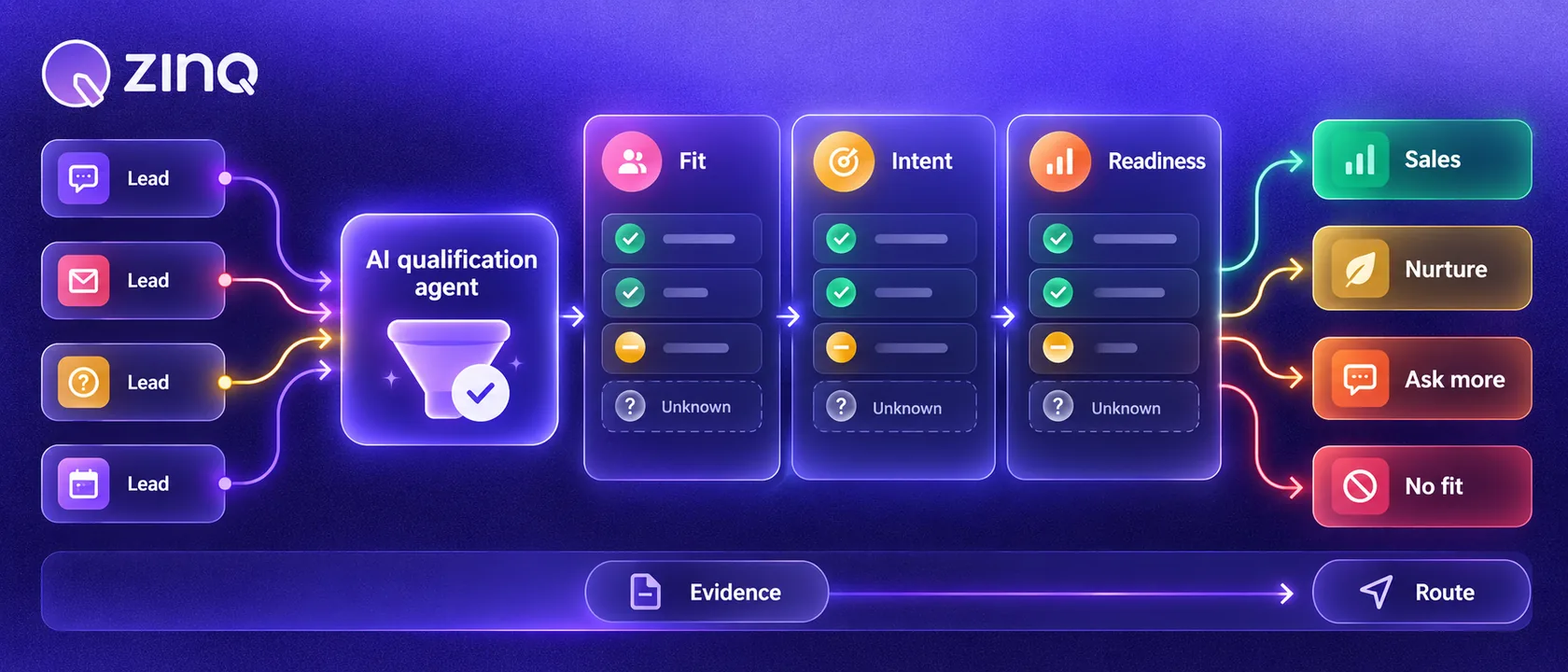
An AI lead qualification agent asks approved qualifying questions, records fit and intent evidence, identifies missing answers, routes ready leads and hands uncertain or high-value opportunities to sales with context.
Key takeaways
- A lead qualification agent should collect evidence, not only assign a score.
- Fit, intent and readiness should be separated so sales can understand the route.
- Unknown answers should stay visible instead of being treated as negative answers.
- The best first workflow routes leads to a useful next step: sales, nurture, more questions or no fit.
What an AI lead qualification agent does
An AI lead qualification agent talks to inbound prospects and collects the information sales needs before choosing the next step. It may ask about the use case, urgency, location, team size, service need, budget range, current process or preferred follow-up channel.
The point is not to interrogate every lead. The point is to collect enough evidence to route the person usefully. A ready lead can go to sales. An early-stage lead can enter follow-up. A missing answer can trigger one more question. A clear no-fit lead can be handled according to approved rules.
Some teams call this a lead generation chatbot or sales chatbot. That can describe the entry point, but qualification needs more discipline than a contact form in chat.
The agent should qualify with evidence
Sales teams need to know why a lead was routed. A black-box score is hard to trust.
A good lead qualification agent records:
- the question asked;
- the customer’s answer;
- the source channel;
- the timestamp;
- the fit, intent or readiness signal created by the answer;
- any unknown answers still needed.
This makes follow-up easier. Sales can see whether a lead is ready because they asked for pricing, matched the target segment and requested a demo, or whether the agent simply lacked enough information.
Separate fit, intent and readiness
Qualification gets messy when every signal becomes one number too early. Keep three dimensions visible.
| Dimension | What it means | Example signal |
|---|---|---|
| Fit | Whether the lead matches the business’s target customer | Industry, location, company type, service need |
| Intent | Whether the lead shows buying or action interest | Asked for pricing, demo, appointment or timeline |
| Readiness | Whether the lead can take the next step now | Has contact details, preferred time, authority or required information |
This structure pairs well with the rubric approach in AI lead scoring. The agent collects the evidence. The scoring or routing rule decides what happens next.
Design questions around the next step
Do not ask every possible sales question. Ask what the next step requires.
For a demo request, the agent may need role, company size, use case and preferred time. For a clinic enquiry, it may need service interest, city and contact number. For a real estate enquiry, it may need budget range, location, property type and visit timeline.
The agent should also stop asking when the customer has given enough. Over-qualification can kill a lead that was ready to speak to a person.
Handle unknown answers carefully
Unknown does not mean no. If a customer has not answered the budget question, that is different from saying they have no budget. If they have not given a timeline, that is different from saying they are not interested.
The agent should preserve unknown answers and use them in routing. For example:
- ask one follow-up question if the missing answer is required;
- route to nurture if the customer is early but relevant;
- route to sales if intent is strong and the missing answer can be collected later;
- hand off if the opportunity is high-value or ambiguous.
This avoids the common mistake of rejecting useful leads because the chatbot failed to ask the right question.
A practical qualification workflow
A visitor asks through web chat, “Can ZINQ help with WhatsApp enquiries for my clinic?”
The AI lead qualification agent can ask what type of clinic they run, which city they serve, how many enquiries they handle, whether they need booking or follow-up, and how they prefer to be contacted. If the person shows clear fit and intent, the agent routes them to a demo. If they ask detailed pricing questions, it can collect the question and hand off with context.
The sales team receives the lead with service need, channel, urgency, known answers and missing answers. That is more useful than a name, email and generic “interested” tag.
Connect qualification to follow-up
Qualification should not end when the conversation ends. The next step may be a demo, a call, a nurture sequence, a reminder or a human review task.
This is where lead qualification, contacts and campaigns and segments fit together. The agent can help create a cleaner contact record and send the lead into the right follow-up path.
If the lead is not ready, the business should still know why. Early-stage, missing information, wrong service, wrong location and no response are different outcomes.
How to measure it
Measure what happens after routing.
Useful measures include:
- percentage of leads with required answers;
- sales acceptance rate;
- speed to follow-up;
- booked demo or appointment rate;
- disqualification accuracy;
- unknown-answer rate by question;
- lead source and channel quality;
- revenue or conversion by route where available.
Review transcripts where sales disagrees with the route. Those examples show whether the questions, rubric or handoff rule needs work.
Where ZINQ fits
ZINQ can handle lead qualification conversations across channels such as WhatsApp, web chat, Instagram, email, Telegram and voice. The agent can ask approved questions, record structured answers, route by rule and hand off to your team when a lead is ready or uncertain.
Start with one route. For example: demo-ready, needs follow-up, missing information or no fit. Once those routes are clean, add more nuance.
Frequently asked questions
What is an AI lead qualification agent?
It is an AI agent that talks to inbound leads, asks qualifying questions, records the evidence, identifies missing information and routes the lead to the next sales or follow-up step.
Is it the same as a lead generation chatbot?
A lead generation chatbot often captures contact details. An AI lead qualification agent should also evaluate fit, intent, readiness and routing rules while keeping the evidence visible to sales.
What questions should it ask?
Ask only what the next step needs. Common areas include use case, urgency, location, company size, budget range, current tool, decision role and preferred follow-up channel.
Should it disqualify leads automatically?
It can route clear no-fit leads according to approved rules, but high-value or uncertain cases should be reviewed. Missing information should usually trigger a follow-up question rather than an instant rejection.
Conclusion
An AI lead qualification agent is useful when sales can see the reasoning behind each route. Keep the questions tied to the buying process, preserve unknowns and send every lead to a clear next step.
READY TO SEE ZINQ IN ACTION?
From first enquiry to conversion, follow-up and support, ZINQ helps automate the next step while keeping your team in control.
Book a DemoRelated articles
-
AI lead scoring: build a rubric that records unknown answers
Build an AI lead scoring rubric with separate fit, intent and readiness criteria, explicit evidence for every point, and an unknown state for answers that have not been collected. Route leads using the score and mandatory rules, while keeping the underlying answers visible to sales.
The ZINQ team · September 21, 2026 · Sales & Conversion -
How to qualify website enquiries with an AI agent
An AI qualification flow should collect the minimum information needed to route an enquiry and offer a relevant next step. Use explicit business criteria, keep unknown answers visible and let visitors ask questions before demanding a full profile.
Pavan · June 30, 2026 · Sales & Conversion -
Planning lead capture and follow-up with ZINQ
A lead workflow should capture the customer's request, collect relevant details and deliver an owned next step. With ZINQ, confirm the supported qualification, action and follow-up configuration for that sequence before rollout.
Pavan · June 10, 2026 · Sales & Conversion