AI lead scoring: build a rubric that records unknown answers
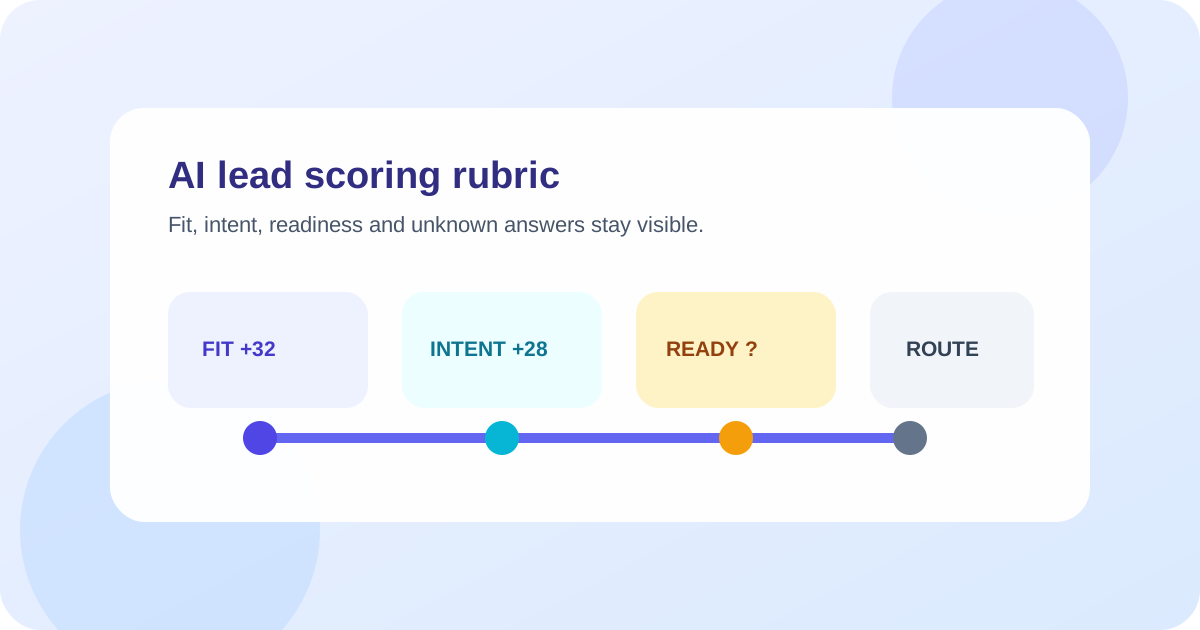
Build an AI lead scoring rubric with separate fit, intent and readiness criteria, explicit evidence for every point, and an unknown state for answers that have not been collected. Route leads using the score and mandatory rules, while keeping the underlying answers visible to sales.
Key takeaways
- Separate customer fit, buying intent and readiness so one strong signal does not hide a critical gap.
- Record unknown separately from no; missing evidence should not silently become a negative answer.
- Store the answer, source and timestamp behind every score contribution.
- Combine numeric thresholds with mandatory routing rules for disqualifiers, urgency and human review.
- Test the rubric against historical examples before using it to change sales priority.
What is an AI lead scoring rubric?
An AI lead scoring rubric is a defined set of criteria that turns verified lead information into fit, intent and readiness signals. The AI may collect and structure the evidence, but the business decides which answers matter, how they are weighted and what route follows.
A score should help a team choose the next useful action. It might route a ready, well-matched buyer to sales, place an early-stage lead into an approved follow-up journey, ask for one missing answer or stop a clearly unsuitable request from consuming sales time.
The number alone is not enough. Sales should be able to see the answers, sources and rules behind it. If two leads both score 60, one may have confirmed moderate fit while the other has strong signals plus several unknowns. Those situations need different next steps.
Separate fit, intent and readiness
Begin with three dimensions rather than one undifferentiated list.
| Dimension | Question | Example evidence |
|---|---|---|
| Fit | Is this account or person within the market you can serve? | Industry, use case, location, team or technical requirement |
| Intent | Is there evidence that the lead is actively exploring a solution? | Direct question, requested comparison, repeat visit or demo request |
| Readiness | Can a useful next step happen now? | Timeline, decision process, required stakeholder or available project owner |
Separating the dimensions prevents an enthusiastic but unsuitable enquiry from outranking a quiet, well-matched account without explanation. It also stops long-term fit from being mistaken for immediate buying intent.
Keep each criterion specific. “Good company” cannot be scored consistently. “Operates in a supported industry” or “needs a supported customer workflow” gives the team an answer it can verify.
Give every criterion an evidence rule
For each criterion, define:
- the question or field being evaluated;
- accepted answer values;
- the source that can support the answer;
- the points or category contribution;
- the expiry rule, if the fact can become stale; and
- the next action when the answer is unknown.
Suppose “implementation within 90 days” adds readiness points. A customer saying “we want to start this quarter” is direct evidence. An AI agent inferring urgency because the customer used the word “soon” is not equivalent. Store the direct quote or structured response behind the score.
The HubSpot lead scoring documentation shows one established pattern: separate fit and engagement scores can be stored in distinct properties. Your exact criteria will differ, but preserving dimensions makes the result easier to inspect and revise.
Record unknown instead of converting it to no
Use at least four answer states:
- Yes: the criterion is supported by current evidence.
- No: current evidence shows the criterion is not met.
- Unknown: the answer has not been collected or cannot be verified.
- Not applicable: the criterion does not apply to this lead or route.
Unknown may contribute zero points to a numeric total, but it must remain visible. Otherwise the calculation cannot distinguish a poor match from an incomplete conversation.
Unknown also creates an action. If timeline is the only missing readiness field, the next message can ask one concise question. If several high-value fields remain unknown, the route may be manual review rather than automatic rejection.
Do not reward a system for collecting every possible field. Ask only for information needed to choose a useful next step. A long qualification interview can create friction without improving the route.
Build the first scoring table
Consider a hypothetical B2B service that qualifies enquiries for an AI customer-operations platform.
| Criterion | Dimension | Yes | No | Unknown action |
|---|---|---|---|---|
| Needs a supported customer workflow | Fit | +20 | Stop or alternative route | Ask for primary workflow |
| Uses a supported channel | Fit | +10 | 0 | Ask only if channel affects feasibility |
| Has a named implementation owner | Readiness | +15 | 0 | Flag for follow-up |
| Plans to act within 90 days | Readiness | +15 | 0 | Ask timeline |
| Requests a demo or technical review | Intent | +15 | 0 | No extra question required |
| Describes current process or constraint | Intent | +10 | 0 | Ask one context question |
Weights express business judgment, not universal truth. Use a small range and avoid false precision. A score of 63 is not inherently more accurate than a score of 60.
Add hard rules outside the total. A request involving an unsupported geography, prohibited use or missing mandatory consent may require a different route regardless of points. A strategic account may require human review even with incomplete data.
Turn the score into a routing contract
A routing contract names the destination, owner and next action for each combination of score and mandatory rules.
For example:
- High fit + high readiness: create a sales task and offer an approved booking step.
- High fit + unknown readiness: ask the missing readiness question or assign research.
- High fit + low current intent: enter an appropriate nurture path if the person has agreed to it.
- Low fit + high intent: route to a truthful alternative or decline without wasting the customer’s time.
- Conflicting or sensitive evidence: send to human review.
Do not use the score to conceal ownership. If an AI lead qualification agent creates a sales task, name the queue and expected acceptance event. If no one owns a route, it is not ready for automation.
The broader website visitor qualification guide covers conversation flow. The lead qualification use case shows where this routing fits within ZINQ.
Store an explainable score record
Every score event should retain enough context to answer “why did this lead receive this route?” A useful record contains:
- criterion identifier and version;
- normalized answer state;
- evidence value and source;
- timestamp;
- points or rule outcome;
- unknown fields;
- total by dimension;
- mandatory rule results; and
- selected route.
Keep the source conversation or CRM field linked where permitted. When a representative corrects an answer, update the score and preserve the change rather than silently overwriting the history.
Use the contacts and CRM layer to understand how customer context can support workflows, but verify the exact fields and integrations available for your setup.
Test the rubric before changing priority
Take a sample of historical leads that represents good outcomes, poor fits, long sales cycles and incomplete records. Hide the eventual outcome while reviewers apply the proposed rubric, then compare the route with what happened.
Look for:
- criteria that reviewers interpret differently;
- unknown values that dominate the score;
- one field that overwhelms every other signal;
- leads routed correctly for the wrong reason;
- groups systematically disadvantaged by a proxy field; and
- thresholds that create queues the team cannot serve.
Do not claim that the rubric caused a conversion improvement without an appropriate comparison and measurement design. The initial goal is more modest: consistent, explainable routing that the team can inspect.
Run regression examples whenever the questions, weights, offer or route changes. Review disagreements between sales and the score as evidence, not as proof that either side is always right.
Track whether the score helps
Measure the operating decision, not only the average score. Useful checks include:
- acceptance rate for leads routed to sales;
- time to ownership by route;
- percentage of leads with critical unknown fields;
- routes changed by a person and the recorded reason;
- progression by fit, intent and readiness band; and
- stale scores based on expired evidence.
Segment results by rubric version. If the criteria change, comparisons that combine old and new logic can mislead the team.
Where ZINQ fits
ZINQ can conduct customer conversations, collect approved qualification fields, use customer context and move a qualified enquiry into a configured workflow across supported channels. The score and route should still reflect criteria your sales team has approved.
Bring the rubric, mandatory rules and representative examples to a ZINQ evaluation. A useful demonstration should show an unknown answer, a conflicting answer and the resulting task or route, not only a perfectly qualified lead.
Frequently asked questions
What is AI lead scoring?
AI lead scoring uses customer data and conversation evidence to estimate fit, intent or readiness and support a routing decision. The scoring logic still needs business-defined criteria, evidence rules and human ownership.
Should an unknown answer receive zero points?
Keep unknown as its own state. You may assign it no points for calculation, but the record should distinguish missing evidence from a confirmed no so the next step can collect the answer instead of rejecting the lead.
Can an AI lead score replace sales review?
A score can prioritize and route, but it should not conceal the evidence or make unsupported decisions. Use human review for ambiguous, strategic or high-value cases and monitor disagreements between the rubric and sales.
How often should a lead scoring rubric be updated?
Review it when the offer, target customer, sales process or available data changes. Also review it on a fixed cadence using conversion outcomes, routing errors and examples where unknown answers affected the decision.
Conclusion
A useful AI lead score is an explainable routing aid, not a mysterious rank. Define the evidence for each criterion, preserve unknown answers, expose the calculation and test the route with real examples. Improve the rubric when observed outcomes show that a criterion or weight no longer helps the team.
READY TO SEE ZINQ IN ACTION?
From first enquiry to conversion, follow-up and support, ZINQ helps automate the next step while keeping your team in control.
Book a DemoRelated articles
-
How to qualify website enquiries with an AI agent
An AI qualification flow should collect the minimum information needed to route an enquiry and offer a relevant next step. Use explicit business criteria, keep unknown answers visible and let visitors ask questions before demanding a full profile.
Pavan · June 30, 2026 · Sales & Conversion -
Planning lead capture and follow-up with ZINQ
A lead workflow should capture the customer's request, collect relevant details and deliver an owned next step. With ZINQ, confirm the supported qualification, action and follow-up configuration for that sequence before rollout.
Pavan · June 10, 2026 · Sales & Conversion -
How to write instructions for an AI customer-service agent
Useful AI agent instructions define the task, approved sources, allowed actions and conditions for clarification or handoff. Give the system behavioral rules and examples rather than a rigid script for every possible conversation.
Pavan · July 13, 2026 · AI Agents & Conversational AI