What Is an AI Voice Agent?
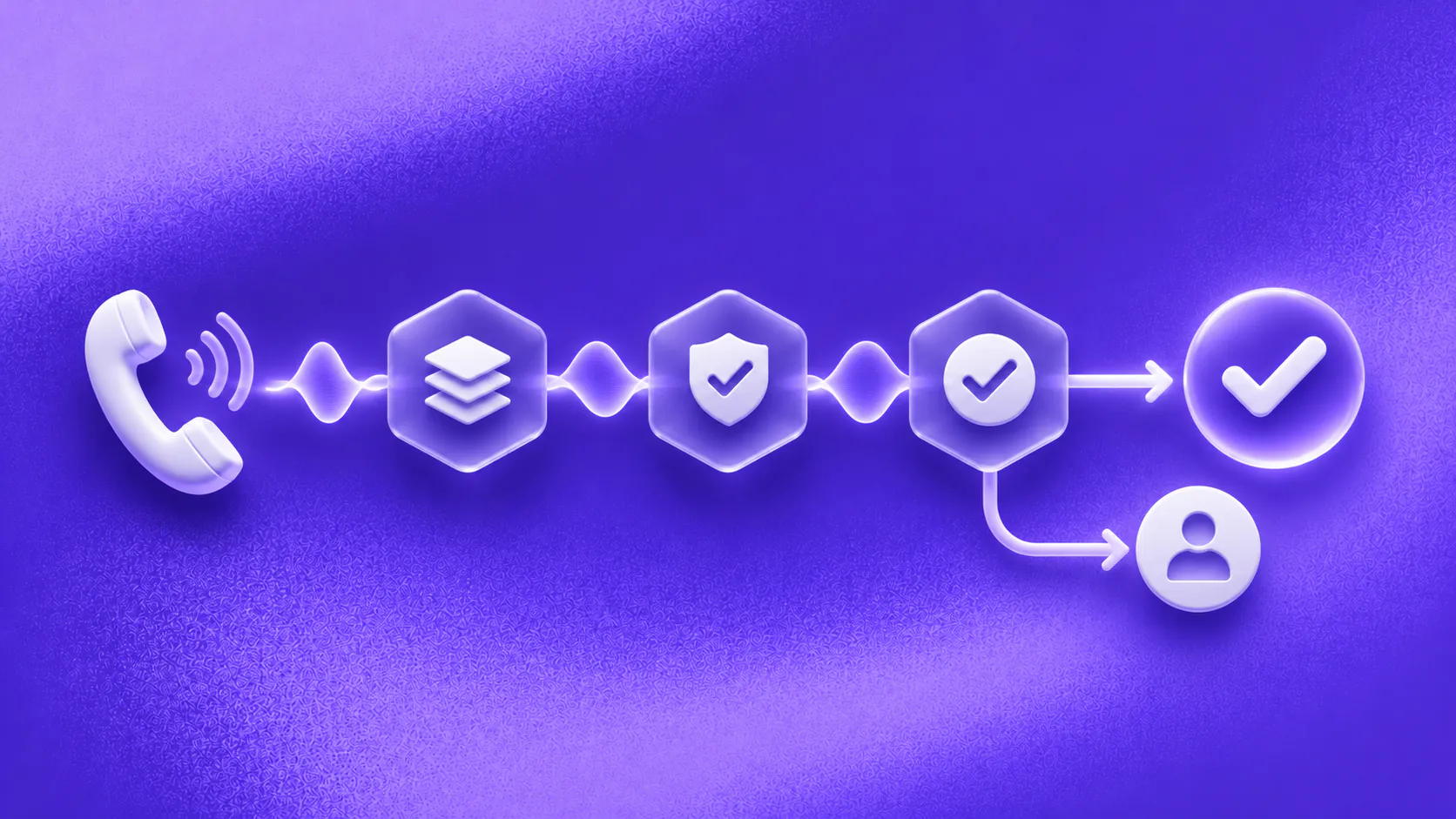
An AI voice agent is software that holds spoken conversations, understands a caller's request, uses approved information and connected tools, and moves the call toward a confirmed action or an accountable human handoff.
Key takeaways
- Judge a voice agent by the customer task it completes, not only by how natural it sounds.
- Require connected systems to confirm bookings, updates and other actions before the agent describes them as complete.
- Test background noise, interruptions, corrections, failed tools and requests for a person before launch.
- Keep identity-sensitive actions, exceptions and consequential decisions with authorised people and systems.
What is an AI voice agent?
An AI voice agent is software that listens and responds during a spoken conversation. It works out what the caller needs, answers from approved information and may use connected tools to complete a defined task. When the request needs judgment, authority or information it cannot verify, it should involve a person with enough context to continue.
The important test is not whether the voice sounds human. It is whether the caller reaches a reliable next step. A natural conversation that promises an appointment without creating one leaves more work for the customer and the team.
A business may use an AI voice agent to answer suitable incoming calls, collect details, qualify an enquiry, support booking or create a service request. Outbound calling is a separate decision. It brings consent, disclosure, calling-time, suppression and opt-out responsibilities that vary by purpose and jurisdiction.
For a broader explanation of the underlying category, see what conversational AI is. The ZINQ Voice channel describes the supported commercial product scope.
Related must-read articles
- What is an AI receptionist?
- How conversational AI works
- Where people should remain in control
- How to implement conversational AI
- Planning Voice support with ZINQ
What happens during a Voice AI agent conversation?
Each turn begins when the caller speaks. The system must detect that speech, determine when the caller has finished, interpret the request and decide whether to answer, ask another question, use a tool or transfer the call. It then produces a spoken response and listens again.
Some systems connect separate speech recognition, language-model and speech-generation components. Others use a speech-to-speech model. That architecture matters to technical teams, but business buyers should begin with the observable result: Can the system hear the caller in realistic conditions, use the right source, complete the permitted action and recover when something fails?
The approved knowledge layer determines which business facts the agent can use. The workflow layer determines which actions it may attempt. A calendar, CRM, ticketing system or other system of record determines whether the action actually happened.
This distinction matters on a live call. If the caller selects Tuesday at 3 p.m., the agent can repeat the requested time. It should describe the appointment as booked only after the scheduling system confirms it.
How is it different from IVR, voicemail and an AI receptionist?
These tools may share a phone line, but they do different jobs.
| Option | What it usually does | Where it stops |
|---|---|---|
| Voicemail | Records a message for later review | The caller waits for someone to listen and respond |
| IVR | Routes callers through fixed menu choices | Unexpected requests often fall outside the menu |
| Live answering service | Uses a person to answer and collect information | Capacity and availability depend on staffing |
| AI receptionist | Handles first-contact work such as answering, booking and routing | Its role is centred on reception and the opening stage |
| AI voice agent | Holds a spoken conversation and may complete configured work across a wider customer journey | It remains limited by knowledge, permissions, connected systems and human-ownership rules |
The labels are not reliable by themselves. A product called an AI voice bot may complete connected actions, while a product called an agent may only answer questions. Compare what it can do during an ordinary call, what happens on failure and what the next employee receives after transfer.
The AI receptionist guide covers the narrower first-contact role. This pillar covers the wider Voice operating model.
Which calls suit a Voice AI agent?
Suitable calls have a clear customer goal, approved information, a bounded action and a visible completion state. They do not need to be trivial, but the organisation must be able to explain what the system may do and when responsibility changes.
New enquiries and qualification
A caller may ask whether a service is available, which location serves their area or what happens next. The agent can answer approved questions and collect declared needs such as location, time frame and preferred next step. The lead-qualification workflow should route what the caller says, not make sensitive or opaque inferences.
Appointment requests
Voice works well when a caller would rather explain timing and constraints than complete a form. The agent can collect the required details, check permitted availability and submit a selection through an appointment-booking workflow. It must preserve corrections and wait for confirmation from the responsible system.
Routine service requests
A customer may ask for an order update, a callback, a cancellation request or help with a known problem. The agent can answer from approved information or create an owned request when the configured workflow supports it. The Customer Support use case shows how routine work and exceptions can share one operating model.
Human transfer
Complaints, negotiation, unusual exceptions, sensitive decisions and direct requests for staff need a person. A useful human handoff includes the caller’s goal, details already collected, answers already given, actions attempted and the reason for transfer.
What does a complete Voice AI agent call look like?
Consider an illustrative inbound call to a multi-location service business. The caller asks whether a service is offered nearby and wants an appointment next week.
The AI voice agent answers from the approved service and location information. It asks which location the caller prefers, collects a suitable time window and checks the scheduling system. The requested slot is unavailable, so it offers two returned alternatives. The caller chooses one. The scheduling system confirms the booking, and the agent reads back the location, date and time.
Now change one condition. The scheduling tool does not respond. The agent should not hide the failure behind a friendly confirmation. It can collect the caller’s preferred alternatives, create a pending callback and explain when the responsible team will review it. The unfinished request needs a visible owner.
The call changes again when the caller asks an identity-sensitive question about an existing account. A phone number may provide a clue, but it is not sufficient verification for every action. The agent follows the organisation’s approved identity process or transfers the call to an authorised person.
The value in all three paths comes from clarity. The first call ends in a confirmed booking. The second creates an owned pending request. The third protects an action that requires stronger verification.
Where should people remain responsible?
An AI voice agent should complete suitable work before handing off, but its boundaries need to be designed before launch.
People or authorised systems should remain responsible when a call requires:
- A consequential clinical, financial, insurance or legal decision;
- Negotiation, discretion or a policy exception;
- Identity or authority that the current process cannot establish;
- Sensitive information outside the approved collection purpose;
- A response missing from approved knowledge;
- Recovery from a failed connected system;
- Complaint handling, safeguarding or urgent human judgment;
- A direct request to speak with a person.
Human involvement is not a failure metric. A poor transfer repeats the entire call. A good transfer continues the work with clear ownership.
What should you test before launch?
A polished browser demo is not enough. Phone audio, customer behaviour and connected systems introduce conditions that a scripted demonstration may avoid.
Use real but non-sensitive test cases that include:
- A caller speaking over the agent.
- Background noise and a weak connection.
- An unclear name, address or reference number.
- A caller correcting an earlier answer.
- Silence, a long pause and an abandoned call.
- A question the approved knowledge cannot answer.
- A calendar, CRM or workflow that returns an error.
- A request that needs identity verification.
- A complaint or explicit request for a person.
- A transfer when the intended employee is unavailable.
Review what the caller heard, what the system recorded, which action it attempted and who owns anything unfinished. The team should be able to inspect failures without reading every transcript manually. Use only the analytics available in the implementation, and do not infer a successful outcome from call completion alone.
How should a business evaluate a platform?
Begin with one customer task and give every provider the same ordinary and difficult calls. Compare the full operating system, not a single voice sample.
- Conversation quality. Can callers interrupt, correct details and speak naturally without losing the task?
- Knowledge control. Can the team approve, update and review the information used in answers?
- Actions and confirmation. Which tools can the agent use, and how does it distinguish requested, pending, failed and confirmed states?
- Identity and permissions. Which actions require verification, and who defines that policy?
- Telephony. How does the product connect to existing numbers, carriers, queues and contact-centre systems?
- Handoff. Can a person continue with the caller’s goal and attempted actions visible?
- Failure recovery. What happens after unclear speech, a dropped call or an unavailable system?
- Review and improvement. Can teams find recurring failures, correct knowledge and retest changes?
- Total cost. Include telephony, model and speech usage, concurrency, integrations, implementation, monitoring and staff recovery work.
The customer’s phone number may connect to a contact record where configured. Do not assume that every conversation across every channel automatically becomes one verified customer identity.
What rules apply to outbound AI calls?
Outbound calling needs a separate review from incoming service calls. The purpose of the call, relationship with the recipient, jurisdiction, use of an artificial voice and type of information all affect the rules.
In the United States, the Federal Communications Commission has confirmed that restrictions covering artificial or prerecorded voices include AI-generated voices. The Federal Trade Commission’s Telemarketing Sales Rule also addresses disclosures, calling times, do-not-call requests and prerecorded telemarketing calls. India’s TRAI framework covers unsolicited commercial voice calls, consent and registered preferences. UK guidance applies stricter consent requirements to automated marketing calls.
These are starting points, not a universal legal checklist. Before an outbound launch, obtain appropriate legal review and define the approved audience, purpose, consent record, caller identification, calling window, suppression rules, opt-out handling and human escalation path.
ZINQ does not plan, buy, serve or report on paid advertising campaigns. Its customer-operations role begins when an enquiry reaches the business or when the business communicates with an appropriate first-party contact under the required permissions.
How should the first Voice workflow begin?
Choose a frequent call with a visible result and a named owner. An approved service question followed by a callback request is easier to govern than “answer every call.” A booking journey may also work when calendar access, confirmation and failure handling are ready.
Write down the information source, questions, permitted actions, confirmation states, identity requirements, transfer triggers and stop conditions. Test the happy path and the awkward cases. Then review early calls with the operational team that owns the outcome.
An AI voice agent earns a wider role when the business can explain what it heard, what it answered, what it attempted, what another system confirmed and who owns the next step. Explore ZINQ Voice when you are ready to compare that operating model with your current customer calls.
Additional resources
- Explore ZINQ Voice
- Review approved business knowledge
- See workflow automation
- Plan contextual human handoff
- Understand the omnichannel inbox
Frequently asked questions
What is an AI voice agent?
An AI voice agent is software that conducts spoken conversations, understands a caller's request, uses approved knowledge and connected tools, and moves the call toward a verified action or human handoff.
How is an AI voice agent different from IVR?
IVR usually asks callers to select from fixed menu options. A voice agent can interpret a request expressed in ordinary speech, ask relevant follow-up questions and continue into configured actions, subject to its knowledge and permissions.
Can an AI voice agent book appointments?
It can support appointment booking when availability rules and a scheduling connection are configured. It should say the booking is confirmed only after the scheduling system returns a successful result.
Can a voice agent identify every caller?
No. A phone number or conversation may provide useful context, but sensitive actions require an appropriate verification method. A shared inbox does not automatically create one verified identity across channels.
When should a person take over a voice call?
A person should take over for exceptions, sensitive decisions, complaints, negotiation, failed actions, unclear identity, missing approved information or a direct request for human help.
Conclusion
Start with one frequent call that has a visible result, a reliable system of record and a clear human owner. Expand only after ordinary calls and failure cases both reach an accountable next step.
READY TO SEE ZINQ IN ACTION?
From first enquiry to conversion, follow-up and support, ZINQ helps automate the next step while keeping your team in control.
Book a DemoAdditional resources
What Is an AI Receptionist?
An AI receptionist handles suitable first-contact conversations by answering approved questions, collecting intent, coordinating configured bookings or requests and passing exceptions to the right person with useful context.
The ZINQ team·November 19, 2026·AI Agents & Conversational AIWhat is conversational AI?
Conversational AI is technology that lets software understand and respond to spoken or written language. In business, it can also use approved knowledge, collect information, start permitted workflows and hand a conversation to a person when the request needs human judgment.
The ZINQ team·October 19, 2026·AI Agents & Conversational AIHuman-in-the-loop AI agents: where people should stay in control
Human-in-the-loop AI agents keep people involved when a customer request needs judgment, authority, empathy, sensitive information review or a decision the agent is not allowed to make.
The ZINQ team·September 30, 2026·AI Agents & Conversational AI