Conversational AI for Banking and Fintech
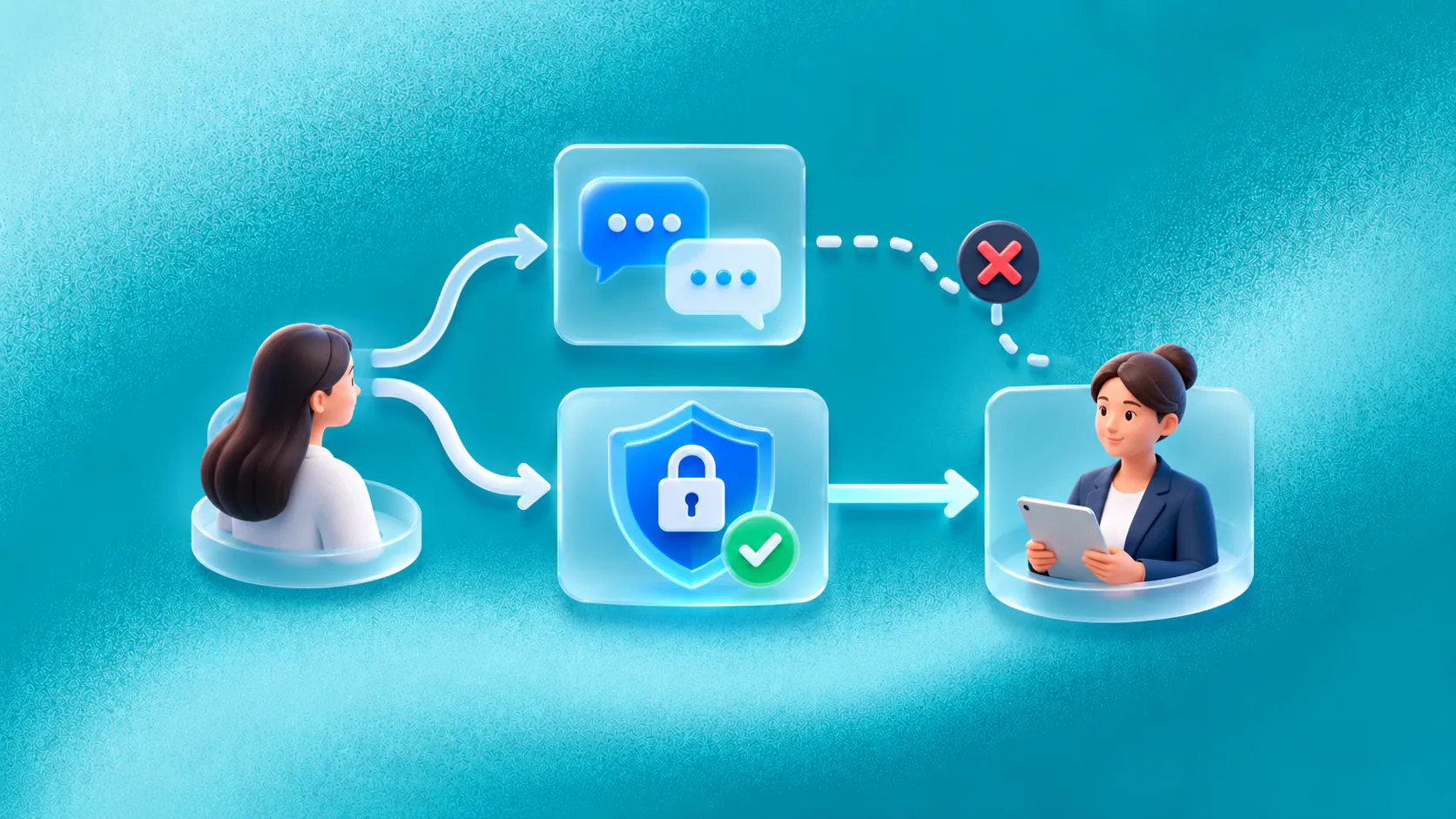
Conversational AI in banking and fintech can provide approved public information, collect service requests, retrieve permitted account or case status after verification and route customers to authorised staff. It should not provide unreviewed financial advice or make consequential credit, fraud or eligibility decisions.
Key takeaways
- Separate public information, authenticated service and consequential decisions into different workflows.
- Verify identity and authorisation according to the risk of the requested action.
- Keep financial advice, credit decisions, fraud determinations and sensitive exceptions with authorised processes and people.
- Communicate confirmed system states and provide a secure human route when evidence or access is insufficient.
What is conversational AI in banking and fintech?
Conversational AI in banking and fintech helps customers navigate information and service workflows through natural language. It may answer an approved public question, collect a request, retrieve a permitted status or connect the customer with an authorised team.
Financial services involve sensitive data and consequential decisions. The interface should not blur general information, authenticated account service, regulated advice and decisions such as credit or fraud outcomes.
A practical design separates those activities into distinct zones with different identity, permission, evidence and review requirements.
Related must-read articles
- Conversational AI for customer support
- Banking chatbots for public information and secure handoff
- Handling financial-service questions with approved knowledge
What are the three service zones?
Public information
Public content can cover branch or service availability, published fees, application steps, documentation checklists and general product information. Sources need an owner, jurisdiction and effective date.
Authenticated service
After the required verification, conversational AI in banking and fintech may retrieve a case or application status, collect a support request or perform a narrowly permitted account action.
Consequential advice and decisions
Financial advice, credit decisions, fraud determinations, dispute outcomes and eligibility decisions need separately governed processes, authorised people and applicable legal oversight. A conversational interface may collect information or communicate an approved result; it should not invent the decision.
This three-zone model makes authority visible to customers and operating teams.
Which public-information workflows fit?
Customers frequently ask how to open an account, which documents are requested, where a service is available or how a process works. An assistant can retrieve the relevant approved page and ask which market or product applies.
Conversational AI in banking and fintech should not turn general product information into personal advice. If a customer asks which investment, credit or financial product they should choose, route them to the institution’s authorised process.
The public-knowledge banking guide provides a narrow implementation pattern. The knowledge platform supports governed sources.
How can authenticated service work?
Identity and authorisation should match the risk of the action. Checking a general application checklist is different from revealing a balance or changing contact details.
After verification, the system can call a permitted service and return the state it receives. It should not expose additional account information merely because the customer asked a related question.
For any write action, distinguish requested, pending and completed states. “Your request has been submitted for review” is not confirmation that the account changed.
What does a service scenario look like?
Imagine a customer reporting that a card is unavailable. The assistant first determines whether the customer wants general troubleshooting, to report a lost card or to contact support.
For a lost-card request, it follows the institution’s approved secure path. It does not ask the customer to share prohibited credentials in an ordinary chat. After verification in the appropriate flow, it submits the permitted action or routes immediately to the authorised team.
The customer receives the actual returned status and an approved next-step message. If the service is unavailable, the assistant clearly says it cannot confirm the action and provides the secure alternative.
The system is useful here because it identifies the need and accelerates the route without pretending that language generation is a security control.
How should advice and product questions be handled?
General explanations can help a customer understand terminology or a published process. Personal recommendations, suitability assessments and regulated advice require the institution’s approved method and authorised staff.
The assistant should recognise when a question crosses that boundary. It can collect the customer’s request and arrange an adviser conversation without generating a recommendation.
Likewise, credit or account eligibility should not be inferred from conversation. Use the governed decision process and communicate only approved results and reasons where applicable.
What about fraud and disputes?
A conversational system can identify that a customer is reporting an unrecognised transaction or potential fraud and route the case quickly. It can collect the minimum approved information and provide official protective steps from an authoritative source.
It should not declare that fraud occurred, accuse a person or predict a dispute outcome. These determinations require evidence and authorised review.
Sensitive routes may need to bypass ordinary queues. Document ownership, access and escalation timing before launch.
How should authentication and privacy work?
Do not use conversation familiarity as proof of identity. Apply the institution’s risk-based verification and channel policy.
Use minimum permissions for each tool. Separate services that read a status from those that change account data. Control transcript access and avoid retaining sensitive values that are not needed for the workflow.
Requirements vary by jurisdiction, product and institution. Obtain financial legal, compliance, privacy and security review. No platform feature alone proves compliance.
What should be handed to a person?
Route advice, disputes, fraud concerns, vulnerability, complaints, failed verification, inaccessible services, legal questions and any request outside approved authority.
The human-handoff workflow should provide the stated goal, verification state, information collected, system action and reason for transfer. The receiving team should have only the access appropriate to its role.
The conversational AI for customer support guide explains how to preserve useful context without claiming resolution. When the request changes channel, the omnichannel conversational AI guide helps separate continuity from identity verification.
Which metrics are appropriate?
Measure service quality rather than consequential financial outcomes:
- Public questions answered from the correct current source;
- Authenticated status requests completed;
- Permitted actions confirmed or failed;
- Verification failures and secure-route completion;
- Customer or staff corrections;
- Routing accuracy and reassignment;
- Time to authorised human ownership;
- Repeated contact for the same service need.
Review false confidence and privacy incidents separately, even if their volume is low.
How should the first workflow launch?
Begin with public information or a low-risk request-routing task. Define the source, market, identity requirement, permission, completion evidence and exception owner.
Test vague product questions, personal advice requests, failed verification, suspicious messages, unavailable services, vulnerable customers and direct human requests. Use the implementation guide for staged rollout and the platform buyer’s guide to assess authority controls, monitoring and evidence.
ZINQ’s banking and financial services page, workflow layer and omnichannel inbox show how approved conversations can connect with actions and handoff. The boundary between help and decision should remain unmistakable.
What should a financial-service control matrix include?
For each intent handled by conversational AI in banking and fintech, record customer state, verification, source, permitted action, completion evidence and authorised exception owner.
Separate public, authenticated and consequential tests. Public tests check current information. Authenticated tests check identity, role and minimum access. Consequential tests confirm that advice or decision requests reach the governed process rather than generation.
Include customers sharing credentials, account requests on an unverified channel, recommendations framed as general questions, credit or fraud decisions, vulnerability, complaints, contradictory identity details, unavailable services and requests for an authorised person.
Security testing should cover prompt manipulation, data leakage between customers, unauthorised tool calls and transcript access. Use specialists appropriate to the institution.
Conversational AI in banking and fintech needs versioned sources. Fees, application steps and service routes may differ by product and jurisdiction. Keep effective dates and remove superseded content. Review every action failure and sensitive handoff during early operation. Conversational AI in banking and fintech should expand only when owners can trace source, verification, permission and outcome.
Frequently asked questions
How is conversational AI used in banking?
It can answer approved public questions, collect service requests, retrieve account or application status after verification, support routine actions and route customers to the appropriate authorised team.
Can a banking chatbot give financial advice?
This guide does not recommend unreviewed financial advice. The assistant may provide approved general information and connect the customer to an authorised adviser or governed advice process.
Can it approve a loan or detect fraud?
Credit and fraud decisions are consequential and require separately governed systems, evidence, oversight and applicable legal review. A conversational interface may collect information or communicate an approved status.
How should account data be protected?
Use risk-based verification, minimum permissions, role-based access, secure channels where required and controlled transcript retention. Applicable requirements depend on jurisdiction and service.
Conclusion
Conversational AI in banking and fintech should improve service access without weakening decision accountability. Separate information from advice and decisions, verify access, confirm actions and route sensitive cases to authorised people.
READY TO SEE ZINQ IN ACTION?
From first enquiry to conversion, follow-up and support, ZINQ helps automate the next step while keeping your team in control.
Book a DemoAdditional resources
-
Banking chatbot guide: public information and secure handoff
A banking chatbot should separate public information from account-specific service, use approved identity and access controls before retrieving customer data, and transfer disputes, sensitive requests and uncertain cases to an owned secure channel with the permitted context.
The ZINQ team · September 21, 2026 · Industries → Banking & Financial Services -
Which financial-service questions can use public knowledge?
A financial-services chatbot can use public knowledge for approved facts such as opening hours, published product information and application steps. It should require an approved secure process for customer-specific information, restricted actions, disputes, advice and any request whose answer depends on a customer's circumstances.
The ZINQ team · September 21, 2026 · Industries → Banking & Financial Services -
AI agent guardrails for customer conversations
AI agent guardrails define what an agent may answer, ask, change, promise, escalate and log so customer conversations stay useful without letting automation exceed its authority.
The ZINQ team · September 30, 2026 · AI Agents & Conversational AI