Which financial-service questions can use public knowledge?
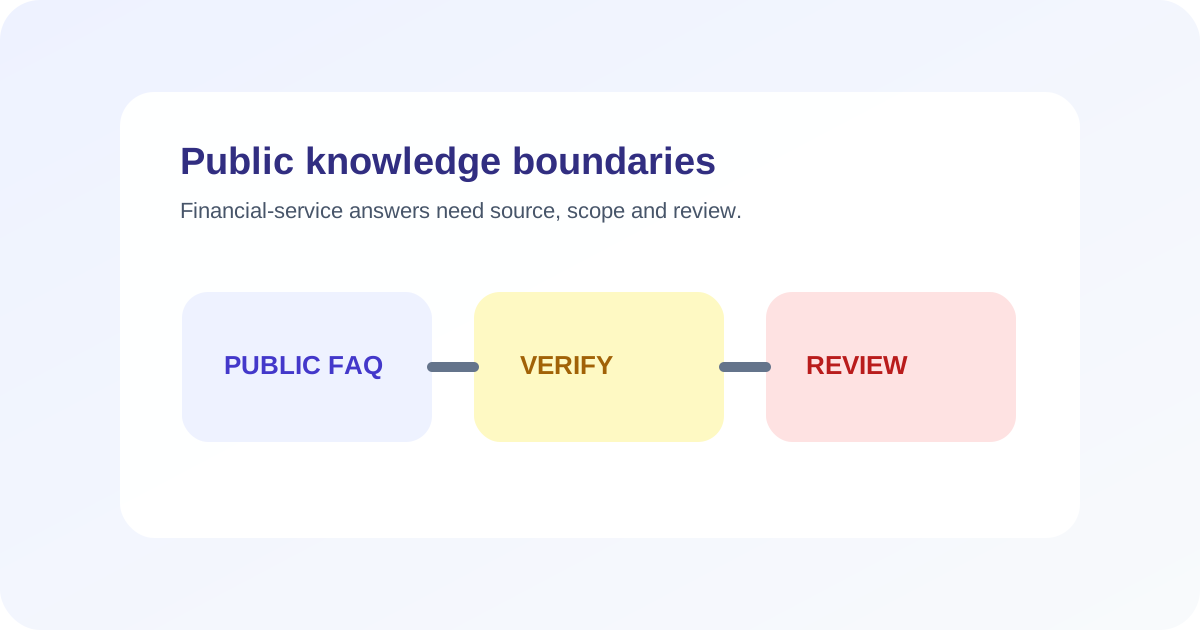
A financial-services chatbot can use public knowledge for approved facts such as opening hours, published product information and application steps. It should require an approved secure process for customer-specific information, restricted actions, disputes, advice and any request whose answer depends on a customer's circumstances.
Key takeaways
- Public means approved for any customer, not merely easy for a chatbot to retrieve.
- Give every answer source an owner, applicable market, effective date and review trigger.
- Move customer-specific questions behind approved identity and authorization controls.
- Route advice, disputes, exceptions and uncertain answers to the qualified team that owns them.
- Test stale, conflicting and ambiguous information before expanding the chatbot's scope.
What counts as public knowledge in financial services?
Public knowledge is information an institution has approved for any intended visitor to access without proving who they are. Examples can include branch hours, published contact routes, general product descriptions and documented application steps.
“Public” is a governance decision, not a technical shortcut. Information does not become public because a search engine indexed it, an employee pasted it into a document or a model can recall it. The institution should identify the authoritative source, audience, market and effective date.
This article covers customer communication and information management. It does not provide financial, legal, security or regulatory advice.
Use this with the broader banking chatbot guide before you define any public-answer workflow. For buyer context, connect the workflow to banking and financial services.
Classify the question before choosing the answer
A useful financial-services chatbot needs more than a list of FAQs. Classify each customer question by the information and authority it requires.
| Question class | Example | Appropriate route |
|---|---|---|
| Approved public fact | “What time does this branch open?” | Answer from the maintained public source |
| Public process | “Which documents are listed for an application?” | Explain the published steps and link to the source |
| Customer-specific status | “Has my application been approved?” | Approved authentication and authorization workflow |
| Restricted action | “Change the phone number on my account” | Secure, permissioned process with confirmation |
| Dispute or exception | “I do not recognize this transaction” | Institution-defined secure route to trained staff |
| Advice or suitability | “Which investment is right for me?” | Qualified human route under the institution’s policy |
Classify the actual intent rather than the noun in the message. A question about “fees” might ask for a published schedule, a charge on a particular account or a disputed transaction. Those routes cannot share the same response.
Build a source register, not a document pile
For each public answer, record:
- the exact source page or approved document;
- the content owner and escalation contact;
- the audience and applicable market;
- the effective date and known expiry date;
- the approved wording or facts the chatbot may use;
- the review interval and events that trigger an immediate review; and
- the fallback when the source is unavailable or conflicts with another source.
The register should distinguish a product overview from contractual terms. A short chatbot answer can summarize an approved public process, but it should point customers to the authoritative material when details matter.
The ZINQ knowledge layer is designed to ground conversations in configured business information. The institution remains responsible for deciding which material is approved and current.
Apply market, product and date boundaries
Financial information often varies by market, customer type, product version and date. Attach those dimensions to the source instead of expecting the chatbot to infer them from a generic question.
If a customer has not identified the relevant market, ask a narrow clarifying question. If the answer could differ across product versions, state which version the public information covers. When a published fee or rate changes, the workflow should use the effective date rather than silently mixing old and new content.
Do not let a confident response hide a source conflict. If approved materials disagree, the safe outcome is to state that the information cannot be confirmed and route the issue to the source owner.
Keep personal information behind approved controls
Public knowledge can explain how a process works. It should not expose whether a particular person has an account, application, transaction or eligibility result.
When a question becomes customer-specific, move it to the institution’s approved identity and authorization process. Authentication alone is not a universal permission. A verified user may have access to one account or action but not another.
Minimize the data collected in chat. A customer may volunteer an account number, card detail or identity document before the workflow asks for it. The chatbot should not repeat sensitive data or treat its presence as proof of identity. Provide the secure route defined by the institution.
Separate factual comparison from personalized advice
A chatbot may present approved public differences between products, such as published features or documented eligibility criteria. It should not turn those facts into an unapproved personalized recommendation.
Requests that depend on a customer’s finances, objectives, risk, legal position or individual circumstances need the route assigned by the institution. The same applies when a customer asks the chatbot to interpret ambiguous terms, waive a condition or decide an exception.
Make the boundary clear in the response. A vague disclaimer attached to an otherwise personalized recommendation does not fix the underlying workflow.
A worked example: application-document question
Consider a hypothetical visitor who asks, “What documents do I need to apply for a business account?”
The chatbot first identifies the relevant market and business-account type. It retrieves the institution’s approved public checklist, includes the source’s effective date where useful and links to the authoritative application page.
The visitor then asks, “Will these documents guarantee approval?” The intent has changed. The chatbot should not predict an outcome. It can explain the published process and state that the application is assessed through the institution’s approved procedure.
If the visitor says an application is already pending, the question becomes customer-specific. The chatbot routes the visitor to the approved authenticated status flow or secure service team. It passes the stated goal, but it does not expose an application record in the public conversation.
Test knowledge drift and boundary changes
Test each public answer against situations that reveal weak governance:
- The source has passed its review date.
- Two approved pages contain different information.
- The customer asks about another market or product version.
- A public question turns into an account-specific request.
- The customer pastes sensitive data into the conversation.
- A follow-up asks for personalized advice or an exception.
- The source system is unavailable.
- The customer asks for a person.
Inspect the retrieved source, response, link, data handling and destination queue. Testing only the visible prose misses failures in retrieval and routing.
The NIST AI Risk Management Framework can inform the institution’s broader governance process. The OWASP guidance on excessive agency is also useful when a conversational workflow can call tools or take actions.
Measure whether the knowledge stays dependable
Track answer accuracy against approved sources, expired-source incidents, conflicting-source cases, customer corrections, routes to secure service, failed handoffs and time to repair content after a policy change.
Do not optimize only for containment. A chatbot that refuses to transfer an account-specific or disputed request may appear efficient while creating more customer effort. Review conversation samples by intent class and source version.
Where to begin
Choose 10 to 20 stable public questions with clear owners and low ambiguity. Build the source register, define the boundary for each question and connect a real human route before launch. Then test how those questions change during follow-up messages.
The broader banking chatbot guide in this topic covers authentication, actions and secure handoff. Teams evaluating a deployment can also review ZINQ for banking and financial services and start with one traceable public-information workflow.
Frequently asked questions
Is published product information safe for a financial-services chatbot?
It can be used when the institution has approved the source for public use, identified the applicable market and date, and defined what happens when information is missing or inconsistent.
Can a chatbot explain which account is best for a customer?
A chatbot may present approved factual differences, but a personalized recommendation can involve suitability, advice and market-specific rules. Route that request according to the institution's qualified-review policy.
Does authentication make every answer appropriate for automation?
No. Authentication establishes identity through an approved process; authorization, permitted data use and the workflow's decision authority still need separate controls.
How often should public chatbot knowledge be reviewed?
Set review timing according to how quickly the source can change, and add event-based review when a product, fee, policy, market or contact route changes.
Conclusion
Start with a small register of stable, approved public questions. Keep the source and effective date visible to the system, and send personal, disputed or judgment-based requests into secure owned workflows. This boundary makes the chatbot easier to maintain and safer to extend.
READY TO SEE ZINQ IN ACTION?
From first enquiry to conversion, follow-up and support, ZINQ helps automate the next step while keeping your team in control.
Book a DemoRelated articles
-
AI customer service: an operating guide for support teams
AI customer service uses AI to assist, answer, retrieve, act or route within a support workflow. Operate it by assigning owners, defining request-level authority, maintaining knowledge and integrations, testing changes, reviewing failures and measuring the customer's completed outcome.
Kushal Verma · June 8, 2026 · Customer Support & CX -
How to implement customer service chatbot handoff
Implement customer service chatbot handoff by defining transfer triggers, conversation ownership, destination queues and the context a person needs to continue. Test explicit human requests, authority limits, missing information and system failures, then verify that the receiving team accepted the case.
The ZINQ team · September 21, 2026 · AI Chatbots -
AI chatbot for business: a practical buyer guide
Choose an AI chatbot for business by starting with the customer task it must complete, then test its knowledge, actions, handoff, channels, integrations, data controls and operating requirements. The best option is the one that completes your verified workflow reliably, not the one with the longest feature list.
The ZINQ team · September 21, 2026 · AI Chatbots