Banking chatbot guide: public information and secure handoff
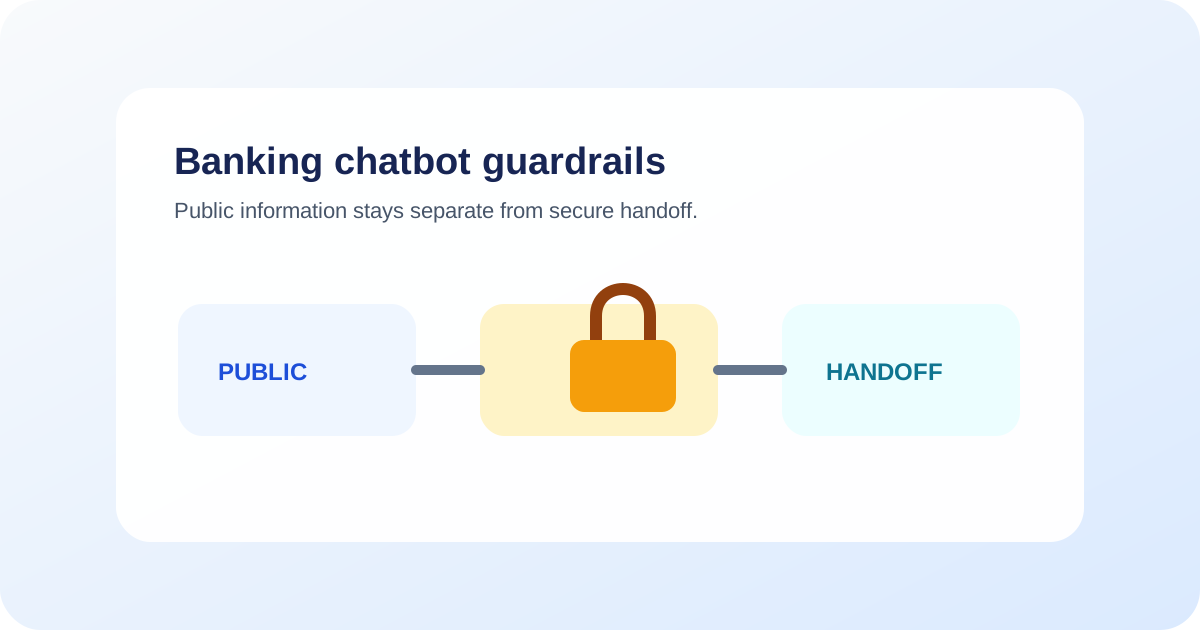
A banking chatbot should separate public information from account-specific service, use approved identity and access controls before retrieving customer data, and transfer disputes, sensitive requests and uncertain cases to an owned secure channel with the permitted context.
Key takeaways
- Classify every intent as public, authenticated, action-based or human-owned before launch.
- Never treat a conversational identifier as sufficient proof of identity without an approved process.
- Keep financial guidance, disputes and discretionary decisions outside a general chatbot's authority.
- Pass only necessary, verified context into a secure handoff and confirm that a real queue owns it.
- Test data exposure, prompt manipulation, system failure and wrong-customer scenarios as well as routine answers.
What is a banking chatbot?
A banking chatbot is a conversational interface that helps customers find information or enter an approved service workflow. Depending on its design, it may answer public questions, collect an enquiry, guide an authenticated customer, retrieve permitted information or transfer a request to trained staff.
The category includes very different risk levels. Explaining published branch hours is not the same as showing a balance, changing contact details, discussing a disputed transaction or recommending a financial product. Treating them as one “banking support” workflow creates unclear authority and data exposure.
This guide covers administrative customer communication. It does not provide financial, legal, security or regulatory advice. Institutions must obtain qualified review for their markets, products and systems.
Use this guide with the companion article on financial-service questions that can use public knowledge. For the commercial page, connect the workflow back to banking and financial services so buyers see where public answers, secure handoff and human review fit together.
Classify intents before writing responses
Create an intent register with four classes:
| Class | Example | Required boundary |
|---|---|---|
| Public information | Published hours or application documents | Current approved public source |
| Authenticated information | Account or application status | Approved identity and authorization |
| Permitted action | Create a callback or update an eligible preference | Restricted permission and system confirmation |
| Human-owned | Dispute, suspected fraud, complaint or suitability question | Secure route to authorized staff |
Classify the exact request, not a broad topic. “Cards” can mean public eligibility information, a lost card, an unrecognized transaction or a PIN issue. Each needs a different route.
For every intent, record its source, data classification, identity requirement, permitted response, prohibited behavior, completion evidence and owner. If those fields are unclear, defer automation.
Keep public knowledge genuinely public
A public-information chatbot can cover information the institution has approved for general distribution, such as:
- branch and service hours;
- published contact channels;
- general product definitions;
- documented eligibility criteria;
- publicly stated fees and terms, with a source and effective date;
- application documents and steps; and
- accessibility or complaint-contact information.
The source should be the institution’s maintained content, not a model’s general knowledge. Attach an owner and review date. If two pages conflict, the chatbot should not choose the more convenient answer.
Published information can still become stale. Store the applicable date where it matters and link the customer to the authoritative source. The ZINQ knowledge layer describes how approved business information fits into customer conversations.
Move account questions behind approved controls
An account number, phone number or date of birth supplied in chat is not automatically sufficient identity evidence. Use the institution’s approved authentication and authorization flow before retrieving or exposing customer-specific information.
Separate authentication from authorization. A verified customer may be allowed to view one account but not another, or to see a status without changing it. Tool permissions should reflect the narrow action.
When verification fails, do not reveal whether a guessed account exists. Provide the approved recovery route. Limit attempts and store only the diagnostic information permitted by policy.
Avoid collecting sensitive information in a channel merely because the chatbot asks for it. Define which fields belong in chat, a secure form, an authenticated application or a staff conversation.
Restrict actions and verify the result
List every connected action separately. Reading a published rate, retrieving a verified application status and changing a customer record have different consequences.
The OWASP guidance on excessive agency identifies risk from excessive functionality, permissions and autonomy. Apply least privilege: give the workflow only the function and data needed for the approved intent.
After an action, rely on the destination system’s response. If a callback request fails, the chatbot should not say it was booked. It should preserve the customer’s request and use a defined recovery path.
Require human approval where policy assigns judgment or discretion to staff. Do not encode a broad instruction such as “make the best decision for the customer.”
Design secure handoff as an ownership change
Handoff should move the request to a named role or queue through an approved channel. Define triggers such as:
- customer asks for a person;
- authentication cannot be completed;
- suspected fraud or account compromise;
- disputed transaction or formal complaint;
- financial advice or suitability question;
- action requiring approval;
- repeated misunderstanding; or
- required system unavailable.
The transfer packet should contain only permitted information: the customer’s stated goal, completed verification state, relevant reference, steps attempted, confirmed system results, reason for transfer and next required decision. Do not convert an uncertain chatbot inference into a fact.
Tell the customer whether the case is accepted, pending or redirected to another secure channel. “You are connected” is inaccurate when the request is only waiting in a queue. The handoff implementation guide provides a state model.
A worked example: card replacement enquiry
Consider a hypothetical customer who writes, “My card is damaged. How do I replace it?”
The chatbot may first provide the bank’s public replacement options and explain which secure channel handles the request. It should not ask the customer to post a full card number or security code into a general conversation.
If the institution supports an authenticated replacement workflow, the customer enters the approved secure process. The system checks eligibility and returns a confirmed request identifier. Only then does the chatbot state that the request was submitted.
If the customer says the card was stolen or identifies an unrecognized transaction, the intent changes. The workflow follows the institution’s urgent route rather than continuing the damaged-card script. It does not make a fraud determination.
If the replacement system is unavailable, the chatbot states that it cannot confirm submission and passes the permitted context to the appropriate queue. The customer receives the actual next step, not a success message.
Test attempts to cross the boundary
Routine tests are not enough. Include:
- a public question followed by a request for account data;
- one customer asking about another person’s account;
- guessed identifiers and repeated failed verification;
- a prompt asking the chatbot to ignore bank policy;
- conflicting published information;
- unavailable account or case systems;
- an action timeout after possible submission;
- suspected fraud language inside a routine request;
- an explicit request for a person; and
- a closed or unavailable destination queue.
Inspect the reply, tool call, data exposed, system record and handoff acceptance. A fluent refusal can still fail if sensitive data was already retrieved.
The NIST AI Risk Management Framework offers a governance, mapping, measurement and management structure. Institutions can use it as one input to their own risk process, not as certification of a chatbot.
Measure service without rewarding risky containment
Track public-answer accuracy, source freshness, authentication failures, prohibited-data incidents, false confirmations, correct handoffs, unaccepted cases, repeat contact and staff corrections.
A low handoff rate is not automatically good. It can indicate effective self-service or an inaccessible human route. Review samples from each intent class and retain the policy version used at the time.
Where ZINQ fits
ZINQ supports customer conversations across WhatsApp, web chat, email and other supported channels, with configured knowledge, workflows and human handoff. For financial services, the institution must define the permitted intents, data and actions.
Review the banking and financial services page, then evaluate one public-information workflow and its secure handoff. Product testing should include boundary-crossing requests and destination-system evidence before any authenticated use expands.
Frequently asked questions
What can a banking chatbot answer without authentication?
It may answer approved public questions such as published hours, branch locations, product definitions and documented application steps. The bank must define the exact source and keep it current.
Can a banking chatbot provide account balances or transaction details?
Account-specific information requires the institution's approved identity, authorization and secure-channel controls. A general chat session should not expose it merely because a customer supplies a name or account number.
When should a banking chatbot transfer to a person?
Transfer disputes, suspected fraud, complaints, requests requiring discretion, failed verification, unavailable systems and any case that a defined policy assigns to trained staff.
Is a banking chatbot allowed to give financial advice?
That depends on the institution, market, product and applicable rules. A general service chatbot should stay within approved factual information and route advice or suitability questions to appropriately qualified staff.
Conclusion
Begin with public, low-consequence questions and a reliable secure handoff. Add authenticated lookups or actions only after the institution has approved identity, permissions, evidence, failure recovery and review. The chatbot's useful boundary is as important as the answers it provides.
READY TO SEE ZINQ IN ACTION?
From first enquiry to conversion, follow-up and support, ZINQ helps automate the next step while keeping your team in control.
Book a DemoRelated articles
-
AI chatbot for business: a practical buyer guide
Choose an AI chatbot for business by starting with the customer task it must complete, then test its knowledge, actions, handoff, channels, integrations, data controls and operating requirements. The best option is the one that completes your verified workflow reliably, not the one with the longest feature list.
The ZINQ team · September 21, 2026 · AI Chatbots -
How to implement customer service chatbot handoff
Implement customer service chatbot handoff by defining transfer triggers, conversation ownership, destination queues and the context a person needs to continue. Test explicit human requests, authority limits, missing information and system failures, then verify that the receiving team accepted the case.
The ZINQ team · September 21, 2026 · AI Chatbots -
AI customer service: an operating guide for support teams
AI customer service uses AI to assist, answer, retrieve, act or route within a support workflow. Operate it by assigning owners, defining request-level authority, maintaining knowledge and integrations, testing changes, reviewing failures and measuring the customer's completed outcome.
Kushal Verma · June 8, 2026 · Customer Support & CX