Omnichannel conversational AI: context and ownership
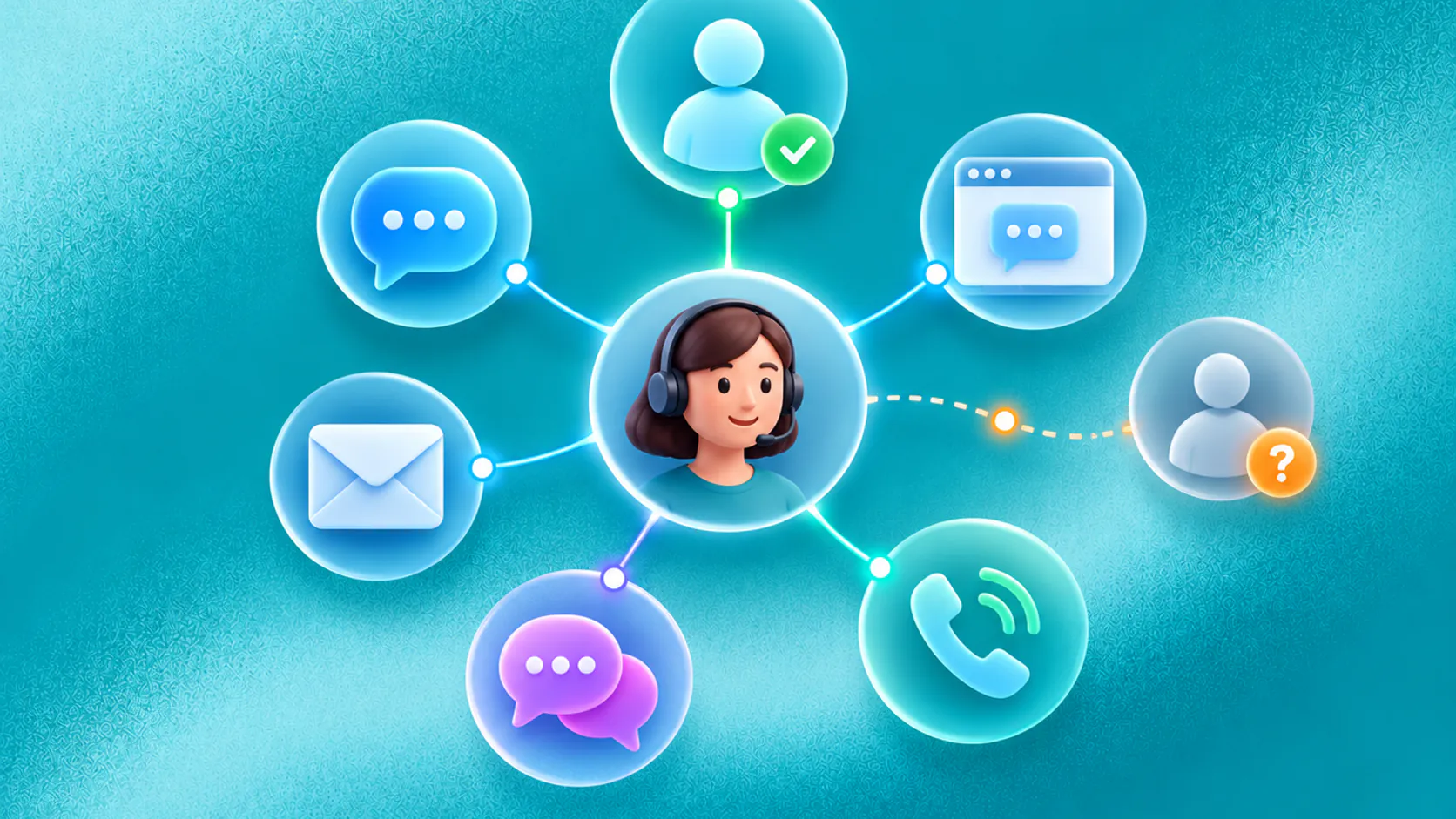
Omnichannel conversational AI connects customer conversations across supported channels while preserving identity, context, consent and ownership. It should adapt to each channel's rules and capabilities instead of sending identical messages everywhere or merging people without reliable identity evidence.
Key takeaways
- Omnichannel means continuity with channel-aware behavior, not identical automation on every channel.
- Separate a conversation identifier from a verified customer identity and use cautious record matching.
- Store the customer goal, workflow state and owner so a channel change does not reset the task.
- Apply channel-specific consent, timing, format and escalation rules before sending messages.
What is omnichannel conversational AI?
Omnichannel conversational AI lets a business manage related customer conversations across supported channels without losing the task, context or owner. A customer might discover a company on Instagram, continue on WhatsApp and receive a confirmation by email while the operating team sees one coherent journey.
The purpose is continuity, not uniformity. Each channel has different message formats, response windows, consent requirements, identity signals and customer expectations. The shared workflow can remain consistent while the conversation adapts to the channel.
Omnichannel conversational AI also needs a shared view for people. Automation cannot create continuity if support, sales and operations work from separate queues with no clear owner.
For the foundation, review what conversational AI is. The conversational AI use-case guide then helps identify which customer task should be connected across channels first.
Related must-read articles
How is omnichannel different from multichannel?
Multichannel means a business can receive messages in more than one place. A company may have web chat, email and WhatsApp but still operate three disconnected inboxes.
Omnichannel adds coordinated state. The system knows the customer’s current goal, information already collected, actions completed, unresolved exception and responsible team. The customer does not need to restart merely because the channel changed.
This does not mean every message should be copied to every channel. It means the business can select an appropriate channel for each step while maintaining a governed record of the work.
The multichannel AI support guide covers day-to-day management. This article focuses on the architecture and operating decisions behind continuity.
What context needs to move across channels?
A useful conversation state includes:
- The customer’s stated intent;
- Verified identifiers and their source;
- Details already collected;
- The current workflow step;
- Knowledge or answers already provided;
- Actions attempted and confirmed;
- Consent and channel preferences;
- The current human or team owner;
- Outstanding questions and deadlines.
Store facts separately from summaries. A short summary helps a person scan the case, but important details such as a booking reference or returned system status should remain in structured fields.
Omnichannel conversational AI should also record uncertainty. If two conversations may belong to the same person but identity is not verified, the operating view should show that possibility without silently combining private records.
How should customer identity be handled?
A channel account is not automatically a verified customer identity. A phone number, email address, social handle and web session may refer to the same person, a shared account or different people.
Use an evidence-based matching policy. Low-risk continuity may rely on a conversation reference. Access to account details or changes may require a stronger verification step defined by the business.
The one customer across five channels guide explains the distinction in more detail. The core rule is simple: match cautiously, expose uncertainty and never reveal protected information merely because two fields look similar.
How should the experience change by channel?
The workflow can share a goal while the interface changes.
Web chat
Web chat supports immediate, interactive exchanges but may begin with a visitor who is not signed in. Keep the first questions useful and avoid demanding identity before it is needed.
Messaging applications
WhatsApp, Instagram and Telegram support ongoing conversations, but their business rules and available features differ. Templates, response windows, media support and user consent must be checked against current channel documentation.
Email is useful for longer explanations, confirmations and asynchronous follow-up. Threading and forwarding can make identity and case ownership less certain, so references and structured records remain important.
Voice
Voice needs transcription, spoken confirmation and careful handling of names and numbers. The interaction may also need an immediate transfer path because the customer cannot inspect a long written answer.
ZINQ’s channel overview lists the supported surfaces. Confirm current functionality and policies for the exact channel before designing a production workflow.
What does a cross-channel workflow look like?
Imagine a customer asking about a service through Instagram. The assistant answers from approved information and collects the preferred location. The customer chooses to continue on WhatsApp to share contact details and book.
The system sends a permitted continuation link or instruction. After the customer verifies the context, the WhatsApp conversation resumes at slot selection rather than repeating the service questions. The booking tool returns a reference, and a confirmation is sent on the agreed channel.
If the customer later emails to reschedule, the team can locate the booking through the reference and verification process. The email does not automatically expose the Instagram or WhatsApp history to every agent; access follows role and business rules.
This is omnichannel conversational AI in practice: the task continues, while identity, consent and permissions remain controlled.
How do routing and human ownership work?
Every active task needs one current owner, even when several teams can view it. Define when automation owns the next step, when a queue owns it and when a named person is responsible.
Routing can use the stated intent, language, location, customer status and workflow state. Avoid using sensitive inferred traits. Make the routing reason visible so a team can correct it.
A shared omnichannel inbox should show new work, waiting customers, automated progress, failed actions and handoffs. Human handoff should transfer the reason and context, not merely forward the latest message.
The task itself should remain in a controlled workflow, while verified identity and channel history belong in the appropriate contact record. This separation makes ownership easier to inspect when a conversation changes channel.
Which metrics reveal channel problems?
Measure both customer outcomes and operational continuity:
- Completion rate by channel and workflow;
- Channel transfers that preserve the task state;
- Duplicate contacts or cases;
- Identity-match corrections;
- Messages sent outside the intended timing or consent state;
- Routing corrections and handoff delays;
- Repeated questions after a channel change;
- Action failures by connector.
Compare equivalent tasks rather than declaring one channel universally better. A short web-chat answer and a complex email case have different operating demands.
How should you implement omnichannel conversational AI?
Start with one workflow across two channels. Map the identifiers, permissions, state fields, owner and transfer points. Decide which information may move and which requires verification.
Test customers who begin anonymously, change devices, use a different email, share a phone number, return after a long gap or contact two channels at once. Test channel outages and message-delivery failures as well as the normal path.
Use the conversational AI implementation guide for rollout and evaluation. Omnichannel conversational AI becomes useful when the operating model remains understandable even after the customer changes channel.
What should an omnichannel operating map contain?
Map the chosen workflow before adding channels. Show entry points, identifiers, consent state, task fields, system actions, automation owner and human queue.
For every channel, record whether the customer is anonymous, identified or verified; which formats and timing rules apply; what can appear in notifications; how a person requests help; and what happens when delivery fails.
Test channel collisions. A customer may contact web chat and WhatsApp at once, reply to an old email after a case closes or forward another person’s message. Omnichannel conversational AI needs rules for duplicate work and uncertain identity.
Give staff one view of the current state, including whether the workflow is waiting for the customer, a system or a team member. Preserving context does not grant every employee access to every message. Omnichannel conversational AI should carry the minimum useful context while respecting role and data boundaries.
Frequently asked questions
What is omnichannel conversational AI?
It is a conversational system that can manage supported customer interactions across channels while preserving relevant context, workflow state and ownership.
What is the difference between multichannel and omnichannel AI?
Multichannel means the business is available in several places. Omnichannel adds continuity, so the customer and team can continue the same task without rebuilding context on each channel.
Should every channel use the same conversation design?
No. The intent and workflow may be shared, but message length, templates, timing, authentication, media and consent rules vary by channel.
How do you prevent duplicate conversations?
Use reliable identifiers, cautious matching rules and a shared operating view. When identity is uncertain, ask for verification rather than merging records automatically.
Conclusion
Omnichannel conversational AI succeeds when channel choice does not break the customer journey. Preserve the task state and ownership, adapt behavior to each channel and treat identity matching as a controlled decision.
READY TO SEE ZINQ IN ACTION?
From first enquiry to conversion, follow-up and support, ZINQ helps automate the next step while keeping your team in control.
Book a DemoAdditional resources
-
Managing WhatsApp and web chat in one support operation
WhatsApp and web chat can share a support operation while retaining different identity, messaging and follow-up rules. Define queue ownership and supported contact association rather than assuming that every conversation automatically becomes one customer history.
Pavan · June 30, 2026 · Omnichannel -
Linking customer conversations safely across channels
Linking conversations across channels requires reliable identity evidence and appropriate access controls. A mistaken merge can reveal another customer's information, so uncertain matches need a review or verification path.
The ZINQ team · June 5, 2026 · Omnichannel -
Omnichannel AI Agent: Context, Ownership and Handoff
An omnichannel AI agent applies shared knowledge, workflow rules and ownership across connected customer channels while respecting the identity, consent and technical limits of each channel.
The ZINQ team · October 7, 2026 · Omnichannel