What Is Omnichannel Customer Service?
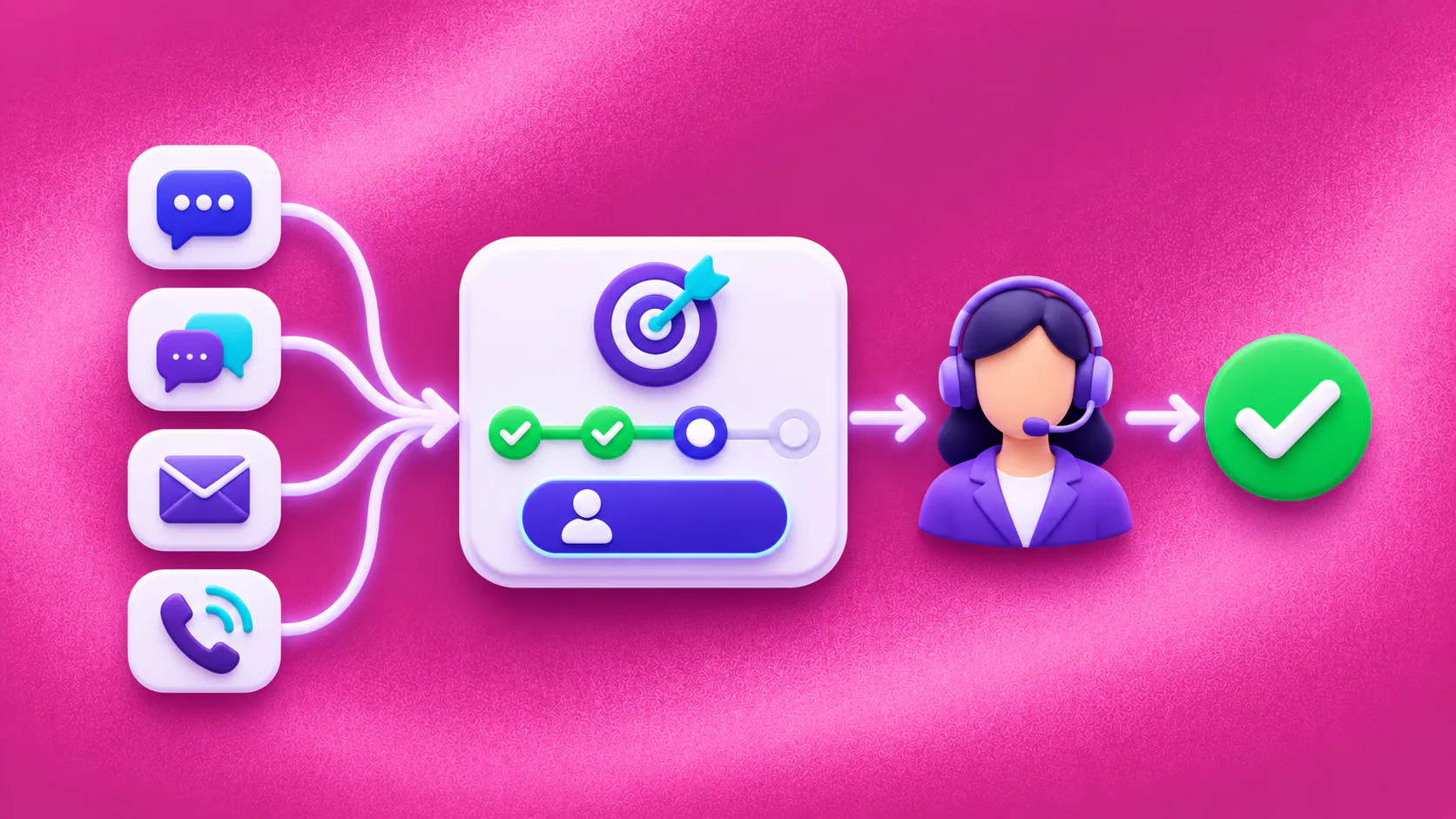
Omnichannel customer service coordinates supported conversations, context, assignments and follow-up across channels so customers can continue a service task without unnecessary repetition while each request retains a clear owner.
Key takeaways
- Coordinate customer work across supported channels without pretending every account is one verified identity.
- Preserve the customer's goal, useful context, current status and responsible owner.
- Adapt timing, consent, verification and message format to each channel.
- Measure completed service outcomes, missed conversations, repeat contact and handoff quality.
What is omnichannel customer service?
Omnichannel customer service coordinates customer conversations across supported channels around one service task. The team can see where the request arrived, what the customer is trying to accomplish, what has already happened and who owns the next step.
That does not mean copying every message everywhere or automatically merging every channel account into one identity. WhatsApp, web chat, Instagram, email, Telegram and voice have different formats, response expectations, consent rules and identity signals. The operating model must respect those differences while keeping the work understandable.
The omnichannel conversational AI guide explains the technology and context architecture. This article focuses on what service leaders need to change in queues, ownership, follow-up and measurement.
Related must-read articles
- Conversational AI for customer support
- Omnichannel conversational AI
- Managing AI support across WhatsApp and web chat
- One customer across five channels
- Omnichannel AI agents
Why do disconnected inboxes create poor service?
A customer does not experience departments, inboxes and software tools as separate operations. They experience one business. When those systems are disconnected, the customer pays the price.
A web-chat question may end with “email us.” The email reaches another queue with no useful context. A WhatsApp follow-up arrives after the issue was already resolved elsewhere. Two employees reply to the same enquiry, while another conversation waits without an owner.
Omnichannel customer service addresses this coordination problem. It gives the team a shared operating view of supported conversations, assignments, task state and available context. The goal is not to make every channel identical. It is to make the next action clear.
What context should continue across channels?
Only context that helps complete the task should continue. A useful service record may include:
- The customer’s stated goal;
- The source channel and available identifiers;
- Details the customer already provided;
- Approved answers already shown;
- Actions requested, attempted and confirmed;
- The current workflow state;
- The responsible queue or person;
- Consent, timing and channel preferences;
- Outstanding questions and promised follow-up.
Keep verified facts separate from summaries. A short summary helps an employee scan the situation, but a booking reference, returned order status or confirmed cancellation should remain tied to the responsible system record.
The shared omnichannel inbox can organise supported conversations and assignments. The contacts platform holds permitted customer context. Neither should be used to imply that matching contact details prove one identity.
What does an omnichannel service journey look like?
Consider an illustrative customer who asks through web chat whether an order can be changed. The assistant answers the approved policy and asks for the order reference. Because the request involves account-specific information, the workflow directs the customer to the permitted verification step.
The customer chooses WhatsApp for the next part of the conversation. After the required checks, the service workflow retrieves the current order state. The requested change is no longer available, so the system does not promise it. It explains the current approved options and offers a route to a person.
The employee receives the original request, verified reference, policy already shown, returned order state and reason for transfer. The customer does not have to repeat the entire exchange.
This is omnichannel customer service in practical terms. The channel changed, but the task, evidence and owner remained clear.
Where can conversational AI help?
Conversational AI can support the parts of service work that have reliable information, bounded actions and observable outcomes.
Answer routine questions from approved knowledge
Customers often ask about opening hours, delivery, cancellation rules, booking preparation or service availability. An assistant can retrieve the applicable information and ask a clarifying question when needed. The knowledge platform should make the source and scope clear.
Collect the details the next step requires
A customer may say, “It still has not arrived,” without including the order reference or delivery date. The conversation can collect the missing details without forcing the customer through an unrelated form.
Complete permitted service actions
Where the connected workflow and permissions allow it, the system may create a case, submit a booking request, retrieve a status or record a cancellation request. It should communicate the returned state rather than assume the action succeeded. The workflow platform provides the controlled path.
Continue follow-up on the appropriate channel
If a case is waiting for customer information, a permitted follow-up can ask for the missing detail. It should stop when the customer replies, the case closes, the contact opts out or a person takes ownership.
Prepare a contextual human handoff
Automation should stop when the request needs judgment, an exception, sensitive review, negotiation, professional advice or an action outside its authority. The human-handoff platform should carry the goal, relevant context, actions attempted and reason a person is needed.
How should each channel behave?
The service task may remain consistent, but the conversation design should change by channel.
Web chat often begins without a verified identity. It works well for discovery, quick questions and collecting the first useful detail. WhatsApp and other messaging channels support asynchronous follow-up, but message windows, templates, consent and opt-out rules still apply.
Social messaging may begin with a product or promotion question. The conversation should move to a more suitable channel when the customer needs to share sensitive information. Email supports longer explanations and records, but a long response time can leave urgent work hidden in a queue. Voice requires careful confirmation of names, numbers and action states.
Omnichannel customer service should use the right channel for the next step rather than force every task through the channel where it began. Review the current policies and capabilities of every supported channel before launch.
ZINQ’s channel overview shows the available customer conversation entry points.
How should queues and ownership work?
Every active service task needs one current owner. That owner may be automation while the system waits for a customer reply or connected action. It may be a team queue when the request needs review. It may become a named person when someone accepts the handoff.
The operating view should show new, assigned, waiting, failed and resolved work. It should also make the transfer reason visible. Forwarding only the latest message leaves the next employee to reconstruct the situation.
Define what happens when two conversations appear related but identity is uncertain. Low-risk context may use a conversation reference, while account access or changes may require stronger verification. Keep records separate when the business cannot establish a valid connection.
The customer-service use case shows how approved answers, service actions and handoff fit together.
What should service leaders measure?
Omnichannel customer service should be measured through customer outcomes and operating continuity. Useful measures may include:
- Requests that reach a confirmed resolution or next step;
- Conversations waiting without an owner;
- Repeat contact about the same unresolved task;
- Customers asked to repeat information after a transfer;
- Duplicate replies or competing follow-ups;
- Handoffs accepted with enough context to continue;
- Failed actions and unavailable integrations;
- Identity-match corrections;
- Messages that fail, arrive outside the intended timing or trigger an opt-out.
Compare equivalent service journeys. A quick web-chat question and a complex email complaint have different handling needs. In omnichannel customer service, message volume alone does not show service quality.
How should an omnichannel service model launch?
Start with one customer task across two channels. Map the entry points, required context, verification, workflow state, owner, handoff and confirmation. Decide what information may continue and what must remain behind a stronger identity check.
Test anonymous customers, changed contact details, simultaneous messages, old replies, unavailable tools, failed delivery and requests outside scope. Ask service employees whether the handoff gives them enough information to continue without making the customer start again.
Use the conversational AI implementation guide to define the first bounded workflow and review cycle. Omnichannel customer service should expand only when the team can explain what happened to a request from entry to resolution.
Human involvement is the final use case. A person should take responsibility for complaints, exceptions, sensitive account questions, professional judgment, negotiation and failed workflows. The system should preserve the reason and current state, then stop competing automated messages.
Omnichannel customer service earns a wider role only when customers reach a clear next step and employees can see what remains unresolved.
Additional resources
Frequently asked questions
What is omnichannel customer service?
It is an operating approach that coordinates supported customer conversations across channels while preserving useful context, task status and ownership.
What is the difference between multichannel and omnichannel customer service?
Multichannel service offers several contact options. Omnichannel service coordinates the work between them so the customer and team can continue the task without rebuilding all the context.
Does omnichannel service merge every customer identity?
No. A shared operating view can display supported conversations and available context, but sensitive records should remain separate until the business has a valid basis and suitable verification to connect them.
Where can conversational AI help?
It can answer from approved knowledge, collect missing details, complete permitted routine steps, maintain workflow state and prepare a contextual handoff. People remain responsible for exceptions, judgment and sensitive decisions.
Conclusion
Omnichannel customer service works when the customer can reach a clear outcome and the team can see who owns the next step. Start with one journey across two channels, preserve only useful context and keep identity-sensitive actions controlled.
READY TO SEE ZINQ IN ACTION?
From first enquiry to conversion, follow-up and support, ZINQ helps automate the next step while keeping your team in control.
Book a DemoAdditional resources
-
Omnichannel conversational AI: context and ownership
Omnichannel conversational AI brings supported channel conversations into a shared operating view so teams can answer, assign, follow up and hand off work without treating every inbox as a separate operation.
The ZINQ team · October 19, 2026 · Omnichannel -
Conversational AI for Customer Support
Conversational AI for customer support can answer approved questions, collect diagnostic details, complete permitted service tasks and transfer exceptions to a person with context. Its value depends on accurate knowledge, reliable actions, clear ownership and measurement of resolved outcomes rather than reply volume.
The ZINQ team · October 19, 2026 · Customer Support & CX -
Linking customer conversations safely across channels
Linking conversations across channels requires reliable identity evidence and appropriate access controls. A mistaken merge can reveal another customer's information, so uncertain matches need a review or verification path.
The ZINQ team · June 5, 2026 · Omnichannel