Which Customer Calls Should a Voice AI Agent Handle?
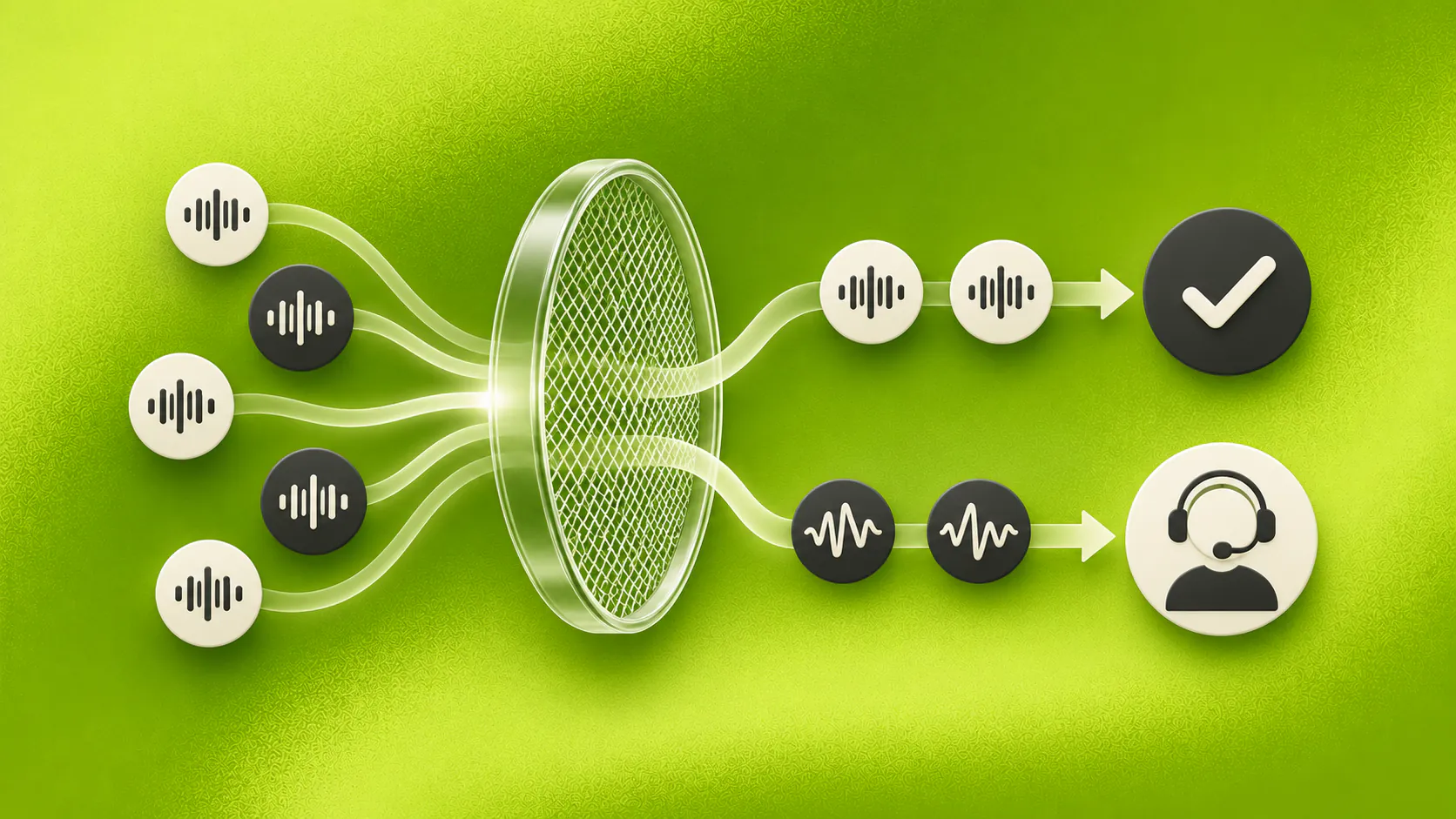
A voice AI agent is best suited to frequent, bounded calls with approved answers, reliable connected actions, a visible completion state and a clear human owner for exceptions.
Key takeaways
- Start with a customer task, not a target percentage of calls to automate.
- Prefer frequent calls with bounded decisions and a result another system can confirm.
- Keep high-consequence, ambiguous and discretionary work with authorised people.
- Treat transfer quality and exception ownership as part of the workflow.
Which customer calls should a voice AI agent handle?
A voice AI agent should handle calls where the customer goal is clear, the permitted response is known, any action can be verified and an exception has an owner. Appointment requests, basic qualification, routine status questions and callback requests may fit. Complaints, disputed decisions, sensitive advice and unusual exceptions usually need a person.
That answer is more useful than asking how many calls can be automated. A high automation target can push the wrong work into a system that lacks the information or authority to finish it. Start with the work a caller needs completed, then test whether the whole path is dependable.
If the category is new to you, begin with what an AI voice agent is. The ZINQ Voice channel describes the commercial scope; this guide helps you decide which workflow deserves attention first.
Related reading
- What is an AI receptionist?
- Where people should remain in control
- How agent guardrails work in customer conversations
- Knowledge-based agents and scripted bots compared
- How to implement conversational AI
Use four tests before assigning a call
A practical decision needs more than a list of popular use cases. Apply these four tests to the actual call as it works today.
1. Is the task repeatable?
The wording can vary while the underlying task remains stable. “Can I come on Friday?”, “Do you have anything after work?” and “I need to change next week’s appointment” may all enter the same scheduling workflow.
A voice AI agent does not need every caller to use the same sentence. It does need a bounded set of goals, required details and allowed next steps. If each call becomes a new policy discussion, it is a poor starting point.
2. What happens if the answer is wrong?
Consequence changes the design. Giving an outdated opening time is inconvenient. Changing a financial instruction, making a clinical judgment or disclosing account information to the wrong person can cause serious harm.
Low-consequence questions may be answered from approved knowledge. High-consequence actions require stronger identity, authority and human controls. The right question is not whether the model can produce an answer; it is who is accountable for acting on it.
3. Can the result be confirmed?
The call needs a completion state. A calendar can return a booking identifier. A service system can confirm that a request was created. A CRM can confirm that an enquiry was recorded. Without confirmation, the system should describe the request as pending, not complete.
This is where connected workflows matter. Conversation quality cannot compensate for an unreliable source or a broken action.
4. Who owns the exception?
Decide what happens when the caller changes their mind, the system is unavailable, identity fails or the request falls outside policy. A voice AI agent needs a named queue, team or role for those cases. “Transfer to support” is incomplete if nobody owns the transferred work.
A useful human handoff carries the caller’s goal, details collected, answers given, actions attempted and reason for escalation. The customer should not have to begin again.
Good candidates for an initial workflow
The following calls can be suitable when the required knowledge, systems and controls are in place.
Appointment and callback requests
A caller wants an available time, needs to reschedule or asks for a callback. The task has a visible end: a confirmed slot or an owned callback request. The appointment-booking use case shows the business workflow around that outcome.
Consider an illustrative call to a service business. The requested Wednesday slot is unavailable. The voice AI agent reads two alternatives returned by the schedule, the caller chooses Friday and the scheduling system confirms it. The agent then repeats the location, date and time. If the connection fails, it creates a pending request or transfers the call rather than claiming a booking.
Routine status and service questions
Customers often call because a status is easier to ask for than to find. A suitable workflow can retrieve permitted information, explain the next expected event or create a service request. The customer-service use case provides the wider operating context.
Identity still matters. Recognising a phone number is not always sufficient authority to reveal an order, account or appointment. The verification step should match the information and action involved.
New enquiry capture
A voice AI agent can answer approved opening questions, collect what the prospect declares and arrange the next step. For example, it may ask which service the caller wants, their preferred location and timing, then route the enquiry through a lead-qualification workflow.
This is qualification by stated need, not hidden profiling. Sensitive assumptions about health, finances or eligibility should remain outside the workflow unless an authorised, lawful process explicitly supports them.
Overflow and after-hours calls
When staff cannot answer immediately, the system can give approved information, capture the reason for calling and set an accountable follow-up. The value is not “24/7” as a slogan. It is that an unanswered call becomes a visible next step instead of an unowned voicemail.
Calls that usually need a person
Some calls can begin with automated intake but should not remain automated through the decision.
- A complaint requiring investigation, empathy, negotiation or compensation;
- A clinical, legal, financial or insurance decision;
- A request for an exception to policy;
- An urgent or safeguarding situation;
- A disputed identity or authority to act;
- A complex cancellation or retention conversation;
- A caller who directly asks for a person;
- Any call where the required source or connected action is unavailable.
The boundary is about responsibility, not whether an AI voice sounds natural. A voice AI agent can collect relevant facts before transfer, but an authorised person must make the consequential decision.
Score one real call, not an abstract use case
Take a sample of recent calls and write down the customer’s goal, information used, actions taken, exceptions encountered and final result. Remove or protect personal data before using recordings or transcripts for evaluation.
Then score each task from low to high on:
| Test | A stronger first candidate | A weaker first candidate |
|---|---|---|
| Frequency | Happens often enough to learn from | Appears rarely |
| Variation | Different wording, stable workflow | Each case needs a new decision |
| Consequence | Error is detectable and recoverable | Error can cause material harm |
| Data | Approved source is available | Staff rely on memory or conflicting files |
| Action | System returns a clear result | Completion cannot be verified |
| Exception | A person or queue owns it | Failure has no owner |
Do not combine every candidate into one launch. Choose one voice AI agent path with enough volume to observe and a failure mode you can recover from.
How should you run the first test?
Write test calls from real variations, including interruptions, corrections, background noise, long pauses, unavailable systems and requests for a person. Include ordinary calls and edge cases. Repeating one clean script only proves that one clean script works.
Review outcomes through conversation analytics that your implementation actually records. Useful questions include:
- Did the caller’s stated goal get identified correctly?
- Was the answer grounded in the approved source?
- Did the connected system confirm the action?
- Were corrections preserved?
- Did a failed call create an owned next step?
- Did the transfer contain enough context to continue?
An AI voice agent is ready for broader use when the business can explain both successful and unsuccessful paths. Expand from one controlled task only after teams can see what happened and who owns what happens next.
The decision in one sentence
Give a voice AI agent frequent, bounded and recoverable work. Give people the calls that need authority, discretion or judgment. The strongest design lets each continue the same customer task without losing context.
Frequently asked questions
Which calls should a voice AI agent handle first?
Start with one frequent call that has an approved answer or bounded action, a reliable system of record and a clear completion state, such as booking a callback or checking permitted appointment availability.
Should a voice agent handle customer complaints?
It may collect the issue and route the call, but complaints that require empathy, investigation, negotiation or an exception should move to a responsible person with the context already gathered.
Can a voice agent handle sales calls?
It can answer approved questions, capture declared needs and arrange a next step. It should not make sensitive inferences, invent terms or present an unconfirmed action as complete.
When should a voice call transfer to a person?
Transfer when the caller asks, identity cannot be established, approved information is missing, a connected action fails, or the request needs judgment, authority or an exception.
Conclusion
Choose the first voice workflow by clarity, consequence and recoverability. A useful call ends in a confirmed action or reaches a person who owns the next step.
READY TO SEE ZINQ IN ACTION?
From first enquiry to conversion, follow-up and support, ZINQ helps automate the next step while keeping your team in control.
Book a DemoAdditional resources
What is conversational AI?
Conversational AI is technology that lets software understand and respond to spoken or written language. In business, it can also use approved knowledge, collect information, start permitted workflows and hand a conversation to a person when the request needs human judgment.
The ZINQ team·October 19, 2026·AI Agents & Conversational AIHuman-in-the-loop AI agents: where people should stay in control
Human-in-the-loop AI agents keep people involved when a customer request needs judgment, authority, empathy, sensitive information review or a decision the agent is not allowed to make.
The ZINQ team·September 30, 2026·AI Agents & Conversational AIAI agent guardrails for customer conversations
AI agent guardrails define what an agent may answer, ask, change, promise, escalate and log so customer conversations stay useful without letting automation exceed its authority.
The ZINQ team·September 30, 2026·AI Agents & Conversational AI