When Should You Use an Outbound AI Voice Agent?
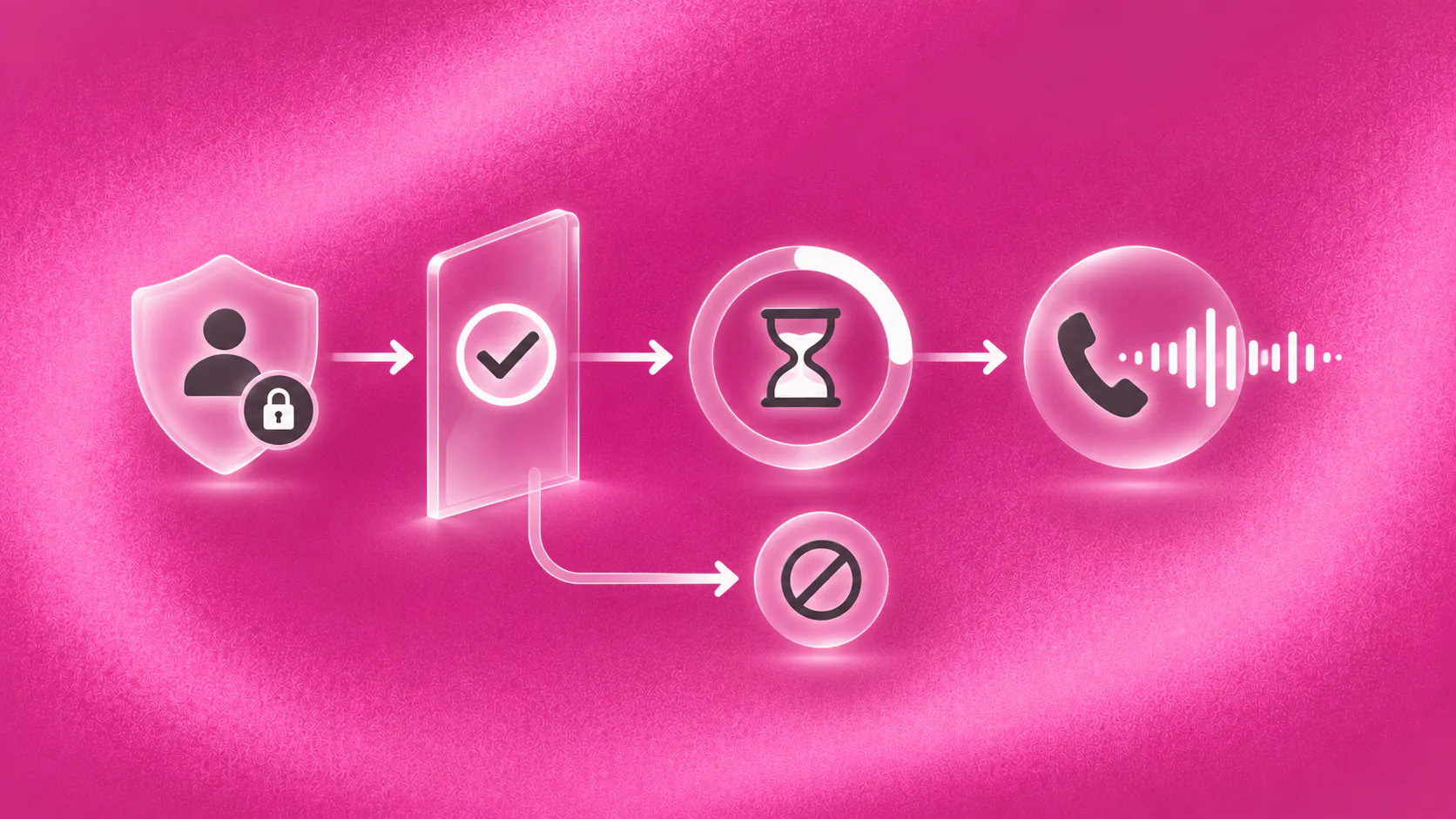
Use an outbound AI voice agent only for a lawful, expected and useful call to an appropriate first-party contact, with required consent, identification, timing, suppression, opt-out and human-escalation controls.
Key takeaways
- Begin with the relationship, purpose and permission for the call—not a list of numbers.
- Service reminders and requested follow-up differ from promotional outreach.
- Identification, local timing, suppression and opt-out must work before scale.
- Laws vary by jurisdiction and calling purpose; obtain qualified advice.
When should you use an outbound AI voice agent?
Use an outbound AI voice agent when the person can reasonably expect the call, the purpose is useful and bounded, the business has the required permission, and the workflow can honour identification, timing, suppression, opt-out and escalation requirements.
Do not begin with a contact list and ask what the system can sell. Begin with the relationship and the customer’s task. A requested callback, a permitted appointment reminder and unsolicited promotional outreach are not the same use case.
Rules depend on the country, recipient, purpose, technology and industry. This article is an operating framework, not legal advice. Obtain qualified review for every jurisdiction in which calls will be placed or received.
For the category foundation, read what an AI voice agent is and where people remain in control. The ZINQ Voice channel describes current product scope.
Related reading
- AI-agent guardrails for customer conversations
- How conversational AI works
- How to implement conversational AI
- What AI-agent analytics should reveal
- What is an AI receptionist?
Separate four outbound purposes
Requested response
A customer asks for a callback or an enquiry reaches the business with an appropriate permission and contact route. An outbound AI voice agent can continue the requested task if the calling process and disclosure are approved. The person should be able to reach a human or choose another channel.
Service communication
Appointment reminders, status updates and renewal notices may be useful, but their legal treatment and consent requirements vary. Include only the information the recipient is authorised to receive. A shared phone can create privacy risk.
Follow-up with first-party contacts
A business may follow up on an incomplete enquiry or a previously expressed interest when permitted. The call should identify the business and purpose, use accurate context and stop when the person declines. An old contact record is not permanent permission.
Promotional outreach
Promotional calling carries the highest interruption and compliance burden. An outbound AI voice agent using an artificial voice may fall within specific consent and telemarketing rules. Do not infer that a purchased lead, third-party form or existing relationship satisfies every requirement.
What do current US and India rules signal?
In the United States, the FCC has confirmed that current AI-generated voices fall within the TCPA’s “artificial or prerecorded voice” restrictions. The FTC’s Telemarketing Sales Rule separately addresses relevant telemarketing practices, including prerecorded-message consent, disclosures, calling times, do-not-call treatment and interactive opt-out requirements.
In India, TRAI defines unsolicited commercial communication around consent and registered preferences and distinguishes registered commercial communication. Its guidance also describes robo calls and the use of telecom resources for commercial communication.
These sources do not create one global checklist. State, sector, privacy, recording and consumer-protection rules may add obligations. Use counsel to classify the actual workflow rather than copying a generic compliance badge.
Build permission into the data model
Before an outbound AI voice agent selects a contact, the system should be able to determine:
- Who provided the number;
- Which business obtained the permission;
- The stated purpose and channel;
- When and how permission was captured;
- Whether it has expired or been withdrawn;
- Applicable preferences or suppression status;
- The recipient’s local time and jurisdiction;
- Whether the planned call matches the approved purpose.
Consent cannot be repaired by a friendly greeting after the call begins. If the record is uncertain, suppress the call until a responsible person resolves it.
What should happen in the first seconds?
The approved opening should identify the business and explain the purpose without deception. Where required or appropriate, it should disclose that the recipient is speaking with an AI system and provide the necessary recording or telemarketing information.
The recipient needs a straightforward way to decline, opt out or reach a person. Do not design a conversation that argues with “stop calling,” hides the caller’s identity or forces the recipient through qualification before honouring a request.
The calling workflow should update the relevant suppression record immediately when required. The change must apply beyond the current call.
Which outbound tasks are bounded enough?
A useful task has a clear reason, limited data need and visible next step. Examples that may fit after legal and product review include:
- Returning a requested call;
- Reminding a person of an existing appointment where permitted;
- Asking whether a customer wants to reschedule through an appointment workflow;
- Following up on a first-party enquiry within its permitted context;
- Providing an authorised status update;
- Inviting the recipient to choose a human callback.
The system should confirm connected actions through configured workflows. A requested time is not booked until the scheduling system returns success.
When is another channel better?
Use messaging or email when the information is easier to review in writing, the response is not urgent or the recipient has chosen that channel. Use a person when the call requires negotiation, empathy, sensitive judgment, identity recovery or a policy exception.
A permitted message that lets the customer choose when to respond can be less intrusive than a call. Channel selection is part of consent and customer effort, not only operational cost.
How should human handoff work?
If the person asks for staff, the call reaches a condition outside the approved flow or identity cannot be established, use human handoff. Pass the call purpose, verified context, answers collected and reason for escalation. Do not transfer sensitive assumptions or unverified claims as facts.
If nobody is available, offer an accurate next step. A callback request needs a queue and owner, not merely a promise that “someone will contact you.”
What should you test before calling anyone?
Test the entire compliance and recovery path in a controlled environment:
- Eligible and ineligible consent records.
- Local calling-time restrictions.
- Required identification and disclosures.
- Spoken and keypad opt-out where applicable.
- Suppression across future calls.
- Wrong numbers, shared phones and voicemail.
- Recording and retention controls.
- Requests for a person.
- Failed connected actions.
- Frequency limits and duplicate contacts.
Use available analytics to review eligibility, outcomes, opt-outs, failed actions and complaints only where the implementation records them. Compliance cannot be reduced to a completion percentage.
A cautious first deployment
Start with a requested, first-party call that has a narrow purpose and clear ownership. An outbound AI voice agent should make the expected task easier, not create a new interruption.
Before expanding, review recordings or transcripts lawfully, inspect opt-out handling, sample failed calls and confirm that suppression works. Expansion follows demonstrated control—not a larger upload list.
Frequently asked questions
When should a business use an outbound AI voice agent?
Use one when the recipient can reasonably expect a useful call, the business has the required permission and controls, and the call has a bounded purpose such as a requested callback or permitted reminder.
Can AI make cold sales calls?
Artificial-voice and telemarketing rules vary and may require prior consent, specific disclosures and opt-out controls. Do not treat a purchased number or general business relationship as universal permission.
What controls do outbound AI calls need?
Controls may include purpose-specific consent, caller identification, permitted calling times, suppression lists, opt-out, frequency limits, recording disclosures and human escalation, depending on jurisdiction and purpose.
Is an outbound voice call always better than a message?
No. Use messaging, email or a human call when the task is asynchronous, sensitive, complex or better handled in writing.
Conclusion
Use outbound voice only where the recipient, purpose, permission and next step are clear. Compliance review belongs in the workflow before any call is placed.
READY TO SEE ZINQ IN ACTION?
From first enquiry to conversion, follow-up and support, ZINQ helps automate the next step while keeping your team in control.
Book a DemoAdditional resources
Human-in-the-loop AI agents: where people should stay in control
Human-in-the-loop AI agents keep people involved when a customer request needs judgment, authority, empathy, sensitive information review or a decision the agent is not allowed to make.
The ZINQ team·September 30, 2026·AI Agents & Conversational AIAI agent guardrails for customer conversations
AI agent guardrails define what an agent may answer, ask, change, promise, escalate and log so customer conversations stay useful without letting automation exceed its authority.
The ZINQ team·September 30, 2026·AI Agents & Conversational AIWhat is conversational AI?
Conversational AI is technology that lets software understand and respond to spoken or written language. In business, it can also use approved knowledge, collect information, start permitted workflows and hand a conversation to a person when the request needs human judgment.
The ZINQ team·October 19, 2026·AI Agents & Conversational AI