How Does Conversational Voice AI Work on Customer Calls?
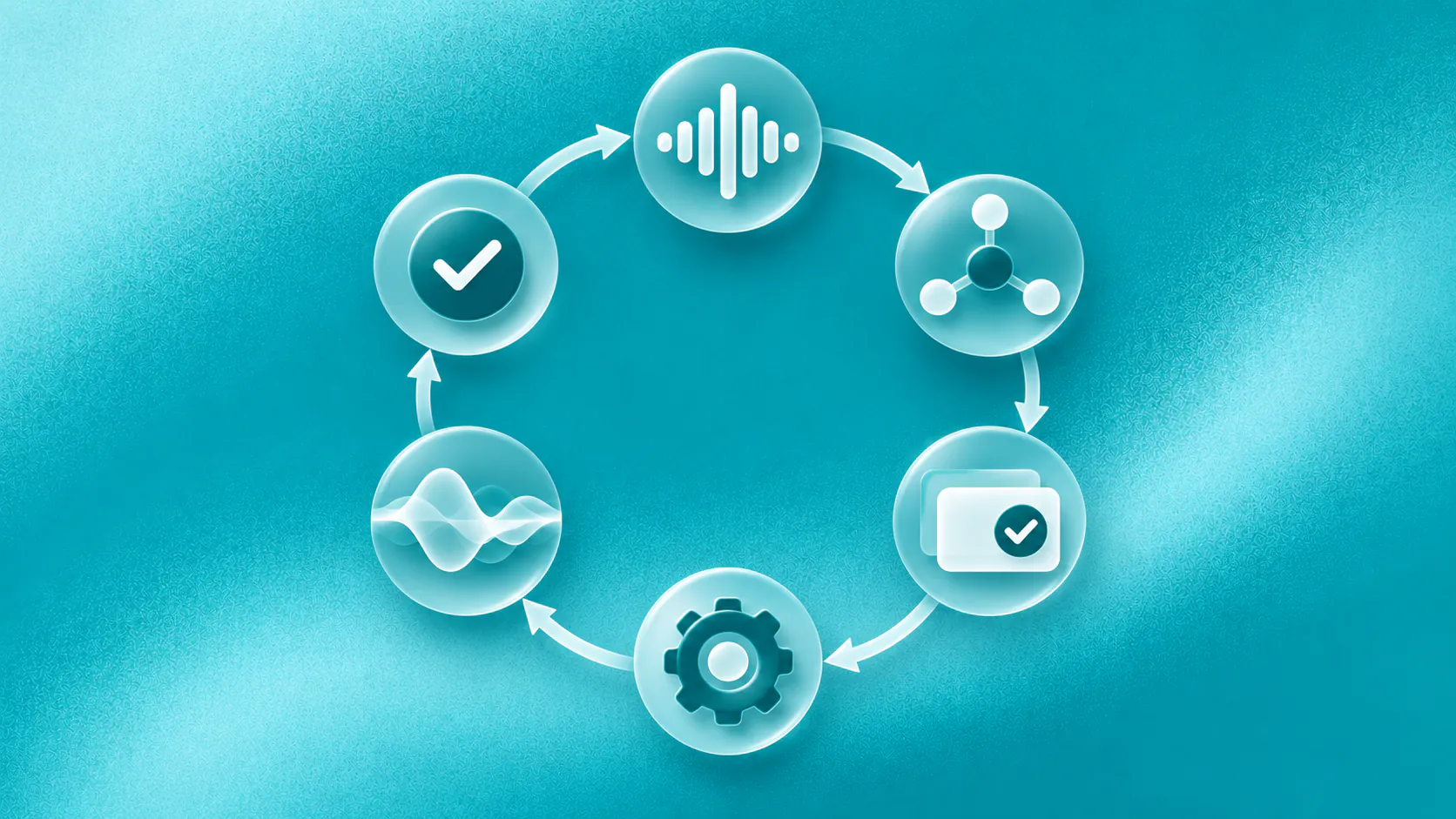
Conversational voice AI turns speech into context, selects an approved answer or permitted action, responds in speech, and repeats that cycle until the call reaches a confirmed outcome or accountable human handoff.
Key takeaways
- A complete voice call joins listening, context, approved knowledge, permitted actions and confirmation.
- Natural speech is useful only when the customer reaches a reliable next step.
- Interruptions, corrections and failed systems must be designed into the call.
- Consequential decisions and unresolved exceptions require authorised people.
How does conversational voice AI work on a customer call?
Conversational voice AI listens to the caller, keeps track of what has been said, uses approved information or a permitted workflow, and replies in speech. That loop continues until the customer reaches a confirmed result or the call moves to a person who owns the next step.
The caller experiences one conversation. Behind it, several jobs must stay aligned: hearing speech, understanding the current request, finding reliable context, deciding what is allowed, using connected systems and confirming what happened. A fluent answer is only one part of the job.
For the broader category, read what conversational AI is. For the voice-specific role, see what an AI voice agent is and the ZINQ Voice channel.
Related reading
- How conversational AI works across channels
- How to implement conversational AI
- Where humans remain in the loop
- How approved knowledge changes agent behaviour
- How to set guardrails for customer conversations
Follow one call from question to outcome
Consider an illustrative call to a service business. A customer says, “I need to move my Tuesday appointment to later in the week.” No real customer or result is represented here; the scenario simply shows the work involved.
1. The system listens for a complete turn
The audio arrives through the phone connection. The system detects speech, distinguishes it from silence and works out when the caller has paused or finished. In many designs, speech recognition produces text for a language or decision layer. Other designs process speech more directly.
Architecture affects latency and control, but the practical test is simple: can conversational voice AI hear the caller under realistic phone conditions? Test accents, names, background noise, weak connections, interruptions and people who change their sentence halfway through.
2. It carries forward the useful context
The request contains an action—reschedule—and a reference—Tuesday. The system may need to establish which appointment the caller means and whether the caller is authorised to change it. It should ask only for information the task needs.
Context is more than a transcript. It includes what has been confirmed, what remains uncertain, which source is authoritative and which actions are permitted. If the caller corrects “Thursday” to “Friday,” the current choice must change without losing the rest of the request.
3. It uses an approved source
The system checks the relevant policy and scheduling data rather than inventing availability. The knowledge layer supplies approved business information. A connected calendar or scheduling system supplies the current slots.
Conversational voice AI should separate an answer from an action. “Friday appointments are available” is information. “Your appointment is now Friday at 3 p.m.” is a completed action and needs confirmation from the system of record.
4. It chooses the next permitted step
The requested Thursday time is unavailable. The workflow returns two permitted alternatives. The system reads them aloud and the caller chooses Friday at 3 p.m.
This decision is bounded by the configured workflow. The system is not free to create a slot, override policy or promise a special arrangement. Where a request needs discretion, an authorised person takes responsibility.
5. It confirms the action
The scheduling system returns success. Only then does conversational voice AI repeat the new date, time and location. Reading the result back gives the caller a chance to catch an error while the call is still active.
If the tool times out, the path changes. The system may create an owned callback request, ask whether the caller wants a transfer or explain that confirmation is pending. It should not smooth over the failure with a false success message.
6. It records or hands off the next step
The completed change and relevant conversation outcome can be recorded where the implementation supports it. If a person takes over, the human handoff should include the caller’s goal, verified details, alternatives offered, action attempted and failure reason.
That is the full loop: listen, understand, ground, act, confirm and continue. Removing any one step can leave the customer with a pleasant conversation but unfinished work.
What happens when the caller interrupts?
Telephone conversations are rarely turn-perfect. A caller may speak over the response, pause to check a date, correct a name or ask a second question before the first is finished.
Conversational voice AI needs rules for those moments. It may stop speaking when it detects a genuine interruption, then decide whether the new words replace the previous answer or add to it. A cough or background voice should not automatically erase the current task.
Test corrections explicitly:
- “Actually, make that Friday.”
- “That is the wrong location.”
- “I said fifteen, not fifty.”
- “Before you book it, what is the cancellation policy?”
- “I want to speak to someone.”
The last request should not trigger a debate. The call should move through the approved transfer path with enough context for the employee to continue.
How is this different from IVR or a consumer assistant?
Traditional IVR usually asks a caller to choose from fixed options. A consumer voice assistant commonly helps an individual with general questions or personal device tasks. Business calling adds an operational requirement: the conversation must use the organisation’s approved information, permissions, systems and ownership rules.
| Experience | How the caller expresses the request | Typical business boundary |
|---|---|---|
| IVR | Menu choice or keypad input | Routes within predefined branches |
| Consumer assistant | Open spoken request | Serves the individual’s device or account context |
| Conversational voice AI | Open spoken request within a business workflow | Answers, acts or transfers within configured knowledge and permissions |
Labels alone do not prove capability. A product called a bot may use open conversation and connected actions. A product called an agent may only answer FAQs. Evaluate the call behaviour and the result.
Where do knowledge, workflows and people meet?
Three boundaries determine whether the experience is trustworthy.
First, knowledge limits what the system can say. Approved content should have an owner and a review process. Second, workflow permissions limit what it can do. A connection should expose only the actions and data needed for the task. Third, human ownership covers exceptions, sensitive decisions and failed actions.
For a customer-service workflow, that might mean answering an approved status question, creating a request when an update cannot be found and transferring a disputed decision. For appointment booking, it might mean showing returned availability, requesting a slot and waiting for confirmation.
Conversational voice AI should make these boundaries visible in behaviour. It asks for verification when required, says when an action is pending and involves a person when responsibility changes.
What should a business measure?
Begin with observable task outcomes, not whether the voice sounded impressive in a demonstration. Use only data that the implementation actually captures.
Questions worth answering include:
- Did the system identify the customer’s task correctly?
- Was the response supported by the approved source?
- Did the connected action return success or failure?
- Did the customer correct information, and was that correction preserved?
- Where did calls transfer or abandon?
- Did an exception reach an accountable owner?
- Did employees receive enough context to continue?
The analytics layer can support review where the relevant events are recorded. Sample individual calls as well as aggregate outcomes; a single percentage can hide repeated failure in one important path.
How should you evaluate it before launch?
Build a test set from actual customer tasks, with personal data removed or protected. Run each case more than once. Include clean and noisy audio, direct and indirect wording, corrections, silence, tool failures, missing knowledge, identity problems and human requests.
Then ask whether conversational voice AI produced one of three accountable endings: a verified answer, a confirmed action or a handoff with ownership. If the team cannot see which ending occurred, the workflow is not ready to expand.
Frequently asked questions
How does conversational voice AI understand callers?
It processes speech, identifies the caller's likely intent and relevant details, and uses the conversation context to decide whether to answer, ask a follow-up question, attempt a permitted action or transfer.
Does conversational voice AI use speech recognition?
Many systems combine speech recognition, a language or decision layer and speech generation. Some use speech-to-speech models. Buyers should test the observable call outcome rather than assume one architecture is always best.
Can conversational voice AI complete actions during a call?
It can attempt configured actions through connected systems. It should describe an action as complete only after the responsible system confirms success.
What happens when voice AI cannot complete a call?
It should explain the available next step, preserve the context and route the caller or create an owned follow-up instead of inventing an answer or hiding a failed action.
Conclusion
Evaluate the entire call loop: what the system hears, what it knows, what it may do, how it confirms results and how a person continues when the loop breaks.
READY TO SEE ZINQ IN ACTION?
From first enquiry to conversion, follow-up and support, ZINQ helps automate the next step while keeping your team in control.
Book a DemoAdditional resources
What is conversational AI?
Conversational AI is technology that lets software understand and respond to spoken or written language. In business, it can also use approved knowledge, collect information, start permitted workflows and hand a conversation to a person when the request needs human judgment.
The ZINQ team·October 19, 2026·AI Agents & Conversational AIHow Does Conversational AI Work
Conversational AI works by receiving text or speech, interpreting the user's intent and context, finding relevant information, choosing a permitted next step and generating a response. Business systems also need workflow state, action confirmation, guardrails and human handoff.
The ZINQ team·October 19, 2026·AI Agents & Conversational AIHuman-in-the-loop AI agents: where people should stay in control
Human-in-the-loop AI agents keep people involved when a customer request needs judgment, authority, empathy, sensitive information review or a decision the agent is not allowed to make.
The ZINQ team·September 30, 2026·AI Agents & Conversational AI