Conversational AI for Dealerships
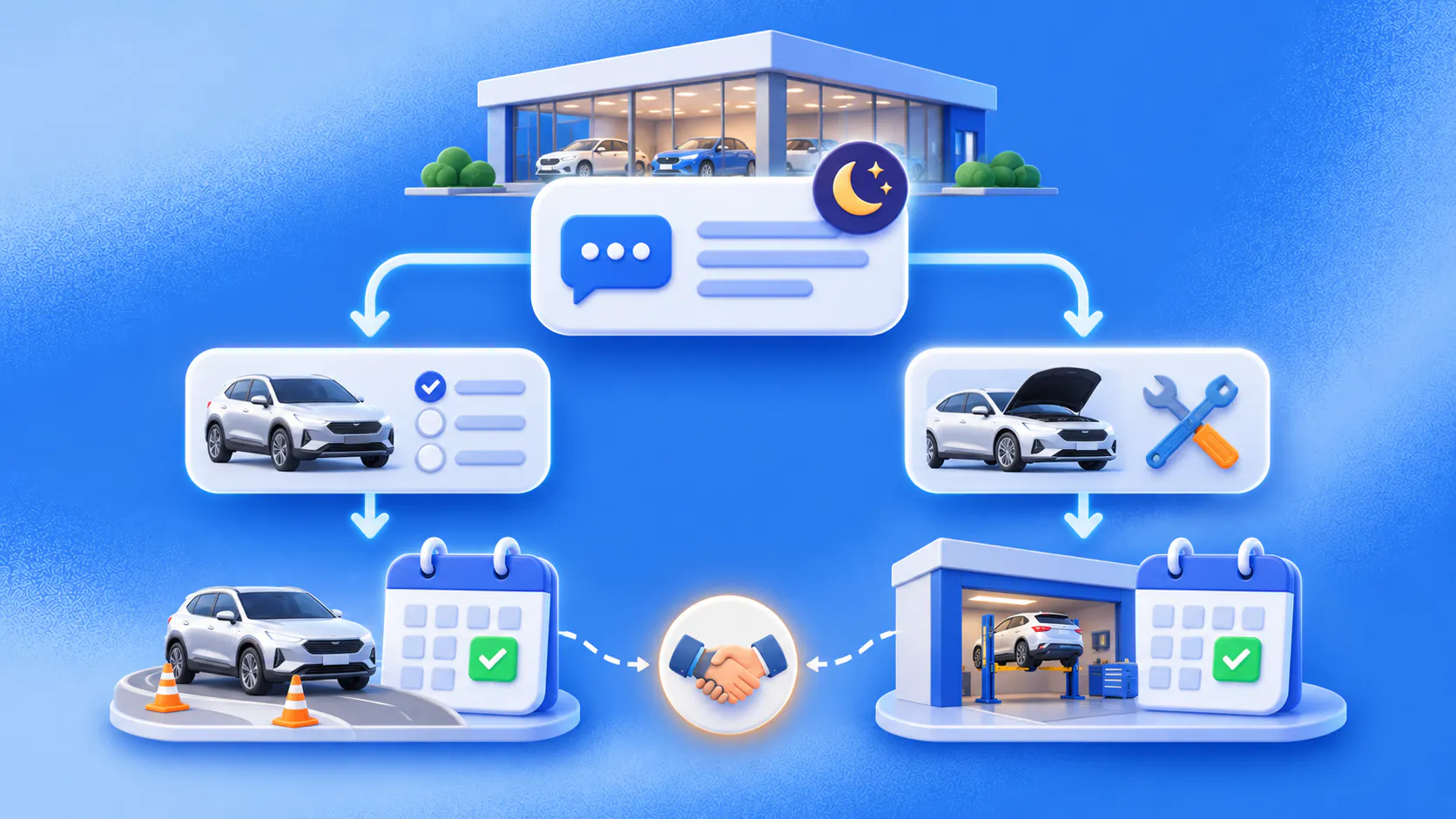
Conversational AI for dealerships can answer approved vehicle and service questions, qualify incoming enquiries, arrange test drives or workshop visits, continue permitted follow-up and route decisions to the right sales, service or finance team.
Key takeaways
- Respond to vehicle and service enquiries while the buyer or owner is ready to act.
- Use current inventory, approved information and connected calendars before promising availability.
- Keep trade-in valuation, finance eligibility, negotiation, diagnosis and safety decisions with qualified people.
- Measure completed next steps such as accepted test-drive requests, confirmed service bookings and owned follow-ups.
What is conversational AI for dealerships?
Conversational AI for dealerships helps a buyer or vehicle owner move from a question to a useful next step through messaging, web chat or another supported channel. It can answer from approved information, collect the details that change the route and continue into a test-drive request, service booking, follow-up or staff-owned conversation.
The value appears in ordinary moments. A buyer asks about a model after the showroom closes. A vehicle owner wants the next available service slot while the workshop team is busy. A previous enquiry replies to a permitted follow-up but reaches an inbox nobody owns. In each case, the business risks losing momentum before a person sees the message.
The wider guide to conversational AI in automotive covers the industry category. This article focuses on the day-to-day customer journeys inside a dealership.
Related must-read articles
- What is conversational AI?
- Conversational AI for automotive
- Conversational AI for lead qualification
- Conversational AI for appointment booking
- Automotive chatbots for dealership teams
Where do dealership enquiries lose momentum?
Dealership demand arrives across forms, calls, social messages, web chat and WhatsApp. The problem is often not a lack of enquiries. It is the delay and missing context between the first question and the next owned action.
A buyer may ask whether a vehicle is available, whether a certain feature is included and when they can visit. A generic acknowledgement answers none of those questions. Sales then starts with a name and number, repeats the discovery work and may respond after the buyer has contacted another dealership.
Service teams face a similar problem. A request such as “Can I bring the vehicle in on Saturday?” does not identify the model, service need, preferred location or urgency. Staff must collect those details before they can offer a valid slot.
Conversational AI for dealerships can collect this context while interest is active. It should not promise a vehicle, price, appointment or repair outcome until the responsible system or person confirms it.
Conversational AI use cases for dealerships
Qualify a vehicle enquiry
The conversation can ask what the buyer is looking for, preferred body type or model, intended use, timing, location and whether they want a showroom visit, call or test drive. The questions should reflect the dealership’s actual routing rules rather than turn the conversation into a long form.
When current inventory data is available through an approved source, the system can retrieve matching options. It should show only information the dealership can support and make availability subject to confirmation when stock changes quickly.
The lead-qualification use case explains how to collect declared needs without making sensitive inferences.
Move a buyer towards a test drive
A buyer who finds a relevant option may be ready to visit. The conversation can collect the preferred location and time, check permitted availability and submit the request through the connected calendar or workflow.
The booking is complete only when the system returns a confirmed state. If no suitable slot exists, the assistant can collect alternatives or create an owned task instead of inventing availability. The appointment-booking use case provides the operating pattern.
Continue approved follow-up
Some enquiries pause after a model comparison, unanswered question or unavailable time. With an appropriate basis and consent, the dealership can continue from the last useful state rather than send the same promotion to every contact.
An illustrative buyer may have asked about a test drive but stopped when the requested time was unavailable. A later message can offer a newly available slot or ask whether another time would help. The follow-up should stop when the buyer books, declines, opts out or moves to a person.
This is where conversational AI for dealerships supports demand already received by the business. It does not create, buy or optimise paid advertising campaigns.
Book routine service visits
For a service request, the conversation can collect the vehicle details, requested service, preferred workshop, timing and contact information. It can answer approved questions about opening hours or preparation and submit a booking request when the calendar and workflow support it.
It should not diagnose a fault or decide whether a vehicle is safe to drive. Warning lights, unusual sounds, breakdowns, recalls, warranty disputes and safety concerns need the dealership’s qualified service process.
The workflow platform can hold the defined steps, while approved information belongs in the knowledge layer.
Give customers confirmed status
A buyer may want to know whether a document was received. A service customer may ask whether the vehicle is ready. After the required checks, the conversation can retrieve a permitted status from the responsible system and communicate it accurately.
“Requested,” “under review” and “complete” are different states. If the connected system cannot confirm the answer, the conversation should say so and route the request instead of guessing.
Route finance, trade-in and negotiation questions
The system may collect a request for finance information, a trade-in discussion or a commercial conversation. It can explain an approved general process and arrange contact with the right team.
A person must handle personal financial advice, eligibility, credit decisions, trade-in valuation, inspection-based claims and negotiation. The human-handoff platform should pass the buyer’s stated goal and relevant details without presenting an automated judgment as fact.
One enquiry from model question to showroom visit
Consider an illustrative enquiry that arrives after hours: “Do you have this type of vehicle, and can I see it this weekend?”
The conversation asks for the buyer’s preferred location and the features that matter. It retrieves current approved options, explains the relevant differences and asks whether the buyer wants a test drive. The buyer selects Saturday morning.
The scheduling workflow checks the selected location and returns an available time. After the buyer confirms, the system creates the request and sends the confirmed details. Sales receives the buyer’s stated preferences, selected vehicle, appointment reference and any unanswered question.
If the requested vehicle is no longer available, the workflow does not substitute another one silently. It offers approved alternatives or routes the enquiry to sales. That boundary protects trust and gives the team a clear reason to step in.
What should dealerships measure?
Measure movement through the customer journey, not the number of automated replies. Useful measures may include:
- Enquiries with enough information for the next action;
- Test-drive requests accepted by the scheduling workflow;
- Service bookings confirmed by the responsible calendar;
- Follow-ups that receive a reply or reach the intended next step;
- Questions that cannot be answered from approved information;
- Incorrect routes, failed actions and staff corrections;
- Handoffs that arrive with the required context;
- Opt-outs and complaints linked to follow-up.
Conversational AI for dealerships should help leaders see where buyers and owners wait, repeat themselves or leave before the next step. A high conversation count can still hide unanswered questions and unowned work.
The contacts platform can preserve permitted context, and the automotive industry page shows how these journeys connect across sales and service.
How should the first dealership workflow launch?
Start with one high-frequency journey at one operating location. A model enquiry that leads to a test drive or a routine service request that leads to a workshop slot is easier to test than an assistant expected to handle every department.
Document the approved source, required questions, connected action, confirmation state, owner and stop conditions. Test unavailable inventory, full calendars, changed customer details, integration failures, out-of-scope questions and requests for a person.
Use the same test conversations before and after changing knowledge, prompts or workflows. Review real failures with sales and service staff, then improve the specific question, source or route that caused the problem.
Human involvement is the final use case. A person should step in for negotiation, finance, trade-in valuation, technical judgment, safety concerns, complaints, exceptions and any request the system cannot verify. Conversational AI for dealerships earns a wider role only after the team can inspect what it answered, what it attempted and what happened next.
Additional resources
- How an AI booking agent supports scheduled journeys
- Conversational AI for customer retention
- Explore ZINQ for automotive teams
Frequently asked questions
How can dealerships use conversational AI?
Dealerships can use it to answer approved questions, collect purchase or service needs, qualify incoming enquiries, arrange test drives and service visits, continue permitted follow-up and route exceptions with context.
Can conversational AI recommend a vehicle?
It can retrieve options that match explicit preferences and current approved inventory data. A person should handle negotiation, suitability judgments, trade-in valuation and any claim that requires inspection or specialist advice.
Can it discuss finance or approve a buyer?
It may explain approved general process information and arrange contact with an authorised finance team. It should not provide personal financial advice, assess eligibility or make a credit decision.
What should a dealership automate first?
Start with one frequent journey that has clear data and ownership, such as a model enquiry that leads to a test-drive request or a routine service request that leads to a confirmed workshop slot.
Conclusion
Conversational AI for dealerships is useful when it turns an incoming question into a verified next step. Keep vehicle and workshop information current, confirm connected actions and give commercial, financial and technical judgment to qualified people.
READY TO SEE ZINQ IN ACTION?
From first enquiry to conversion, follow-up and support, ZINQ helps automate the next step while keeping your team in control.
Book a DemoAdditional resources
-
Conversational AI for Automotive
Conversational AI in automotive can answer approved vehicle and dealership questions, collect sales or service enquiries, book test drives and service appointments, share confirmed status and route exceptions. It should use current inventory and workshop systems and leave finance, safety and technical judgment to qualified staff.
The ZINQ team · October 19, 2026 · Industries → Automotive -
Automotive chatbot guide for dealerships and service teams
An automotive chatbot should route each conversation to sales, service or parts, use current dealership information, collect only the details needed for the next step and confirm appointments or requests from the system of record. Finance, trade-in and technical exceptions need clearly defined human ownership.
The ZINQ team · September 21, 2026 · Industries → Automotive -
AI booking agent: automate appointment requests without losing control
An AI booking agent handles appointment or reservation requests by collecting the right details, checking approved booking rules, confirming the next step, sending reminders and handing complex cases to a person.
The ZINQ team · September 29, 2026 · Workflows & Automation