Best AI Chatbot for Business: How to Compare Your Options
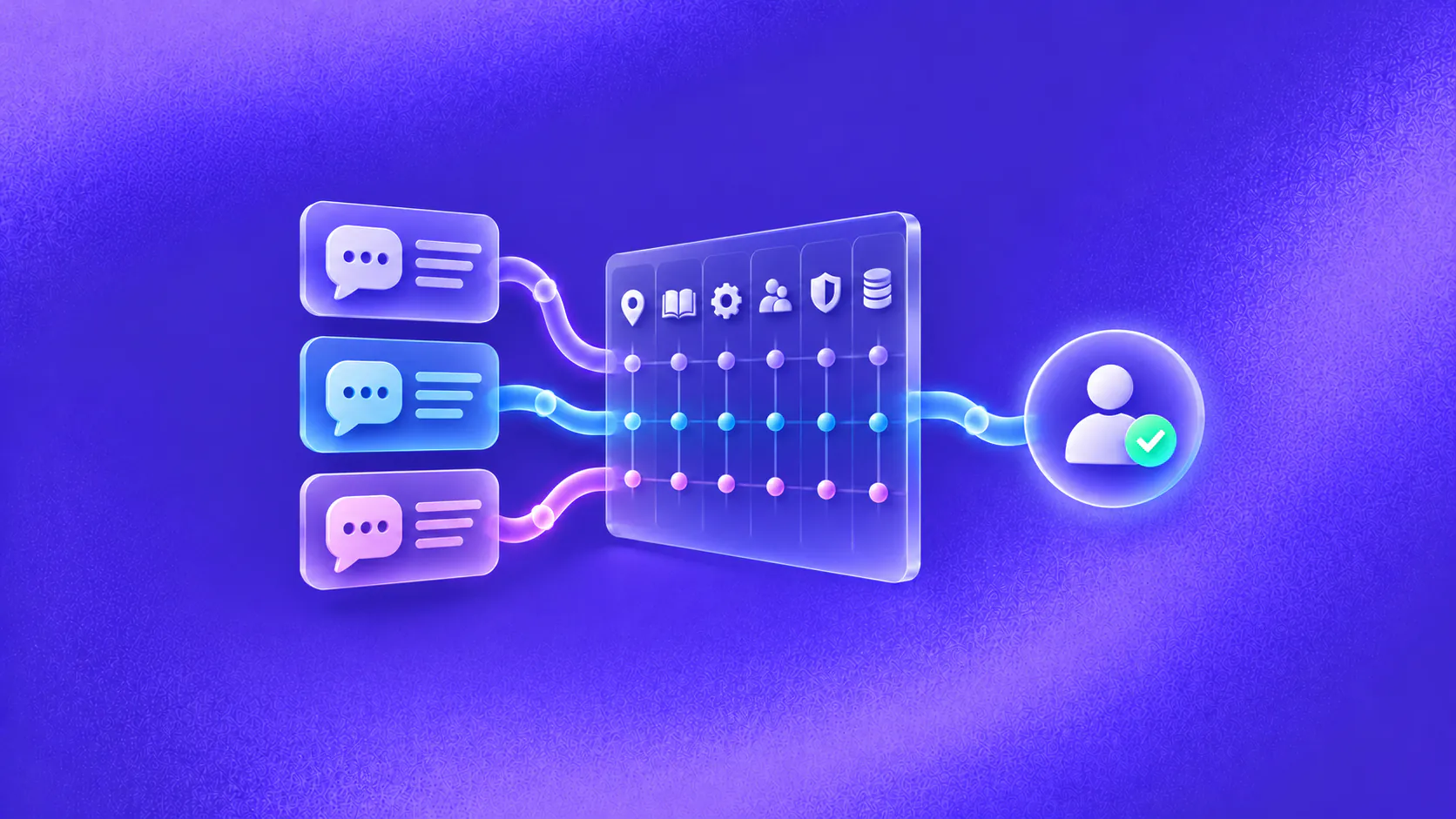
The best AI chatbot is the option that completes your highest-value customer journey reliably, uses approved knowledge, confirms connected actions and gives staff clear ownership of exceptions. Compare candidates with the same real workflow and evidence, not a generic feature count.
Key takeaways
- “Best” depends on the customer journey, risk and operating model you need to support.
- Give every shortlisted chatbot the same information, workflow and exception tests.
- Verify actions in the system that owns the result rather than accepting a successful reply.
- Include implementation, review and failure-recovery work in the buying decision.
What makes an AI chatbot the best fit for your business?
The best AI chatbot is not a universal winner. A retailer recovering an incomplete checkout, a service business booking appointments and a software company qualifying demos need different knowledge, actions and controls.
Imagine three impressive demonstrations. Each chatbot answers the prepared question. Only one can collect the missing detail, check the responsible system, confirm the next step and send an exception to the right team. That is the difference between a convincing reply and a useful operation.
Related must-read articles
Define “best” before you build a shortlist
Choose one customer journey and describe what success means. For a lead enquiry, success may require an approved answer, relevant qualification, a suitable booking option and a usable handoff when the request falls outside the standard route.
The best AI chatbot for that journey must work with the channels, knowledge, systems and team ownership already involved. A platform that performs well in a generic test may still be a poor operational fit.
Use six questions to compare your options
Can it complete the chosen journey?
Ask the provider to demonstrate your workflow, not a prepared showcase. Include the point at which the customer expects a booking, application, order or request to be confirmed.
Does it use the right knowledge?
Verify which sources it can use, how updates are controlled and what happens when an answer is missing. The best option should make unsupported answers less likely and review straightforward.
Can it act and confirm the result?
If an integration is required, confirm that it exists for the relevant system and action. “Integrates with” can mean anything from a data export to a production workflow.
Does it work on the channels customers use?
Website, WhatsApp, Instagram, email and other channels have different identity, consent, format and handoff requirements. Ask what context continues across supported channels and what remains separate.
What happens when it cannot continue?
Look for queues, assignment, context, status and clear responsibility. A transfer that disappears into an unowned inbox is not a handoff.
Can your team operate it after launch?
Identify who updates knowledge, reviews conversations, investigates failures and approves changes. The best AI chatbot should fit the available operating capacity, not only the procurement budget.
Compare every chatbot with the same scorecard
| Decision area | Question to verify | Evidence to request |
|---|---|---|
| Journey fit | Can it complete the defined customer task? | Live test using your scenario |
| Knowledge | Can approved sources be maintained and bounded? | Source and update demonstration |
| Actions | Can required systems confirm completion? | Successful and failed action tests |
| Handoff | Does a real owner receive useful context? | Queue and ownership test |
| Governance | Are access, permissions and review clear? | Roles and operating process |
| Cost | What will implementation and operation require? | Itemised commercial assumptions |
Score evidence, not promises. Record open questions and assumptions beside each result.
Test ordinary, difficult and failed conversations
An evaluation should include a clear request, vague wording, missing information, changed intent, an unsupported question, an unavailable integration and a direct request for staff.
Suppose a prospect starts a booking, changes the required location and then asks a question outside the approved source. The best AI chatbot does not conceal the gap. It preserves the useful details, explains the next step and gives ownership to the right person.
How should price affect the decision?
Compare subscription, channel, usage, implementation, integration, review and maintenance costs. Also consider the cost of incomplete work: repeated contacts, staff correction and customers who believe an action occurred when it did not.
A lower price is valuable when the required journey remains reliable. A larger feature list is valuable only when those features support work you actually intend to operate.
When should you choose a specialist or broader platform?
A narrowly focused tool may suit one stable task. A broader platform may be useful when several teams need connected journeys, channels, knowledge and ownership. Neither category is automatically better.
Choose the best AI chatbot for the next proven scope, then confirm that the option can expand without forcing a complete rebuild. Avoid buying future possibilities that your team has no plan to use.
When should a person step in?
Keep human ownership for judgment, negotiation, sensitive complaints, uncertain identity, professional decisions, policy exceptions and failed actions. The chatbot should pass the goal, relevant verified context, completed steps and next required action.
The handoff is the last use case in the journey. It allows the best AI chatbot for your workflow to complete ordinary work while people handle the conversations where their authority and judgment create value.
Additional resources
- How to create an AI chatbot
- AI chatbot customer service
- Generative AI chatbot vs traditional chatbot
Frequently asked questions
What is the best AI chatbot for a business?
It is the chatbot that reliably completes the business's chosen customer journey within its knowledge, data, permission and human-ownership requirements.
Should a business choose the chatbot with the most features?
No. Features matter only when they help complete a relevant journey. Unused capabilities can add cost and operating complexity.
How many chatbot platforms should a business test?
A focused shortlist is usually more useful than many superficial demos. Apply the same scorecard and realistic tests to each shortlisted option.
Conclusion
The best chatbot decision comes from proving one real journey, including its exceptions, and choosing the option your team can operate responsibly after launch.
READY TO SEE ZINQ IN ACTION?
Compare how ZINQ handles the ordinary path, exceptions and human ownership.
Book a DemoAdditional resources
-
What Is an AI Chatbot?
An AI chatbot is software that understands everyday language and responds through a customer conversation. For a business, it can answer approved questions, collect details, qualify an enquiry, complete a connected action and pass an exception to the right person.
The ZINQ team · October 23, 2026 · AI Chatbots -
AI-Powered Chatbot Platform: Buyer’s Guide for Business
The best AI chatbot platform is the one that can complete your chosen customer journey using approved knowledge, connected systems, clear permissions and accountable human handoff. Compare platforms through a real workflow rather than a feature count or scripted demonstration.
The ZINQ team · October 22, 2026 · AI Chatbots -
AI Chatbot Examples and Practical Use Cases
Useful chatbot examples show a customer reaching an observable next step: a qualified enquiry, suitable option, confirmed booking, completed checkout, current status answer or well-prepared handoff. The best use case is frequent, bounded and connected to a result the business can verify.
The ZINQ team · October 22, 2026 · AI Chatbots