Generative AI Chatbot vs Traditional Chatbot
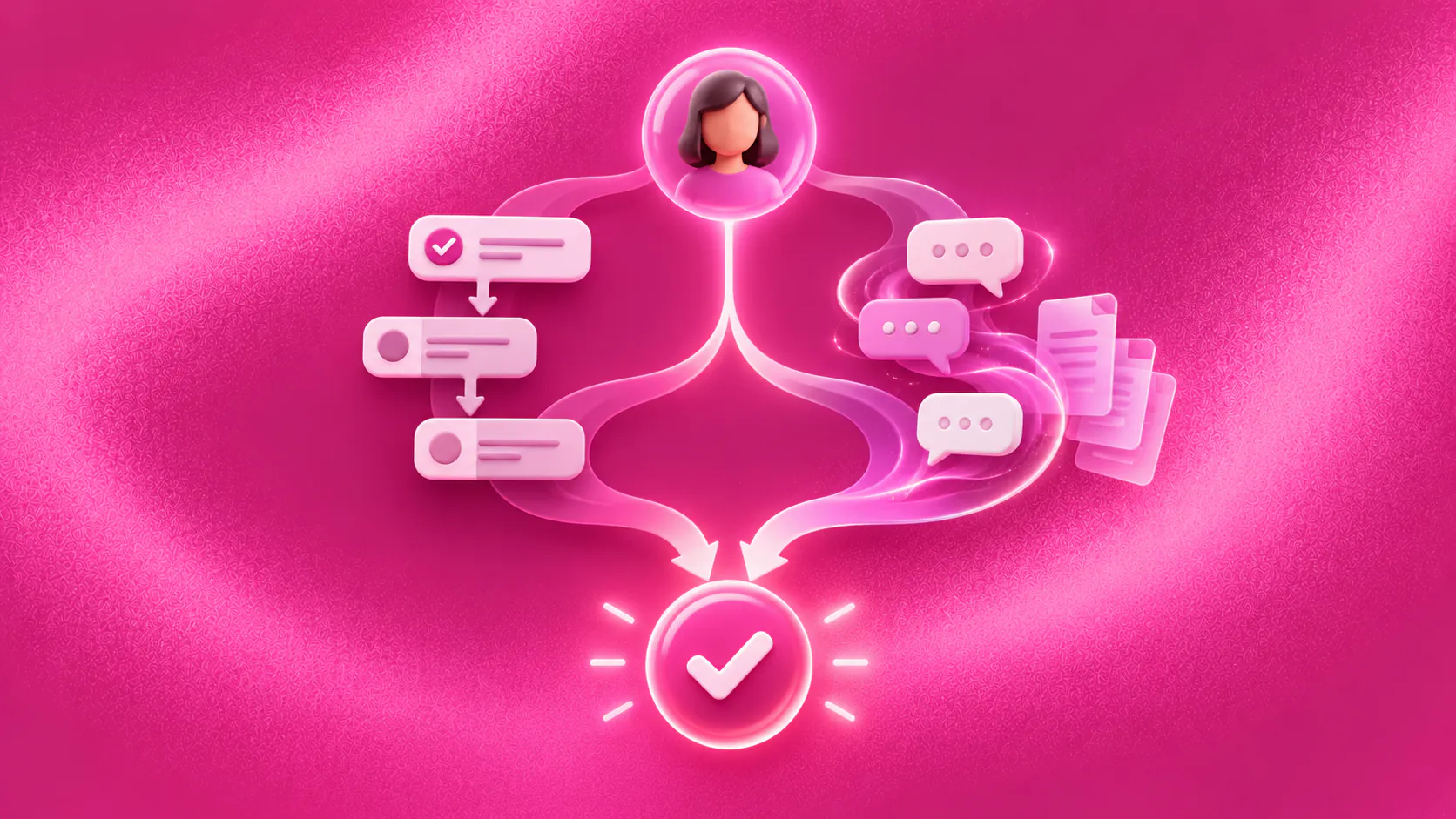
A traditional chatbot follows predefined rules, menus or answer paths, while a generative AI chatbot can interpret varied language and compose a response from instructions and approved context. Businesses often need both: predictable controls for fixed actions and language flexibility for customer questions.
Key takeaways
- Traditional chatbots are predictable but can fail when customers phrase a request unexpectedly.
- Generative systems handle language variation but still need approved knowledge and action limits.
- A hybrid design can use flexible conversation around controlled workflows.
- Choose by customer task, consequence of error and required system action.
What changes when a chatbot can generate an answer?
A traditional chatbot usually follows predefined menus, rules or answer paths. A generative AI chatbot can interpret varied customer language and compose a response using its instructions, conversation context and available knowledge.
The newer approach feels more natural, but fluency is not the same as accuracy or completed work. A customer asking to change a booking needs more than a well-written reply. The system must identify the correct record, follow the permitted change rules and confirm the result through the responsible calendar.
Related must-read articles
- What is an AI chatbot?
- AI chatbot examples and use cases
- How to create and implement an AI chatbot
- AI chatbot for customer support
- Conversational AI vs generative AI
Generative AI chatbot vs traditional chatbot at a glance
| Decision area | Generative approach | Traditional approach |
|---|---|---|
| Customer language | Handles wider phrasing and follow-up | Works best with anticipated inputs |
| Response creation | Composes an answer from context | Selects a predefined response or path |
| Predictability | Requires grounding, testing and boundaries | More predictable inside designed paths |
| Maintenance | Knowledge and instructions need review | Rules and answer trees need manual upkeep |
| Best fit | Varied questions and contextual conversation | Fixed choices and controlled steps |
The two approaches can work together. A flexible conversation can lead into a deterministic identity check, booking rule or approval step.
Where does generative capability help customers?
Understanding the request in the customer’s words
People rarely use the labels built into a menu. A generative AI chatbot can recognise that “Can I come after work next Thursday?” is an availability question and continue towards the correct booking workflow.
Answering follow-up questions with context
Customers often ask a second question that depends on the first. The assistant can preserve relevant conversational context instead of restarting the decision tree.
Explaining approved information clearly
The system can adapt an explanation to the question while remaining grounded in maintained sources. The knowledge platform should define what information is approved and what happens when an answer is missing.
Collecting information conversationally
An enquiry, service request or return can be gathered without presenting a long form all at once. The conversation should still ask only for information the workflow genuinely needs.
Where do traditional controls remain valuable?
Fixed logic is useful when a business must guarantee a sequence, enforce permissions or limit the available choices. Identity verification, consent, transaction approval, cancellation windows and system confirmation should not depend on creative wording.
A generative AI chatbot therefore needs controlled workflows around consequential actions. The model can help understand and explain; the workflow defines what the system may do.
What can go wrong with each approach?
Traditional bots can trap customers in menus, fail on unexpected wording and send requests to the wrong branch. Generative systems can produce unsupported answers, misunderstand context or sound certain when they should stop.
Both can fail when integrations are unavailable, ownership is unclear or the customer cannot reach a person. The human-handoff platform should preserve the customer’s goal, collected details and attempted actions.
How should a business choose?
Start with the task and consequence of error.
- Use fixed choices when the valid options are known and narrow.
- Use generative language handling when customers express the same need in many ways.
- Use approved knowledge when the answer must remain grounded.
- Use controlled workflows for permissions, identity and actions.
- Use a person for exceptions, negotiation, consequential judgment and requested help.
An illustrative product enquiry may begin with open language, use approved catalogue information for discovery and then enter a controlled checkout or staff-assisted path. That is more useful than forcing the entire journey into one technical category.
How should you test a generative AI chatbot?
Test ordinary questions, ambiguous wording, conflicting requests, missing information, unsupported topics and attempts to bypass instructions. Check whether the assistant admits uncertainty and offers the correct next step.
Then test every connected action: success, rejection, timeout, duplicate request and partial completion. A generative AI chatbot should never claim an action succeeded before the responsible system confirms it.
Review conversations through the analytics platform and omnichannel inbox. Measure completed customer work, unresolved questions, failed actions, repeat contact and handoff reasons.
What is the practical buying decision?
Do not choose between “modern” and “old.” Choose the combination that helps the customer complete the task while keeping business actions controlled and observable.
Generative capability is valuable when language flexibility removes friction. Traditional logic remains valuable when predictable execution protects the customer and the business.
Additional resources
- AI-agent platform
- Knowledge management
- Workflow automation
- Customer-service automation
- Human handoff
Frequently asked questions
What is a generative AI chatbot?
It is a conversational application that uses a generative model to interpret language and compose responses according to instructions, context and available knowledge.
Are traditional chatbots obsolete?
No. Rules, menus and deterministic steps remain useful when choices are fixed, actions are consequential or the business needs predictable execution.
Can a business combine traditional and generative chatbot methods?
Yes. A conversation can use generative language handling while keeping identity checks, permissions, approvals and system actions inside controlled workflows.
Conclusion
Use generative capability where language flexibility helps the customer, and controlled logic where the business must guarantee the permitted path and confirm the result.
READY TO SEE ZINQ IN ACTION?
Combine natural customer conversations with controlled knowledge, workflows and human ownership.
Book a DemoAdditional resources
-
What Is an AI Chatbot?
An AI chatbot is software that understands everyday language and responds through a customer conversation. For a business, it can answer approved questions, collect details, qualify an enquiry, complete a connected action and pass an exception to the right person.
The ZINQ team · October 23, 2026 · AI Chatbots -
AI Chatbot Examples and Practical Use Cases
Useful chatbot examples show a customer reaching an observable next step: a qualified enquiry, suitable option, confirmed booking, completed checkout, current status answer or well-prepared handoff. The best use case is frequent, bounded and connected to a result the business can verify.
The ZINQ team · October 22, 2026 · AI Chatbots -
How to Create an AI Chatbot: Implementation Guide
To create an AI chatbot for business, choose one frequent customer task, define its completion and exception rules, prepare approved knowledge, connect only the required systems, test real messages and launch with a named operating owner.
The ZINQ team · October 22, 2026 · AI Chatbots