AI Voice Agent for Customer Service: What Can It Resolve?
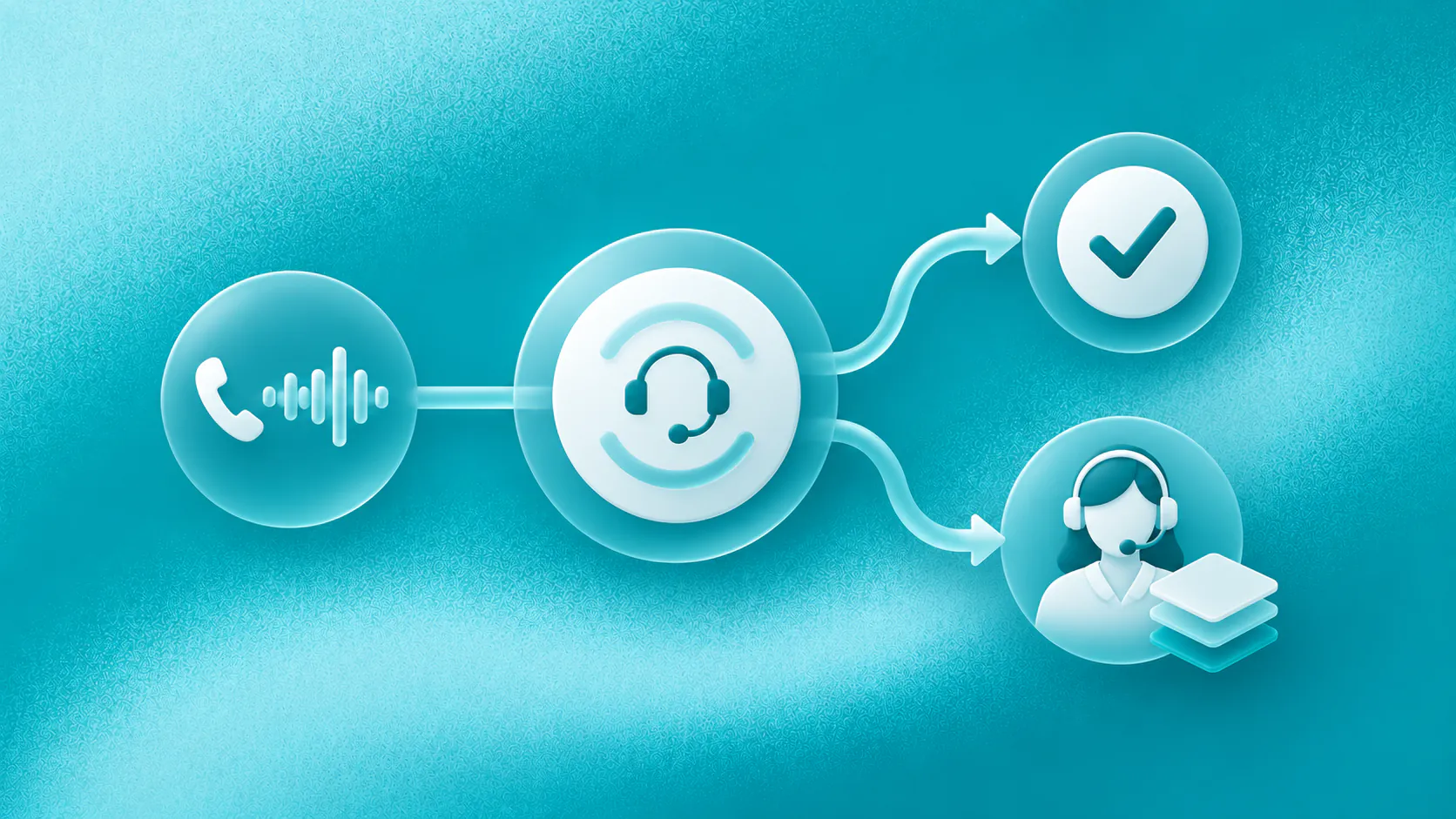
An AI voice agent for customer service can resolve bounded requests when it has approved answers, verified customer context, a connected action and a clear completion state; exceptions need contextual human handoff.
Key takeaways
- Resolution means the customer task is completed, not merely that the call was answered.
- Approved knowledge can answer questions; connected systems must confirm actions.
- Identity, authority and consequence determine which requests remain with people.
- Failed actions and transfers need an owner and enough context to continue.
What can an AI voice agent for customer service resolve?
An AI voice agent for customer service can resolve a request when it understands the customer’s task, uses approved information, completes any permitted action through the responsible system and confirms the result. If identity is unclear, a tool fails or the request needs judgment, the call should move to a person with its context intact.
Resolution is different from answering. Telling a customer how returns work may resolve a policy question. Saying “I have processed the return” without a successful system response does not resolve anything.
Start with what an AI voice agent is if you need the category definition. The Customer Support use case and ZINQ Voice channel describe the wider product context.
Related reading
- Where people remain in control
- How AI-agent guardrails work
- Knowledge-based agents and scripted chatbots compared
- How conversational AI works
- How to implement conversational AI
Use a resolution test, not a call-deflection target
For each call reason, ask four questions:
- What does the customer consider finished?
- Which source owns the answer?
- Which system confirms the action?
- Who owns the exception?
Voice automation may be suitable when those answers are specific. “Help with an order” is too broad. “Retrieve the permitted delivery status after appropriate verification, explain the next expected event and create an owned request when the status is missing” is testable.
This approach prevents a common measurement error. A call that ends without transfer may still fail if the customer calls again because the task remained open.
Which service calls can fit?
Approved information requests
Opening times, service availability, documented policies and process explanations can fit when approved knowledge is current and has an owner. The system should say when the answer is unavailable rather than produce a plausible substitute.
Status enquiries
A customer may ask about an order, appointment or existing request. The workflow needs appropriate identity checks and a connected source. The agent can report the returned status and explain an approved next step; it should not infer a status from an incomplete record.
Routine changes and requests
Selected cancellations, appointment changes, callback requests or service tickets can fit when the action is bounded. A configured workflow should return success, failure or pending status. Only success supports a completed confirmation.
Triage into the right service path
The system can collect the stated problem, ask business-defined questions and route the call. This is service routing, not clinical or other professional triage. Consequential decisions remain with qualified or authorised people.
What should remain with people?
Calls need human ownership when they involve:
- A complaint requiring investigation, empathy, negotiation or compensation;
- A disputed decision or policy exception;
- Clinical, legal, financial or insurance judgment;
- Unclear identity or authority to act;
- Safeguarding, urgency or a vulnerable customer;
- Missing approved information or conflicting records;
- A failed action that cannot be recovered safely;
- A direct request for a person.
The system can collect context before transfer, but it should not make the decision merely because it can continue speaking.
What does a resolved call look like?
Consider an illustrative call about moving an appointment. The customer identifies the booking through the approved process, asks for Friday afternoon and hears two returned options. They choose 3 p.m. The scheduling system confirms the change, and the agent reads back the date, time and location.
Now suppose the calendar times out. The agent explains that the change is not confirmed, preserves the preferred options and creates an owned callback or moves through human handoff. The unfinished action is visible.
The first call is resolved. The second is recovered, not resolved. Both can be good outcomes if the language and ownership are accurate.
How should identity change the workflow?
Recognising a phone number can provide context, but it does not establish authority for every request. The verification method should match the data and consequence involved.
Public information may need no identity check. A general account status may require verification. Changing sensitive details or making a consequential transaction may require stronger controls or an authorised employee. Collect only what the task needs and follow applicable privacy, retention and recording rules.
What should the handoff contain?
A useful transfer includes the customer’s goal, verified details, information already provided, actions attempted, system result and reason for escalation. It should also reach a team or queue that actually owns the next step.
The employee may need to re-verify information; that is different from making the customer retell the entire story. An AI voice agent for customer service should reduce avoidable repetition without hiding uncertainty.
How should you test resolution?
Build a test set from real call reasons, with personal data removed or protected. Include:
- Direct and indirect wording for the same request;
- Interruptions and corrections;
- Missing and outdated knowledge;
- Successful, failed and delayed system responses;
- Identity that passes and fails;
- Policy exceptions and complaints;
- Requests for a person.
Review results using available analytics and individual call samples. Measure confirmed actions, accurate pending states, repeated contacts, transfers with context and exceptions that reached an owner.
An AI voice agent for customer service is ready to expand when the team can explain why each tested call was resolved, recovered or transferred—not simply that the system answered it.
Start with one service outcome
Choose one frequent request with an approved source, bounded action and visible completion state. Document the human path before launch. Then expand only after ordinary calls and failure cases both reach an accountable next step.
That keeps the customer’s result at the centre of the decision and gives service teams evidence they can improve.
Frequently asked questions
What can an AI voice agent resolve in customer service?
It can resolve bounded questions and requests supported by approved knowledge, appropriate identity checks and connected systems, such as selected status enquiries, callback requests and routine changes.
Can a voice agent handle customer complaints?
It can capture the issue and route it, but complaints requiring investigation, negotiation, discretion or compensation should move to an authorised person.
How does a voice agent know a request is complete?
The responsible system should return a successful result. Without confirmation, the request remains pending and needs an owned next step.
When should customer service calls transfer?
Transfer for direct human requests, unclear identity, missing approved information, failed actions, exceptions and decisions requiring authority or judgment.
Conclusion
Give voice automation requests with clear answers, actions and completion states. Design failed actions and human ownership before increasing call scope.
READY TO SEE ZINQ IN ACTION?
From first enquiry to conversion, follow-up and support, ZINQ helps automate the next step while keeping your team in control.
Book a DemoAdditional resources
What is conversational AI?
Conversational AI is technology that lets software understand and respond to spoken or written language. In business, it can also use approved knowledge, collect information, start permitted workflows and hand a conversation to a person when the request needs human judgment.
The ZINQ team·October 19, 2026·AI Agents & Conversational AIHuman-in-the-loop AI agents: where people should stay in control
Human-in-the-loop AI agents keep people involved when a customer request needs judgment, authority, empathy, sensitive information review or a decision the agent is not allowed to make.
The ZINQ team·September 30, 2026·AI Agents & Conversational AIAI agent guardrails for customer conversations
AI agent guardrails define what an agent may answer, ask, change, promise, escalate and log so customer conversations stay useful without letting automation exceed its authority.
The ZINQ team·September 30, 2026·AI Agents & Conversational AI