AI Appointment Setting Chatbot: Booking and Scheduling Guide
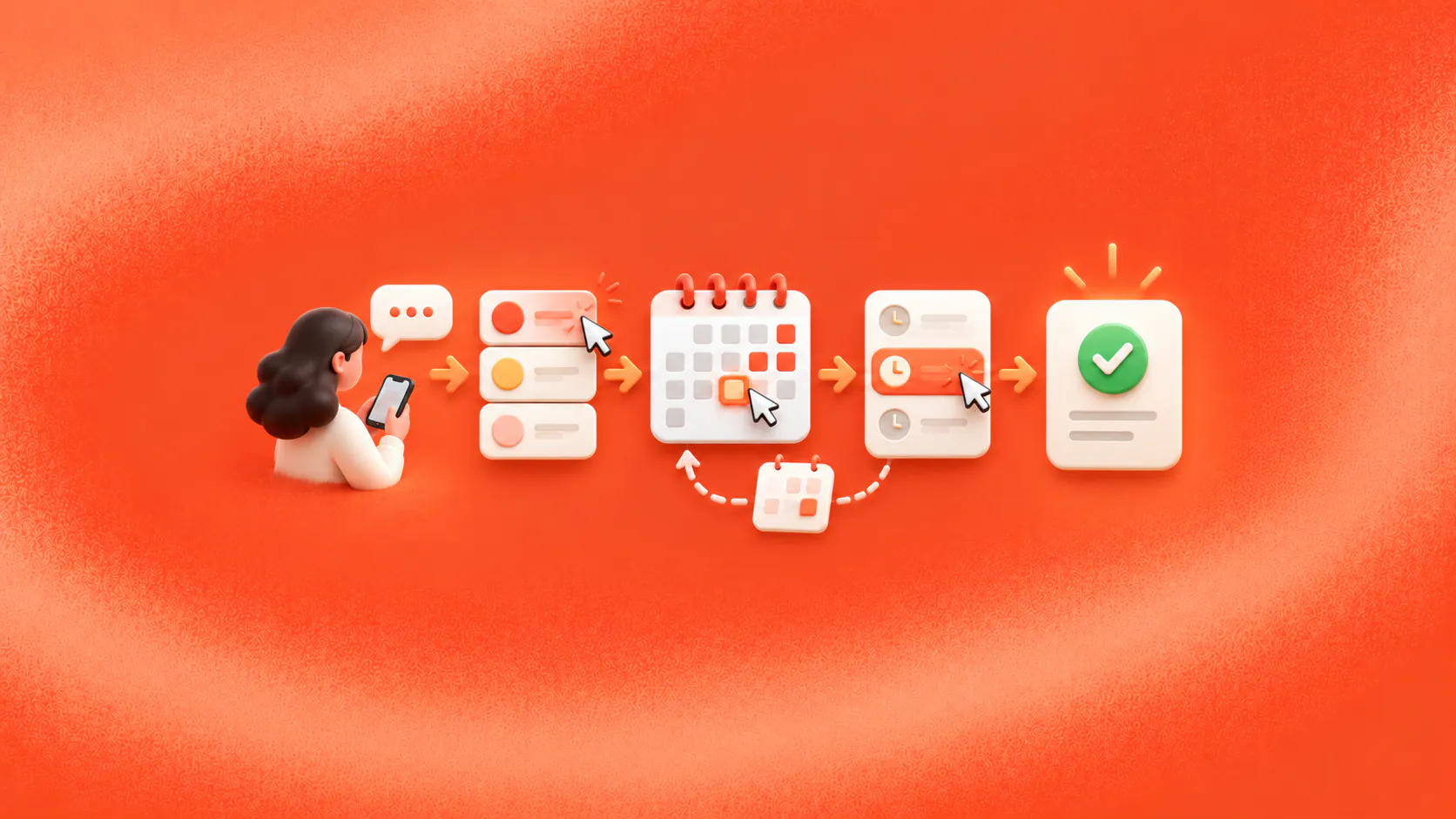
An AI appointment setting chatbot answers common questions, collects the details required for a booking, offers suitable availability and confirms the result through the connected calendar. It can also support permitted reminders and rescheduling while sending exceptions to the responsible team.
Key takeaways
- A booking is complete only when the responsible calendar confirms it.
- Answering service questions before showing slots helps customers choose confidently.
- Reminders and rescheduling need consent, current availability and clear cancellation rules.
- Staff should receive exceptions with the conversation and booking context already attached.
Where does appointment booking usually break down?
The customer is often ready before the business is. They ask whether a service suits their need, which location is available or whether an evening slot exists. A form captures their details but does not answer the question. A callback arrives after their attention has moved elsewhere.
An AI appointment setting chatbot keeps that conversation moving. It answers approved questions, gathers only the information needed for the appointment, offers suitable availability and waits for the connected calendar to confirm the booking.
Consider an illustrative after-hours enquiry: a prospect wants a consultation next week but can attend only after work. The assistant checks the relevant service and location, presents eligible times and confirms the selected slot. The team begins the next day with a booked appointment rather than an unanswered message.
Related must-read articles
- What is an AI chatbot?
- AI chatbot examples and use cases
- AI chatbot for lead generation and qualification
- How to create and implement an AI chatbot
- Conversational AI for appointment booking
What should the booking conversation complete?
An AI appointment setting chatbot should complete a customer task, not merely collect a phone number. The useful outcome depends on where the person is in the journey.
1. Answer the question blocking the booking
A customer may need to know the service duration, preparation, location, availability or general price information before choosing. The assistant should answer from approved sources and avoid making promises that require professional judgment or a custom quote.
2. Collect the minimum required details
Ask for information that changes eligibility, routing or availability. Long conversational forms create the same friction as long webpage forms. Sensitive information should be collected only when necessary, permitted and appropriately protected.
3. Offer suitable availability
The AI appointment setting chatbot should use the correct service, staff, location, duration and booking rules. Showing every open time is not helpful if half the slots cannot support the requested appointment.
4. Confirm the appointment in the responsible system
A conversational message saying “booked” is not enough. The calendar or booking platform must accept the appointment and return confirmation. If that system fails, preserve the request and create an owned recovery task.
5. Support reminders and permitted changes
Once booked, the assistant may send an approved reminder and let the customer confirm, reschedule or cancel when the connected workflow allows it. The appointment-booking use case explains how this fits into the wider operation.
6. Bring in a person for exceptions
A person steps in when availability is uncertain, the customer requests an exception, identity cannot be established, the decision is sensitive or the customer asks for staff. The handoff should include the requested service, preferred time, details already provided and the reason automation stopped. See the human-handoff platform for the operating model.
Which businesses can use booking chatbots?
An AI appointment setting chatbot can support any business where a customer chooses a time-bound service, but the rules differ by journey.
| Business situation | What the conversation can complete | Important boundary |
|---|---|---|
| Consultation or demo | Qualify the request and offer the right calendar | Do not promise suitability before the required review |
| Property viewing | Collect property interest and preferred time | Confirm agent and property availability |
| Vehicle sales or service | Identify the request and schedule the correct appointment type | Route technical or pricing exceptions |
| Clinic appointment | Share approved service information and book an eligible slot | Do not diagnose, prescribe or imply a clinical outcome |
| Hospitality or activity | Check party details and available times | Apply capacity, deposit and cancellation rules |
A booking assistant therefore needs business-specific knowledge and rules. Replacing the industry name in a generic script is not enough.
What should you check before implementation?
Start with the actual booking process. The assistant needs a clear map of customer questions, required fields, calendars, availability rules, confirmation sources, reminder policies, cancellation windows and exception owners.
Then test ordinary and difficult situations:
- The requested slot disappears during the conversation.
- The customer changes the service or location.
- The calendar is unavailable.
- Required information is missing.
- The person asks for an exception or staff member.
- A reminder receives an unexpected reply.
The workflow platform should make the state of each request visible, while the omnichannel inbox gives staff one place to continue supported conversations.
How should appointment booking performance be measured?
Measure confirmed customer outcomes rather than messages sent. An AI appointment setting chatbot should be evaluated against the booking result and the failures surrounding it. Useful measures can include:
- Booking enquiries received.
- Eligible slots offered.
- Confirmed appointments recorded.
- Requests that could not be completed.
- Reschedules and cancellations completed.
- Calendar or workflow failures.
- Exceptions transferred to staff.
- Repeat contact about the same booking.
The booking assistant should make it easier to understand where customers stop and why. It should not be credited for a booking that the connected calendar never created.
Additional resources
- Appointment booking automation
- Lead qualification workflows
- Web chat for customer enquiries
- WhatsApp customer conversations
- Workflow automation platform
Frequently asked questions
What is an AI appointment setting chatbot?
It is a conversational system that answers approved booking questions, collects required information, offers suitable availability and records a confirmed appointment in a connected calendar.
Can a chatbot reschedule an appointment?
Yes, when the connected booking system supports changes and the business has defined availability, notice periods, permissions and exception rules.
Does a booking chatbot replace reception or sales staff?
No. It handles routine booking work while staff remain responsible for exceptions, judgment, sensitive requests and situations that require authority.
Conclusion
A booking assistant creates value when a customer can move from a question to a confirmed next step without waiting or wondering whether the appointment exists.
READY TO SEE ZINQ IN ACTION?
Turn booking enquiries into confirmed next steps while keeping exceptions with your team.
Book a DemoAdditional resources
-
What Is an AI Chatbot?
An AI chatbot is software that understands everyday language and responds through a customer conversation. For a business, it can answer approved questions, collect details, qualify an enquiry, complete a connected action and pass an exception to the right person.
The ZINQ team · October 23, 2026 · AI Chatbots -
AI Chatbot Examples and Practical Use Cases
Useful chatbot examples show a customer reaching an observable next step: a qualified enquiry, suitable option, confirmed booking, completed checkout, current status answer or well-prepared handoff. The best use case is frequent, bounded and connected to a result the business can verify.
The ZINQ team · October 22, 2026 · AI Chatbots -
AI Lead Generation Chatbot: Capture and Qualify Enquiries
A lead generation chatbot engages an incoming enquiry, answers approved questions, collects the details that affect fit and moves the prospect to booking, follow-up or a suitable resource. It supports demand already reaching the business rather than running paid advertising.
The ZINQ team · October 22, 2026 · Sales & Conversion