Insurance AI Chatbot: Use Cases and Boundaries
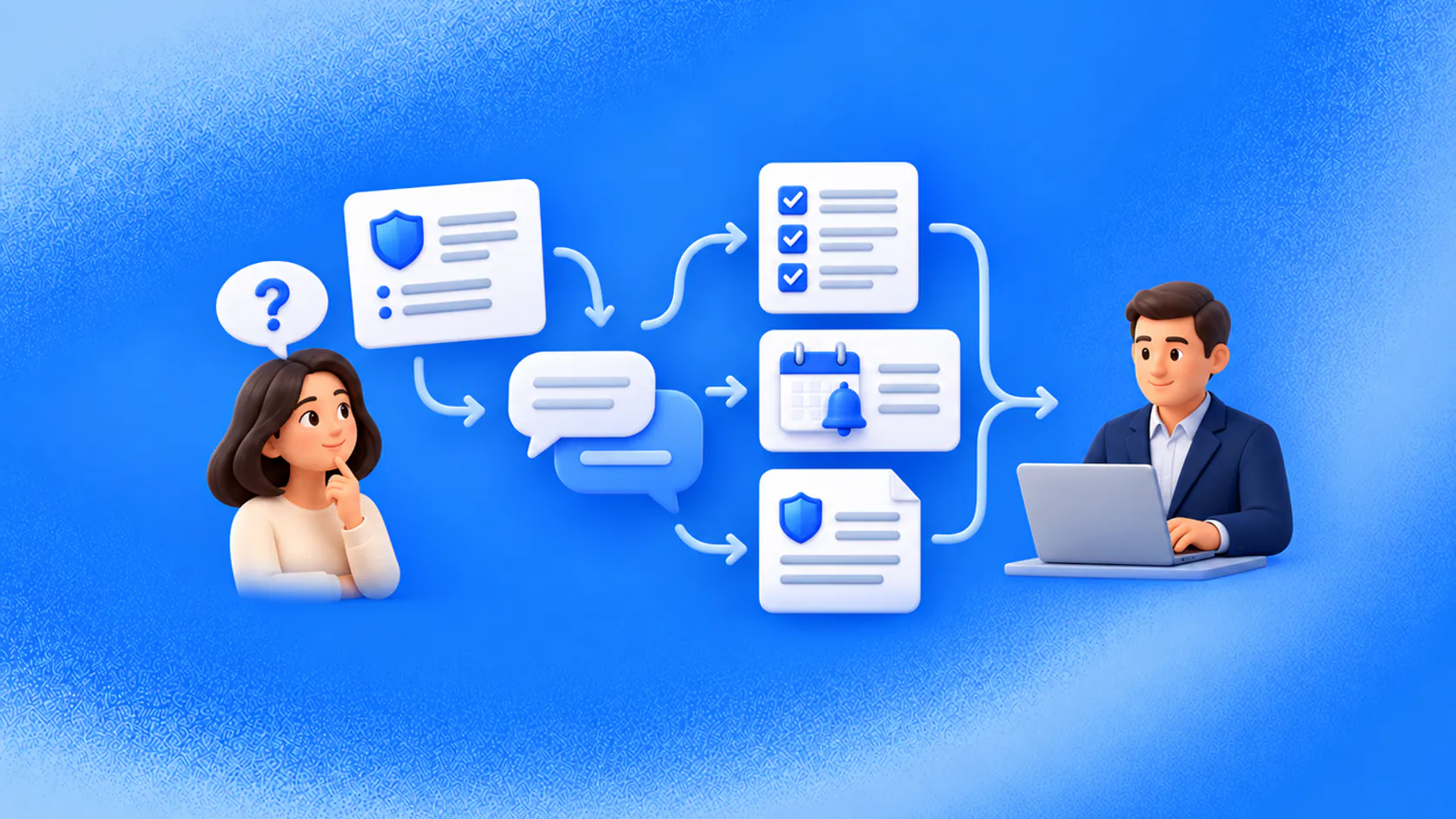
An insurance chatbot supports general product enquiries, quote or application intake, adviser booking, document reminders, renewal conversations, claims intake and status routing. Underwriting, premium calculation, coverage decisions, financial advice, fraud decisions, claim approval and settlement remain with authorised people and systems.
Key takeaways
- Separate sales, service, renewal and claims intent before collecting detailed information.
- Explain insurance categories and process steps without recommending a policy or giving advice.
- Use identity and authorisation controls before sharing policy- or claim-specific information.
- Transfer emotional, complex and consequential decisions to authorised people with context.
Why do insurance conversations lose momentum?
Insurance journeys combine unfamiliar terminology, missing documents, regulated decisions and long periods between enquiry and completion. A prospect may not know which team or product category matches the question. A policyholder starting a claim may not know what information to provide.
An insurance AI chatbot can make the next administrative step clearer. It can answer approved general questions, collect initial information, support adviser booking and route policy, renewal or claims conversations to the right owner.
Consider an illustrative motor-insurance enquiry arriving after hours. The prospect asks what information is normally needed to request a quote. The assistant explains the approved process, collects basic enquiry context and offers an adviser appointment. It does not calculate a premium or recommend coverage.
Related must-read articles
- What is an AI chatbot?
- AI chatbot for lead generation and qualification
- Conversational AI in insurance
- Insurance AI agent
- Human handoff in AI
How do insurance types change the conversation?
| Insurance type | Common conversation | Boundary |
|---|---|---|
| Health | General product, network, document and process questions | No medical, coverage or claims decision |
| Motor | Quote intake, renewal, documents and claim initiation | No valuation, premium or liability decision |
| Life | Product information and adviser booking | No suitability recommendation or financial advice |
| Property | General cover information and claim intake | No coverage determination or settlement |
| Travel | Product, trip-detail and claim-process questions | No visa advice or claim approval |
| Commercial | Initial requirements and specialist routing | No risk underwriting or binding decision |
An insurance AI chatbot needs different approved knowledge, intake fields and owners for each category. A generic script cannot safely handle every product and stage.
Which insurance use cases are appropriate?
Product and process enquiries
Explain approved definitions, requirements, documents and application steps. The assistant may help a prospect find the relevant category, but an authorised adviser owns recommendations and suitability.
Quote and application intake
Collect the basic information an adviser or approved process needs, remind an appropriate contact about missing steps and support appointment booking. The lead-qualification workflow should not become automated underwriting.
Renewal and re-engagement
An insurance AI chatbot may support permitted renewal reminders, answer approved questions and route changes to authorised staff. Consent, communication preferences, frequency, suppression and opt-outs apply.
Claims intake
An insurance AI chatbot can explain how to begin, collect the configured initial details and create an owned request. It must not decide coverage, fault, fraud, approval or settlement. Complex or emotional claims should reach people promptly.
Policy and claim status
An insurance AI chatbot needs appropriate identity, authorisation and connected-system controls before retrieving account-specific information. If current information is unavailable, preserve the question and route it rather than guessing.
Human involvement as the final use case
A person steps in for advice, underwriting, coverage questions, premium decisions, complaints, claim assessment, settlement and sensitive exceptions. The human-handoff platform should pass the relevant context without exposing unnecessary information.
What benefits should a business expect?
An insurance assistant can make general information easier to access, reduce repeated intake, help complete administrative next steps and route enquiries earlier. These are operating effects—not promises of higher conversion, lower claims cost or regulatory compliance.
Use the knowledge platform for approved information, workflows for permitted actions and the omnichannel inbox for supported team ownership.
What should an insurance assistant measure?
Useful measures may include enquiry type, required information collected, adviser appointments, incomplete applications, renewal replies, claims-intake requests, unresolved questions, failed actions and handoff reasons. Do not use containment as the main success measure when the right outcome is authorised human ownership.
Review where customers repeatedly become confused or abandon an administrative step. Improve the information and workflow before expanding the assistant’s authority.
Additional resources
Frequently asked questions
What can an insurance chatbot do?
It can answer approved general questions, collect initial quote or claim information, support adviser booking, send permitted reminders and route policy-specific requests after appropriate controls.
Can a chatbot recommend an insurance policy?
This article keeps policy selection, financial advice, underwriting, premium calculation and coverage decisions with appropriately authorised people and systems.
Can a chatbot approve an insurance claim?
No. It may collect initial claim information and provide approved process guidance, but claim assessment, fraud decisions, approval and settlement remain with authorised teams.
Conclusion
Insurance chat should make the next administrative step clearer while preserving identity, authority and professional judgment around every consequential decision.
READY TO SEE ZINQ IN ACTION?
Support insurance enquiries and administrative journeys while keeping consequential decisions with authorised people.
Book a DemoAdditional resources
-
What Is an AI Chatbot?
An AI chatbot is software that understands everyday language and responds through a customer conversation. For a business, it can answer approved questions, collect details, qualify an enquiry, complete a connected action and pass an exception to the right person.
The ZINQ team · October 23, 2026 · AI Chatbots -
AI Lead Generation Chatbot: Capture and Qualify Enquiries
A lead generation chatbot engages an incoming enquiry, answers approved questions, collects the details that affect fit and moves the prospect to booking, follow-up or a suitable resource. It supports demand already reaching the business rather than running paid advertising.
The ZINQ team · October 22, 2026 · Sales & Conversion -
Conversational AI for Insurance
Conversational AI in insurance can provide approved policy-process information, collect service or claim-notification details, share status from connected systems, send reminders and route customers to licensed or authorised staff. It should not make unreviewed coverage, underwriting or claim decisions.
The ZINQ team · October 19, 2026 · Industries → Insurance