Customer service automation examples with exception handling
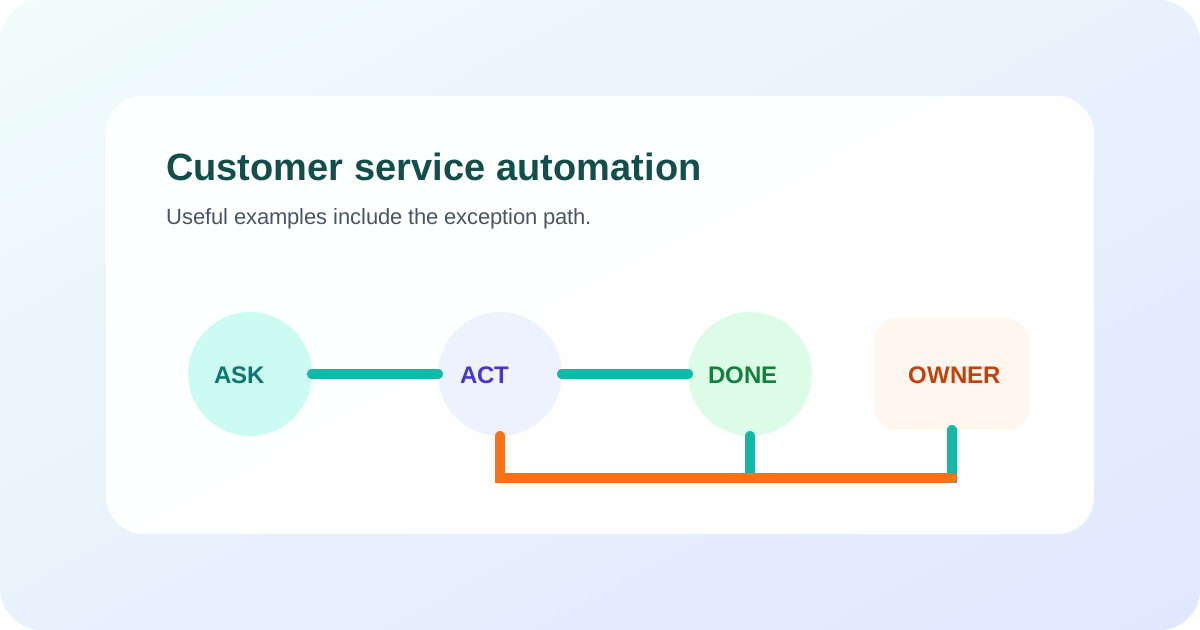
Useful customer service automation examples include the exception path, not only the successful reply. For every automated answer or action, define what happens when information is missing, identity fails, a system is unavailable, policy requires judgment or the customer asks for a person.
Key takeaways
- An automation example is incomplete until it states its failure and handoff behavior.
- Answer workflows need a maintained source and an honest response when evidence is absent.
- Action workflows must verify the destination record before confirming success.
- Partial failures require state, safe retries and an owner for reconciliation.
- Compare automation opportunities by consequence and recoverability, not volume alone.
What makes a customer service automation example useful?
A useful customer service automation example shows the trigger, required information, permitted behavior, completion evidence and exception path. It explains what the system does when the normal path cannot continue.
“A chatbot answers order questions” is an idea. A production-ready example states where current order data comes from, how the customer is verified, which statuses can be explained, what happens when the carrier and store disagree, and who owns a missing parcel.
The five hypothetical examples below are design patterns, not claims about customer deployments or results. Adapt them to your policies and verify supported product behavior before release.
For the operating model behind these examples, read AI customer service and customer operations workflow automation. For adjacent support metrics and outcomes, compare first-contact resolution, AI support and retention, and reducing ecommerce support tickets.
How should teams choose an automation example?
Assess each request rather than automating a whole support category.
| Factor | Lower-complexity candidate | Higher-complexity candidate |
|---|---|---|
| Information | Stable, current, owned source | Conflicting or judgment-heavy evidence |
| Authority | Read or bounded action | Discretionary approval or irreversible action |
| Completion | Clear system state | Subjective outcome with no record |
| Exceptions | Known and routable | Many undocumented variations |
| Consequence | Easy to correct | Financial, safety or legal impact |
| Recovery | Safe retry or staffed queue | No clear owner or reversal path |
Start where the team can observe and recover the outcome. A high-volume request may be a poor first automation if its source is unreliable. A smaller request can teach more when its boundaries are clear.
Example 1: order-status support
Normal path
A verified customer asks, “Where is order 4182?” The workflow retrieves the current fulfilment and carrier state from supported systems. It explains the known status and provides a supported tracking link.
Completion evidence is the returned order and shipment record, not the chatbot’s sentence.
Exceptions
- Order not found: ask for one supported identifier or route after the permitted attempts.
- Several shipments: list each shipment without presenting one delivery date as the whole order.
- Carrier and store disagree: state what can be confirmed and create an investigation if policy requires it.
- Marked delivered but customer reports it missing: stop the status-only workflow and route to the defined missing-delivery process.
- Order system unavailable: do not invent a date; preserve the request and communicate the next step.
What to measure
Track correct status retrieval, unsupported delivery promises, repeat contact, missing-delivery routing and unresolved exception age. The order-query automation guide provides further context.
Example 2: appointment rescheduling
Normal path
The customer asks to move an eligible appointment. The workflow locates the booking through the approved process, retrieves current slots, records a confirmed choice and submits the change. It replies only after the calendar confirms the new time.
Exceptions
- Missing service or booking: collect only the information needed to locate it.
- Requested slot disappears: offer current alternatives rather than retrying the stale slot.
- Change outside policy: explain the boundary and transfer the request without promising approval.
- Timeout after update submission: read the current booking before retrying so a second appointment is not created.
- Customer changes direction: use the latest confirmed choice and retain a clear state history.
What to measure
Track verified booking changes, duplicate bookings, false confirmations, time to reconcile uncertain updates and staff corrections.
Example 3: invoice retrieval and billing triage
Normal path
After the required verification, the workflow locates an available invoice and gives the customer the supported way to access it. The document identifier and permitted delivery state prove completion.
Exceptions
- Invoice has not been generated: state its actual status and next expected process if confirmed by policy.
- Customer disputes the amount: route to billing review rather than defending or changing the charge.
- Requested invoice belongs to another account: reveal no account-specific information and follow the approved identity path.
- Document service unavailable: create an owned request instead of sending a broken link.
- Customer asks to change payment details: start the separate, appropriately protected workflow.
What to measure
Track successful retrieval, privacy or verification failures, wrong-document incidents, dispute routing and repeat contact.
This example shows why “billing automation” is too broad. Invoice access, payment changes and disputes need different authority and evidence.
Example 4: return or exchange intake
Normal path
The customer selects an eligible order item, states the return reason and chooses an available return or exchange path under the current policy. The workflow creates the permitted request and returns a reference.
Exceptions
- Item outside the standard window: transfer an exception request without implying approval.
- Several items or shipments: preserve item-level identity rather than treating the order as one unit.
- Replacement stock unavailable: offer only supported options.
- Evidence required: collect the permitted attachment and label it as customer-provided, not independently verified.
- Return created but label generation fails: keep the return record, retry label generation safely or create a task. Do not create a second return.
What to measure
Track correct eligibility application, duplicate return records, incomplete labels, manual exception rate and reopened requests.
Example 5: technical support intake and handoff
Normal path
A customer reports that a product feature is not working. The chatbot asks one useful diagnostic question, follows the approved troubleshooting path and checks whether the issue is resolved.
If supported steps do not resolve it, the workflow creates a technical case containing the customer’s goal, environment, relevant error, steps attempted and results.
Exceptions
- Ambiguous symptom: clarify before choosing a troubleshooting path.
- Outdated instruction: use only the current owned source and record the knowledge gap.
- Repeated failed step: stop the loop and transfer.
- Potential incident affecting several customers: use the defined incident route rather than creating isolated routine cases.
- Customer asks for a person: respect the request and pass existing context.
What to measure
Track successful supported resolution, repeated questions, correctly formed cases, route accuracy and time to human ownership.
The customer service chatbot handoff guide defines a stronger transfer contract.
Use one exception checklist across workflows
Before releasing any customer service automation, ask:
- What information can be missing, ambiguous, stale or contradictory?
- Which identity or permission checks can fail?
- Which source or system can be unavailable?
- Can an action succeed while its confirmation fails?
- Is retry safe, and how are duplicates prevented?
- Which decisions require authority or judgment the automation does not have?
- What happens when the customer asks for a person?
- Which queue accepts the exception, including after hours?
- What does the customer hear while ownership changes?
- Which record proves the exception was resolved?
Store the answers with the workflow rather than relying on staff memory.
Distinguish retry, clarification, fallback and handoff
These responses solve different failure types:
- Clarification collects a missing or ambiguous fact.
- Retry repeats a safe operation after a transient failure, with duplicate protection.
- Fallback uses another approved way to complete the same task.
- Handoff transfers ownership to a person or team.
- Stop prevents an action that is unsupported or unsafe.
Do not hand every technical error to a general support queue. Do not retry a consequential write without checking whether it already succeeded. Do not call an unverified guess a fallback.
Anthropic’s agent guidance emphasizes environmental feedback and stopping conditions for agentic systems. In customer service, destination-system results and explicit handoff states provide that feedback.
Test examples as workflows, not transcripts
For each example, run routine, incomplete, unsupported and failure cases. Grade the answer, action, handoff and final record separately.
The AI customer service evaluation guide provides a case matrix. Add confirmed production failures to the regression set so a later change does not reintroduce them.
Use human review for judgment-heavy cases and calibrate reviewers with specific criteria. “Helpful” is too broad; “states that the refund is pending review and creates the correct queue item” is testable.
Measure exceptions without hiding them
An automation rate can improve when a system refuses to transfer, so it cannot stand alone. Add:
- false completion rate;
- exception rate by reason;
- unaccepted handoffs;
- time to owned recovery;
- repeat contact and reopenings;
- duplicate or conflicting records; and
- human correction effort.
Segment by workflow version and request type. Review examples behind the totals before changing a policy or threshold.
Where ZINQ fits
ZINQ supports customer-service workflows across messaging channels using configured knowledge, actions, customer context and human handoff. The customer service use case and workflow platform describe the relevant capabilities.
Choose one example, replace the hypothetical policy with your approved process and bring both normal and exception cases to a demonstration. Verify the final business record and the receiving team’s ownership.
Frequently asked questions
What customer service tasks are suitable for automation?
Frequent, bounded requests with reliable information, defined authority, observable completion and a recoverable exception path are strong candidates. Suitability depends on the specific request, not its category.
What is exception handling in customer service automation?
It is the defined behavior when the normal workflow cannot complete, such as asking for missing information, stopping an unsupported action, reading current state after a timeout or transferring an owned case to a person.
Should every failed automation become a human handoff?
No. Some failures can be clarified or retried safely. Handoff is appropriate when authority, judgment, unavailable systems or repeated failure require a person. The destination must have a real owner.
How should automated service outcomes be measured?
Verify the customer result and system record, then track false completion, reopenings, repeat contact, routing accuracy, unresolved exceptions and human correction effort.
Conclusion
Use these examples as design patterns, then replace their assumptions with your own policy, systems and ownership. Automate the request only when the team can identify success, detect uncertainty and recover without leaving the customer between a chatbot and an unowned queue.
READY TO SEE ZINQ IN ACTION?
From first enquiry to conversion, follow-up and support, ZINQ helps automate the next step while keeping your team in control.
Book a DemoRelated articles
-
How to implement customer service chatbot handoff
Implement customer service chatbot handoff by defining transfer triggers, conversation ownership, destination queues and the context a person needs to continue. Test explicit human requests, authority limits, missing information and system failures, then verify that the receiving team accepted the case.
The ZINQ team · September 21, 2026 · AI Chatbots -
How to evaluate an AI customer service agent
Evaluate an AI customer service agent with a repeatable set of realistic customer requests, expected outcomes and pass-or-fail checks. Include routine questions, missing information, unsupported requests, tool failures and human handoffs, then verify the final customer or business record instead of grading the agent's wording alone.
The ZINQ team · September 21, 2026 · AI Agents & Conversational AI -
AI customer service: an operating guide for support teams
AI customer service uses AI to assist, answer, retrieve, act or route within a support workflow. Operate it by assigning owners, defining request-level authority, maintaining knowledge and integrations, testing changes, reviewing failures and measuring the customer's completed outcome.
Kushal Verma · June 8, 2026 · Customer Support & CX