AI customer service agent: what it should handle
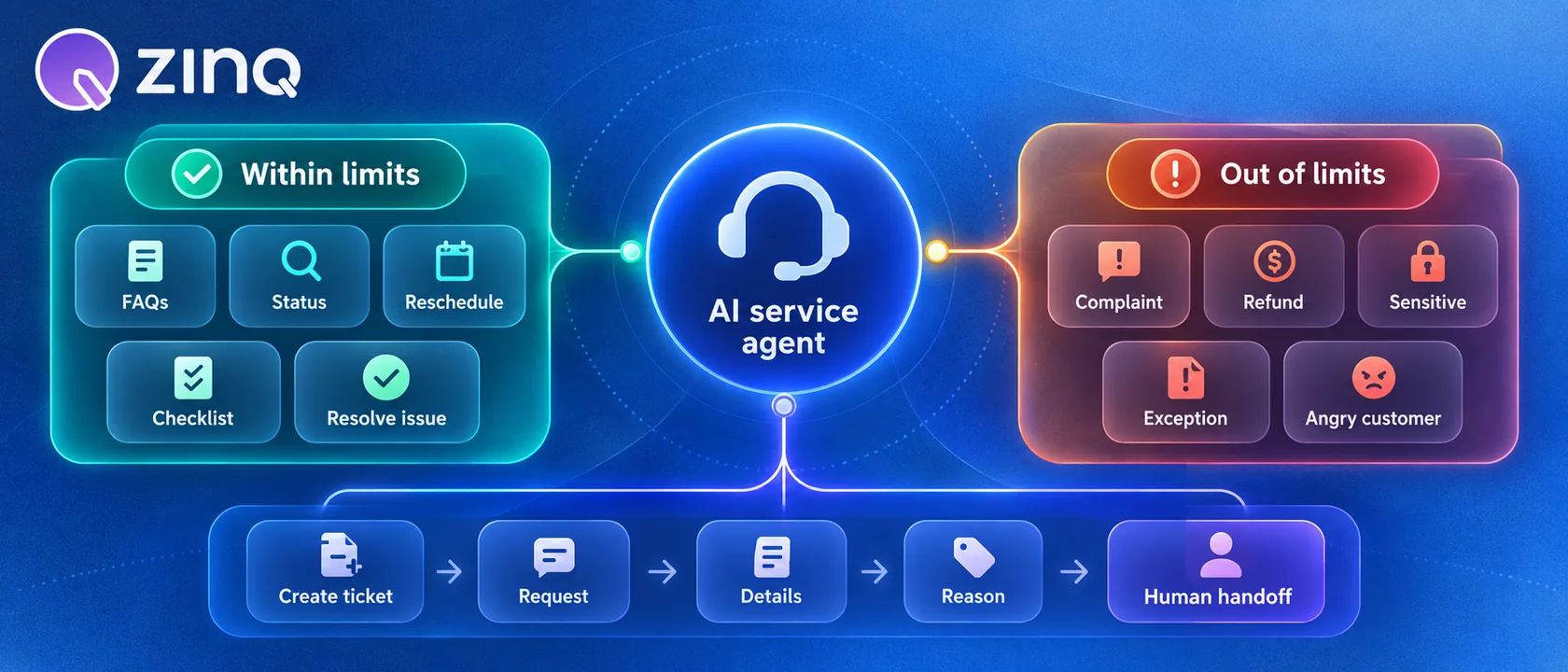
An AI customer service agent handles repeatable customer requests by understanding the message, answering from approved knowledge, collecting missing details, routing exceptions and handing off to a person with context.
Key takeaways
- An AI customer service agent should have a defined request scope, knowledge source, authority level and handoff path.
- Good first use cases are frequent, low-risk and easy to verify.
- The agent should expose the answer source or collected evidence whenever a human takes over.
- Support teams should measure resolution quality, repeat contact and handoff usefulness, not only response speed.
What an AI customer service agent is
An AI customer service agent is an AI agent used inside a support workflow. It reads a customer’s message, identifies the request, checks approved knowledge, asks for missing details and helps move the case to the right result.
That result may be a direct answer, a support task, a booking change, a status update, a callback request or a human handoff. The result should be defined before launch. If the team cannot say what the agent is meant to complete, the workflow is too vague.
People often describe this need as a customer service chatbot. That term is useful for search, but it should not limit the work. A support team usually needs more than chat. It needs context, ownership, routing and review.
What it should handle first
Choose request types that are common, clear and safe. Early success comes from doing a few support jobs well.
Good first candidates include:
- business hours, location and service information;
- order or booking status intake;
- appointment rescheduling requests;
- standard policy questions;
- document or preparation checklists;
- support triage for the right team;
- callback or follow-up collection.
These requests work because they usually have approved source information and a clear next step. They are also easy to review. A manager can read the conversation and see whether the customer reached the right place.
What it should hand off
The agent should stop when the request needs authority it does not have. Handoff is a feature, not a weakness.
Hand off when the customer asks for an exception, shares sensitive information, complains, threatens churn, asks for a refund outside rules or needs a decision that could affect money, health, safety or account access.
A good handoff contains context. The human should receive the customer’s request, collected details, attempted answer, reason for escalation and suggested queue. Without that context, the customer still has to repeat everything.
For teams designing this path, ZINQ’s human handoff page is the better commercial next read.
How the agent uses knowledge
An AI customer service agent should answer from approved knowledge, not from a loose guess. That knowledge may include policy pages, support articles, product instructions, booking rules, fulfilment notes or internal playbooks.
The agent also needs to know what to do when knowledge is missing. It can say it does not have the information, collect a question for review or route the customer to the right team.
This is where knowledge and analytics connect. Missing answers should become visible gaps. Repeated gaps tell the team which article, rule or workflow needs work.
A support workflow example
Take a customer who asks, “Can I change my appointment to Friday afternoon?”
The AI customer service agent should not reply with a generic “contact support” message if the business has a defined process. It can ask for the customer’s name or booking reference, check the allowed rescheduling window, collect preferred time ranges and route the request to the appointment owner if it cannot complete the change directly.
If the customer then asks for a special exception, the agent should hand off. The human sees the original request, the collected details and the reason the agent stopped.
That workflow is simple, but it saves staff from asking the same first three questions every time.
How to measure it
Do not rely on containment alone. A contained conversation can still be a poor experience if the customer did not get the right outcome.
Track:
- completed request by type;
- correct answer rate;
- repeat contact within a set period;
- reopened cases;
- handoff rate and handoff quality;
- unresolved age;
- staff time spent reviewing or correcting cases.
The goal is not to hide customers from the support team. The goal is to remove repeated handling and make human work cleaner.
How ZINQ fits this use case
ZINQ supports customer service across customer channels such as WhatsApp, web chat, Instagram, Telegram, email and voice. The useful setup is request-led: define the support request, connect the right knowledge, decide the agent’s authority and choose the handoff route.
If your team already knows the top five questions customers ask every day, that is enough to start. Turn one of those into a controlled workflow, review it, then add the next.
Frequently asked questions
What is an AI customer service agent?
It is an AI agent used in support workflows to understand customer requests, answer approved questions, collect missing information, route cases and hand off to a human when the request needs judgment or authority.
Is it a customer service chatbot?
Some buyers search for customer service chatbot because they want automated support conversations. An AI customer service agent should go further by using knowledge, request rules, workflow context and handoff.
What should it not handle?
It should not make unsupported policy decisions, handle sensitive cases without review, promise outcomes it cannot verify or continue when the customer is angry and needs a person.
How do you know if it is working?
Check whether the selected request type reaches the right result. Use resolution quality, repeat contact, reopenings, handoff quality and staff review effort alongside speed.
Conclusion
The best AI customer service agent is narrow enough to be trusted and useful enough to remove repeated work. Give it approved knowledge, clear request rules, visible evidence and a clean path to people.
READY TO SEE ZINQ IN ACTION?
From first enquiry to conversion, follow-up and support, ZINQ helps automate the next step while keeping your team in control.
Book a DemoRelated articles
-
AI customer service: an operating guide for support teams
AI customer service uses AI to assist, answer, retrieve, act or route within a support workflow. Operate it by assigning owners, defining request-level authority, maintaining knowledge and integrations, testing changes, reviewing failures and measuring the customer's completed outcome.
Kushal Verma · June 8, 2026 · Customer Support & CX -
How to evaluate an AI customer service agent
Evaluate an AI customer service agent with a repeatable set of realistic customer requests, expected outcomes and pass-or-fail checks. Include routine questions, missing information, unsupported requests, tool failures and human handoffs, then verify the final customer or business record instead of grading the agent's wording alone.
The ZINQ team · September 21, 2026 · AI Agents & Conversational AI -
How to implement customer service chatbot handoff
Implement customer service chatbot handoff by defining transfer triggers, conversation ownership, destination queues and the context a person needs to continue. Test explicit human requests, authority limits, missing information and system failures, then verify that the receiving team accepted the case.
The ZINQ team · September 21, 2026 · AI Chatbots